
DSSSB - 29 August 2019 (Shift-1)
Applied Anatomy
Easy
Abnormal electrical activities in the brain are detected by?
Appeared in: DSSSB - 29 August 2019 (Shift-1)
Explanation
- An Electroencephalogram (EEG) is a test that records the electrical activity generated in the brain.
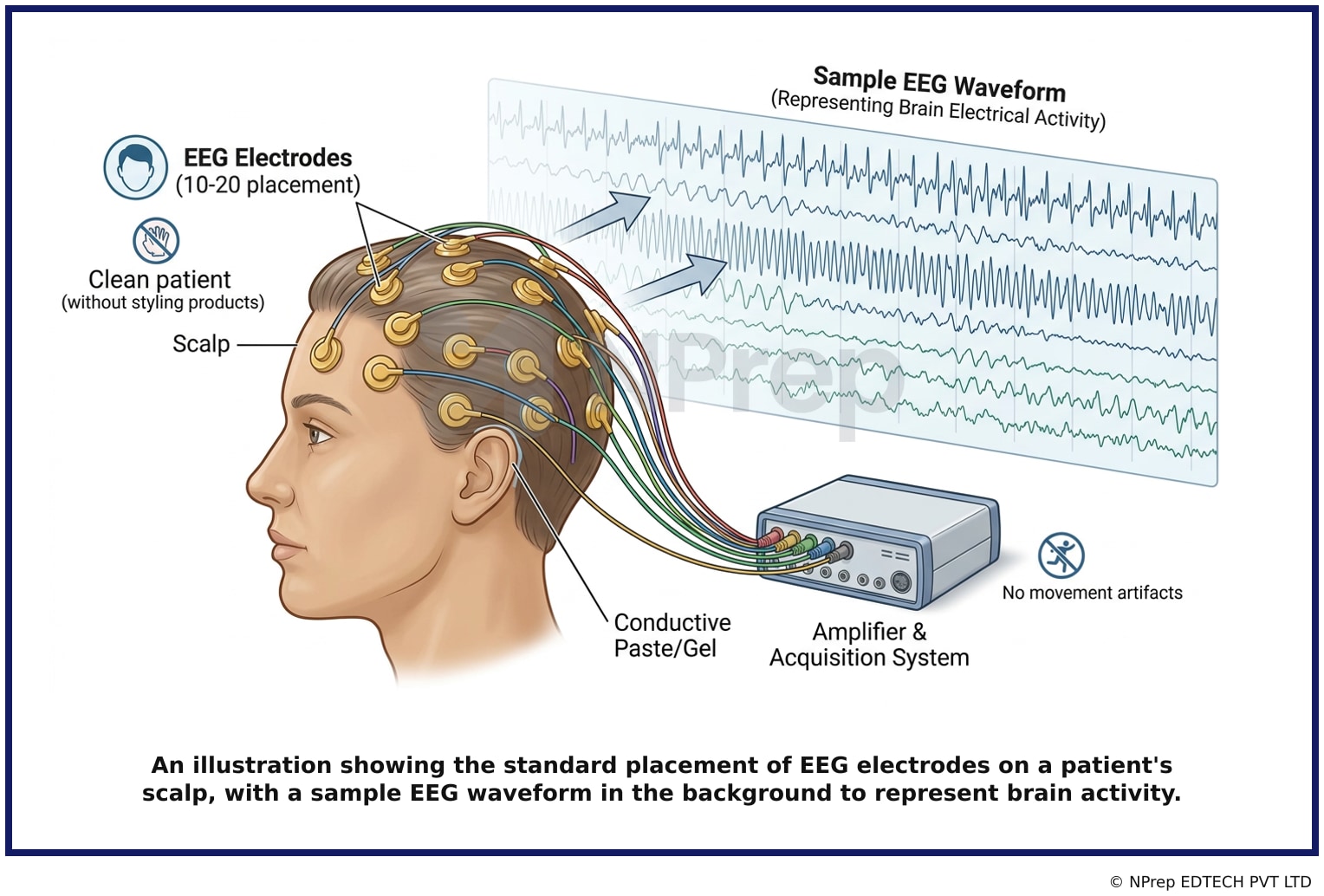
- It is performed by applying electrodes to the scalp, which detect and amplify the brain's electrical signals.
- EEG is the primary tool for diagnosing and evaluating conditions characterized by abnormal brain electrical activity, such as seizure disorders, coma, and organic brain syndrome.
Why Other Options Were Wrong
- Option A: An Electrocardiogram (ECG or EKG) measures the electrical activity of the heart, not the brain.
- Option C: A Nerve Conduction Study (NCS) assesses the function of peripheral nerves (nerves outside the brain and spinal cord), not the brain itself.
- Option D: An Electromyogram (EMG) measures the electrical activity of skeletal muscles, not the brain.
Related Visual
Clinical Relevance
- Nursing practice connection: This is primarily an exam-oriented knowledge point with limited direct bedside application, so retain Neurodiagnostic Procedures as background academic context rather than a clinical decision trigger.
- Nurses play a key role in preparing patients for an EEG, which includes instructing them to have clean hair without products and potentially withholding certain medications (like anticonvulsants or sedatives) or stimulants (like caffeine) as prescribed, to ensure an accurate recording.
- During the procedure, the nurse's role is to ensure the patient remains calm and still, as movement can create artifacts in the EEG reading, making interpretation difficult.
- What if the patient is a child who cannot stay still? In such cases, a sleep EEG may be ordered, or mild sedation might be used. The nurse must be prepared to monitor the child's respiratory status and safety if sedation is administered.
How to Approach the Question
- First, identify the key term in the question stem, which is 'brain'.
- Next, analyze the prefix of each option to understand the body part it relates to. 'Encephalo-' refers to the brain.
- Evaluate the options: 'Cardio-' refers to the heart, 'Myo-' refers to muscle, and 'Nerve conduction' refers to peripheral nerves.
- Based on this analysis, match 'brain' with 'Electroencephalogram' (EEG) as the test that measures its electrical activity.
- This process of elimination based on medical terminology quickly leads to the correct answer.
Concept Tested & Keywords
- Concept Tested: Neurodiagnostic Procedures
- Stem keywords: abnormal electrical activities, brain
- Lead-in keywords: detected by
- Negative lead-in flag: false
Question ID
QDLlja3Z-8P68FsA0Jqlmd
Reference Book
E6 Nursing Brunner Adult Health 3SA Vol 2 Part 2 p. 18-20
E6 Medicine Davidson Principles Practice 24e p. 1096-1098
E6 Robert Boland, Marcia L. Verduin - Kaplan and Sadock's Comprehensive Text of Psychiatry-Wolters Kluwer Health (2024) (pp 1-16525 of 16525) p. 1226-1228
Practise the full DSSSB - 29 August 2019 (Shift-1)
Attempt every question from this paper in a timed mock, then review the full solution for each one.
More Nervous System Questions
- Which one of the following is the third cranial nerve?
- Identify the procedure done by the health care professional in the image below:
- Connection between right and left hemisphere is known as?
- A young adult who was hit by a car was fortunate because the level of his injury did not interrupt his respiratory function. The cord segment involve…
- Auditory area located in which lobe of the brain?
- A patient is unable to see downward and lateral movement of the eyes. Which of the following cranial nerve primarily would be affected?
- Pressure by the upper end of a crutch may cause injury to the?
- Which of the following is the largest cranial nerve?
- How many cervical nerves are there in the spinal cord?
- An injury to the upper brachial plexus results in?
More DSSSB - 29 August 2019 (Shift-1) Questions
- Find the missing number in the following number series. -12, -6, \ \ , 9, 18
- Which of the following cubes in the answer figures CANNOT be made based on the unfold cube in the question figure?
- Out of the given options, three are similar in a certain manner. However, one option is NOT like the other three. Select the option which is differen…
- Which two numbers should be interchanged to make the below equation mathematically correct? 7 + 16 / 4 \ 3 - 5 \= 10
- Select the option that is related to the third number on the same basis as the second number is related to the first number. 0.14 : -7.143 :: 0.17 : ?
- A person walks 6 km towards north, then turns towards west and walks 3 km. He then turns left and walks 4 km, and then again turns left and walks for…
- Which two signs should be interchanged to make the below equation mathematically correct? 7 \ 3 + 12 / 2 - 4 \= 23
- If in a certain code language AC means 'Party is amazing', DEC means 'amazing and fun', DF means 'fun loving', then what is the code for 'and'?
- Two numbers are 40% and 60% respectively more than a third number. What is the ratio of the first number to the second number?
- Read the given statement and conclusions carefully. Assuming that the information in the statement is true, even if they appear to be in variance wit…