
NORCET 5 Prelims - Sept 2023 (Shift-1)
Medical & Surgical Nursing
Hard
A traumatic patient is brought to the ED, initial assessment includes eyes opens with painful stimulus, verbally respond with inappropriate words, minimal flexion of the left hand with painful stimulus in the right hand and unilateral pupils reactive and right pupil is dilated. What would be the possible GCS-P score of the patient?
Appeared in: NORCET 5 Prelims - Sept 2023 (Shift-1)
Explanation
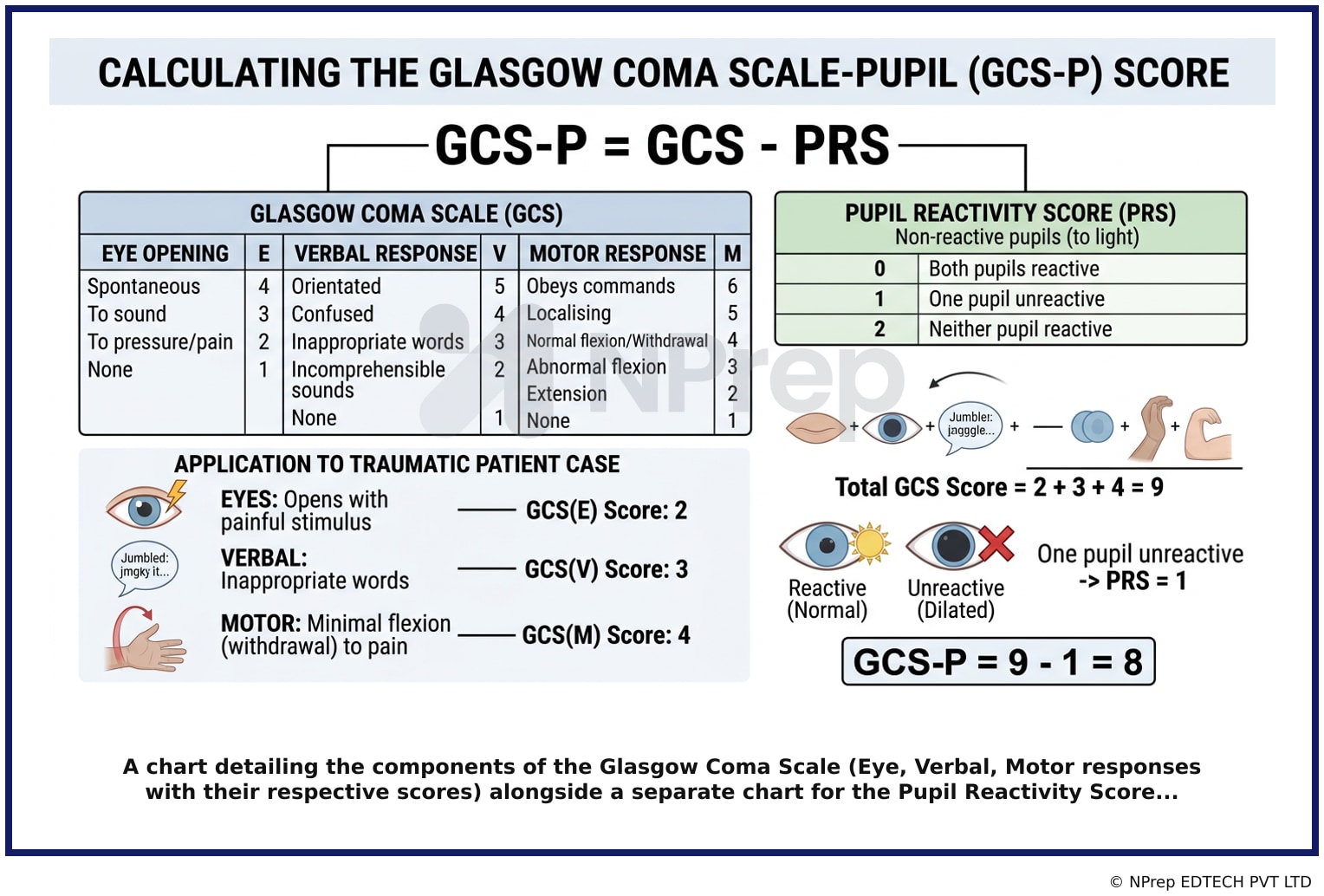
- The GCS-P score integrates the standard Glasgow Coma Scale (GCS) with a Pupil Reactivity Score (PRS) to provide a more accurate prognosis for traumatic brain injury.
- The patient's GCS score is calculated as 9 based on their responses: Eye Opening to pain (2), Inappropriate Words (3), and Withdrawal/Flexion to pain (4).
- The Pupil Reactivity Score (PRS) is 1 because one pupil (the right) is dilated and unreactive to light.
- The final GCS-P score is calculated by subtracting the PRS from the GCS score: GCS-P = 9 - 1 = 8.
Why Other Options Were Wrong
- Option B: A score of 10 is an incorrect calculation. It does not match the sum of the patient's neurological assessment findings (GCS of 9 minus a PRS of 1).
- Option C: A score of 9 represents the patient's GCS score alone, without accounting for the pupillary response. The question specifically asks for the GCS-P score.
- Option D: A score of 7 is incorrect. This would imply either a lower GCS score (e.g., 8 with a PRS of 1) or a higher PRS (e.g., GCS of 9 with a PRS of 2, meaning both pupils are unreactive).
Related Visual
Clinical Relevance
- Nursing practice connection: Prioritize focused assessment, early escalation, and real-time monitoring when managing Calculation of the Glasgow Coma Scale-Pupil (GCS-P) score in a trauma patient in acute care settings.
- The GCS-P is a critical tool in emergency and critical care settings as it has been shown to have greater prognostic accuracy for mortality and unfavorable outcomes in traumatic brain injury (TBI) patients compared to the GCS alone.
- A unilateral dilated pupil (anisocoria) in a trauma patient is a neurological emergency. It often indicates rising intracranial pressure (ICP) causing uncal herniation and compression of the oculomotor nerve (CN III), requiring immediate neurosurgical consultation.
- Nurses must perform frequent and accurate neurological assessments, including GCS and pupillary checks, to detect subtle changes that could signify deterioration. Prompt reporting of a change in GCS-P score is vital for timely intervention.
How to Approach the Question
- First, identify that the question asks for the GCS-P score, which requires calculating both the GCS and the Pupil Reactivity Score (PRS).
- Break down the patient's clinical presentation into the three GCS components: Eye, Verbal, and Motor.
- Assign a score to each component based on the standard GCS criteria: Eye opening to pain = 2; Inappropriate words = 3; Flexion/withdrawal to pain = 4.
- Sum the component scores to get the total GCS score (2 + 3 + 4 = 9).
- Next, assess the pupillary response. 'Unilateral pupils reactive and right pupil is dilated' means one pupil is unreactive. Assign a PRS of 1.
- Finally, apply the GCS-P formula: GCS-P = GCS - PRS. Substitute the calculated values: 9 - 1 = 8. Select the option that matches this result.
Concept Tested & Keywords
- Concept Tested: Calculation of the Glasgow Coma Scale-Pupil (GCS-P) score in a trauma patient.
- Stem keywords: traumatic patient, ED, initial assessment, GCS-P score, Glasgow Coma Scale
- Lead-in keywords: What would be the possible
- Clinical cues: eyes opens with painful stimulus
- Clinical cues: inappropriate words
Question ID
QlPvHef0aztZ-EwdKjNZZR
Reference Book
E6 Guide to Mental Health & PSYCHIATRIC NURSING R Sreevani— Part 2 (pp 290-564 of 579) p. 196-198
E6 Nursing Fundamentals Taylor p. 412-414
E6 Medicine Harrison 22e Part 2 p. 1475-1477
Practise the full NORCET 5 Prelims - Sept 2023 (Shift-1)
Attempt every question from this paper in a timed mock, then review the full solution for each one.
More Neurologic Function Questions
- Which of the following is a differentiating test between mucus and cerebrospinal fluid (CSF) from a nasal discharge?
- The nurse is posted in ED and patient comes with seizure. The priority management of seizure patient is:
- In the following picture, little finger under jaw is used because for:
- Parkinson's disease is characterized by deficiency of neurotransmitter.
- All of the following are complications of spinal cord injury (SCI); EXCEPT:
- A Patient with Parkinson's syndrome receives continuous levodopa to prevent what complication?
- During RTA, a person has a stroke, then his pupils are?
- A 28 year old patient was admitted to the hospital for a suspected brain tumor. While assessing the patient, the nurse would keep in mind that the mo…
- A patient develops an acute confusion (delirium) state. What would be the priority nursing Intervention?
- Pain at lower back and legs when flexed of knee flexes is known as?
More NORCET 5 Prelims - Sept 2023 (Shift-1) Questions
- Which of the following electrocardiogram finding would be seen in a client with Hyperkalemia?
- Identify the following ECG finding in the depicted image?
- Which of the following is not used in management of orthostatic hypotension?
- Which of the following clinical features is not seen in shock?
- Which position is best to identify left pleural effusion?
- A male patient comes in casualty who has a lacerated untidy wound after 4 hours. What would be the priority nursing action?
- A client who underwent abdominal surgery earlier in the day has a small amount of bright red blood on the surgical dressing. How should the nurse doc…
- A nurse entered a nursery unit and observed that a newborn shows jerky movement of the lower limbs. Which of the following is the priority nursing ac…
- The nurse should be concerned for which while a child is on chemotherapy?
- Following a head injury, a person comes into the emergency department with personality changes and loss of voluntary control. Which lobe of the brain…