
HPSSC - 2015
Medical & Surgical Nursing
Easy
A shuffling gait is typically associated with a patient who has?
Appeared in: HPSSC - 2015
Explanation
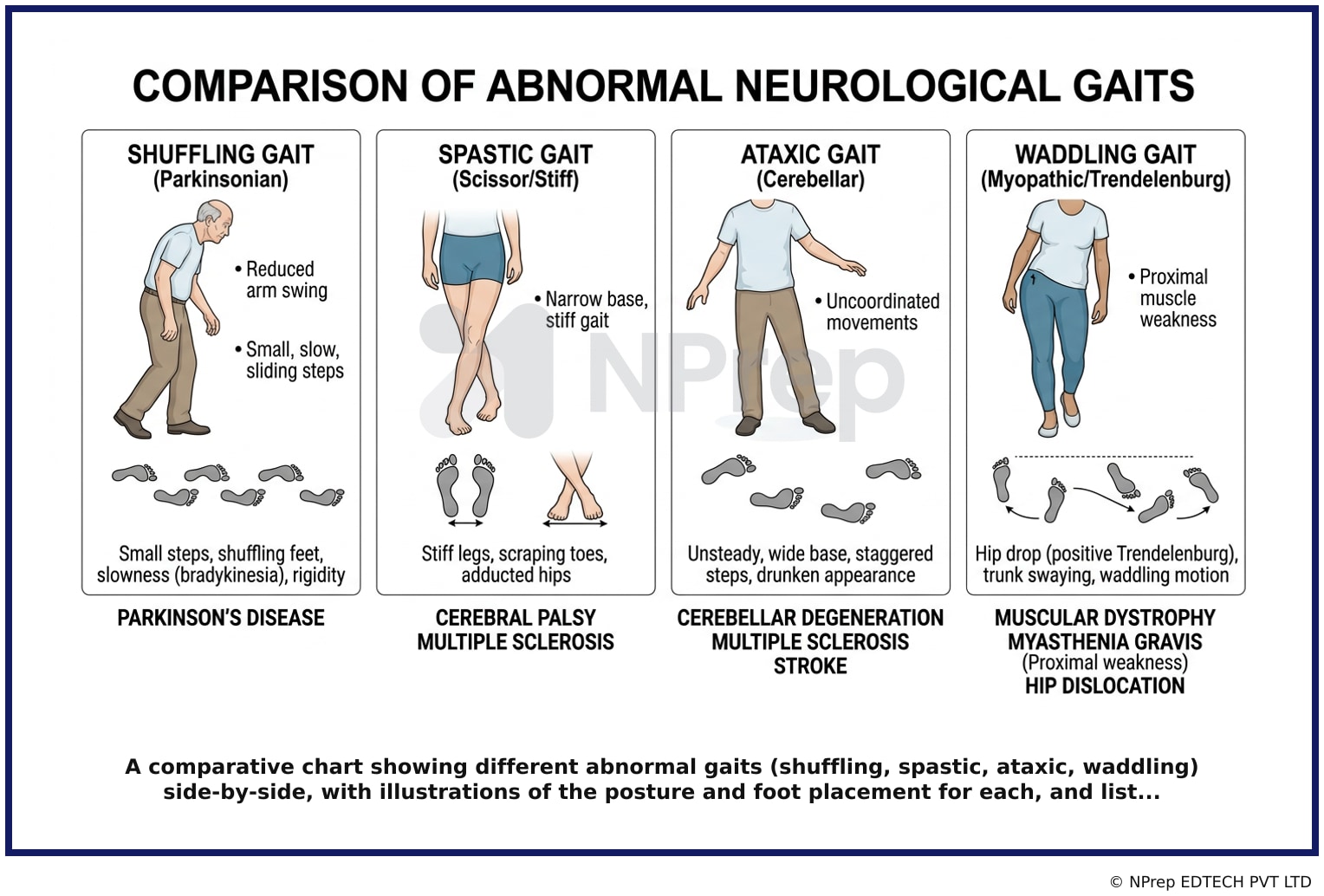
- A shuffling gait is a classic and distinctive feature of Parkinson's disease, as confirmed by the visual evidence in the image.
- This gait results from bradykinesia (slowness of movement) and rigidity, which are core motor symptoms of the condition.
- Other accompanying signs include a stooped posture, reduced arm swing, and a tendency to take rapid, small steps (festination), all of which are caused by the loss of dopamine-producing neurons in the brain.
Why Other Options Were Wrong
- Option A: This is a vascular disorder causing vasospasm in fingers and toes in response to cold or stress; it does not affect gait.
- Option B: This autoimmune disorder causes fatigable muscle weakness. While severe proximal weakness can lead to a waddling gait, it does not typically cause a shuffling gait.
- Option D: This demyelinating disease of the central nervous system typically causes a spastic gait (stiff-legged, scissoring) or an ataxic gait (unsteady, wide-based) due to upper motor neuron damage or cerebellar involvement.
Related Visual
Clinical Relevance
- Nursing practice connection: Use the key finding related to Gait assessment and its association with neurological disorders to guide bedside assessment, documentation, and the next nursing action.
- Observing a patient's gait is a fundamental nursing assessment skill that provides crucial clues to underlying neurological conditions and helps in evaluating fall risk.
- Early recognition of a shuffling gait allows for timely referral and management, which can improve the patient's quality of life and safety.
- What if? If the patient had a wide-based, unsteady, 'drunken' gait, the most likely cause would be a cerebellar disorder (ataxic gait), not Parkinson's disease.
How to Approach the Question
- First, identify the key clinical sign presented in the question: 'shuffling gait'.
- Second, analyze the accompanying image, noting the stooped posture and short steps, which are classic features that complement the description of a shuffling gait.
- Third, systematically review the options and recall the typical presentation of each disease.
- Match the shuffling gait to Parkinson's disease, which is known for its characteristic motor symptoms of bradykinesia and rigidity.
- Eliminate the other options by recalling their distinct presentations: Raynaud's (vascular), Myasthenia gravis (fatigable weakness/waddling), and Multiple sclerosis (spastic/ataxic gait).
Concept Tested & Keywords
- Concept Tested: Gait assessment and its association with neurological disorders.
- Stem keywords: shuffling gait
- Lead-in keywords: typically associated with
- Clinical cues: The image shows a classic parkinsonian posture, which reinforces the diagnosis associated with a shuffling gait.
Question ID
QhXHhJsbkEKU4SAFTzKw1l
Reference Book
E6 Medicine Harrison 22e Part 1 p. 219-221
Practise the full HPSSC - 2015
Attempt every question from this paper in a timed mock, then review the full solution for each one.
More Cardiovascular, Circulatory, and Hematologic Function Questions
- A patient is undergoing blood transfusion and suddenly shows complaints of transfusion reaction. What will be the priority nursing intervention?
- The following all are blood transfusion complications from; EXCEPT:
- Identify the use of following machine used in pneumatic compression device:
- In iron deficiency anemia, the fingernails become spoon shaped, this condition is referred to as:
- Which gauze cannula is commonly used for blood transfusion?
- If 'P' wave is absent in ECG rhythm, it is an indication of:
- Normal compression to ventilation ratio:
- Trans-illumination procedure is done with:
- A patient in the ward experiences sudden cardiac arrest. What is the most appropriate technique for opening the airway to facilitate endotracheal int…
- A patient experiences complications after a blood transfusion. Which of the following signs and symptoms is indicative of circulatory overload?
More HPSSC - 2015 Questions
- During pregnancy, deficiency of which of the following leads to Neural tube defect?
- Digoxin is not given when heart rate is?
- Normal Intraocular pressure is?
- Which of the following is a side effect of streptomycin?
- Most common site of metastasis in breast cancer is?
- Name the disease caused by human papilloma virus?
- Newborn skeleton is made up of?
- The cause of ascites in cirrhosis of the liver is?
- Which of the following hormones is a modified amino acid?
- Which of the following conditions is caused by elevated intraocular pressure?