
UPUMS Nsg.Officer-2024
Medical & Surgical Nursing
Hard
A patient who received spinal anesthesia four hours ago during surgery is transferred to the surgical unit and, after 90 minutes, now reports severe incisional pain. The patient's blood pressure is 170/90 mmHg, pulse is 108 beats/min, temperature is 99°F (37.2°C), and respirations are 30 breaths/min. The patient's skin is pale, and the surgical dressing is dry and intact. The most appropriate nursing intervention is to:
Appeared in: UPUMS Nsg.Officer-2024
Explanation
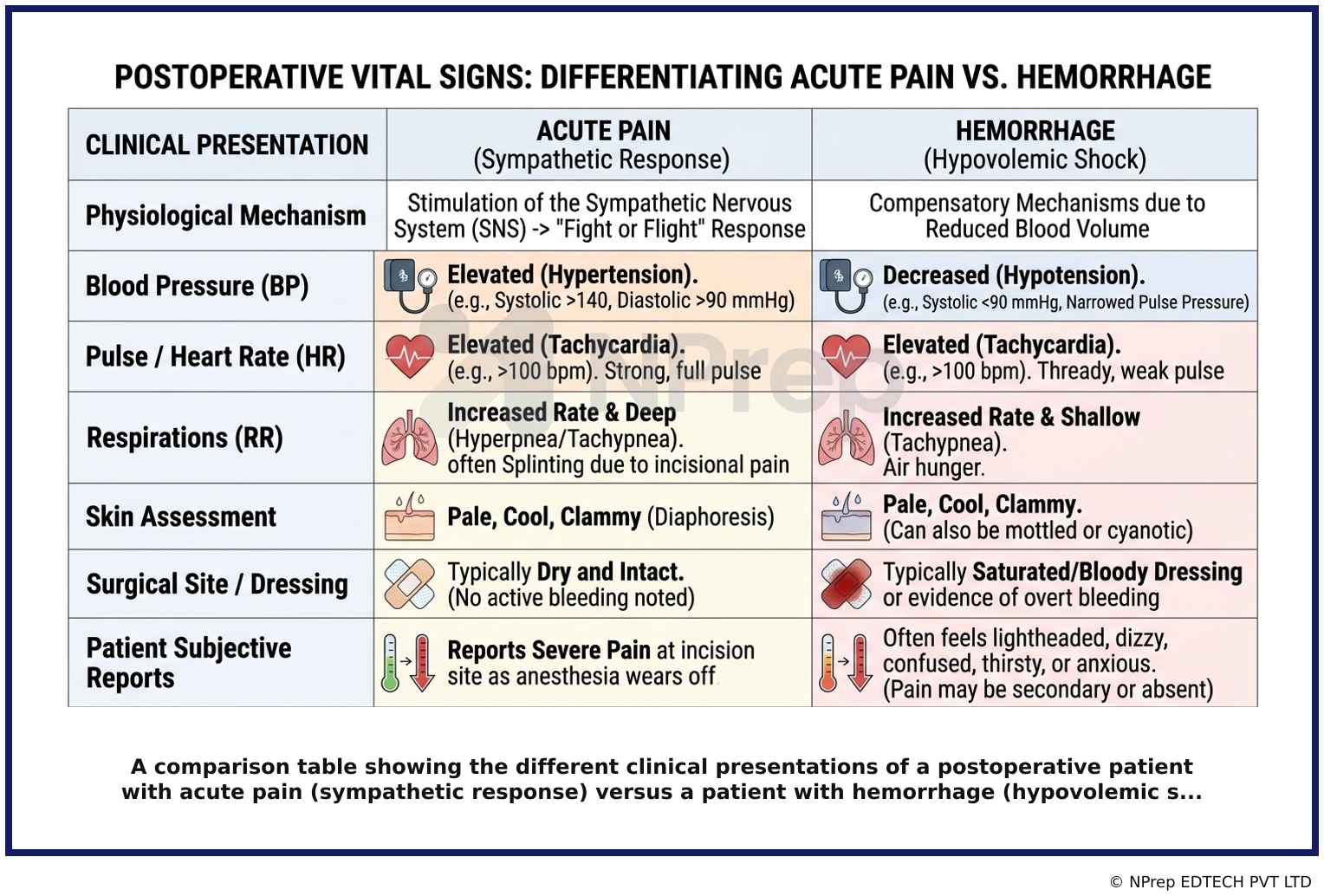
- The patient's signs and symptoms—hypertension, tachycardia, tachypnea, and pale skin—are classic indicators of a sympathetic nervous system response.
- This response is triggered by severe, acute incisional pain, which is expected as the effects of spinal anesthesia diminish.
- Administering prescribed analgesics is the priority because it addresses the root cause of the patient's distress and abnormal vital signs.
- Pain control is a priority to facilitate a patient's recovery and prevent complications from immobility.
Why Other Options Were Wrong
- Option A: High-Fowler's position and oxygen are interventions for primary respiratory distress. The patient's rapid breathing (tachypnea) is a secondary response to pain, not an independent breathing problem.
- Option B: While the provider should be kept informed of the patient's status, it is not the immediate priority. The nurse can and should first provide a prescribed intervention (pain medication) for a predictable postoperative event.
- Option D: Reverse Trendelenburg position and opening the IV line are interventions for managing shock or severe hypotension. This patient is hypertensive, making these actions inappropriate and potentially harmful.
Related Visual
Clinical Relevance
- Nursing practice connection: Knowing Postoperative Pain Assessment and Management helps nurses interpret findings accurately and avoid errors in routine assessment, medication administration, and patient teaching.
- A core nursing competency is differentiating the cause of abnormal vital signs in the postoperative period. Recognizing that severe pain causes a hypertensive and tachycardic response is crucial to avoid misinterpreting it as another complication.
- Failure to manage postoperative pain adequately can lead to increased patient suffering, delayed recovery, and complications like atelectasis (due to shallow breathing from pain).
- What if? If the patient's blood pressure was 80/50 mmHg instead of 170/90 mmHg, and the dressing was saturated with blood, the priority would shift immediately. The nurse should then place the patient flat, ensure IV access, and urgently report to the provider, as these are signs of hemorrhagic shock.
How to Approach the Question
- First, analyze the patient's clinical data: 4 hours post-op with spinal anesthesia, severe pain, hypertension, tachycardia, and tachypnea.
- Identify the core problem. The spinal anesthesia is wearing off, leading to the expected return of surgical pain.
- Connect the symptoms to the problem. The abnormal vital signs are a classic sympathetic 'fight or flight' response to severe pain.
- Evaluate the options based on the identified problem. The goal is to treat the cause of the sympathetic response.
- Rule out interventions for other conditions. The patient is not in primary respiratory distress (ruling out option A) or shock (ruling out option D). Reporting (option B) is secondary to intervening with an available order.
- Select the option that directly addresses the root cause: administering pain medication.
Concept Tested & Keywords
- Concept Tested: Postoperative Pain Assessment and Management
- Stem keywords: spinal anesthesia, postoperative, incisional pain, blood pressure 170/90, pulse 108, respirations 30, pale skin
- Lead-in keywords: most appropriate, nursing intervention
- Clinical cues: Spinal anesthesia wearing off: Explains the sudden onset of severe pain as sensation returns.
- Clinical cues: Dry and intact dressing: Makes active hemorrhage at the surgical site less likely.
Question ID
QhQk5vO42tL5Lfife0gLf7
Reference Book
E6 Nursing Fundamentals Potter Perry 12e Part 6 p. 202-204
E6 Nursing Brunner Adult Health 3SA Vol 1 Part 1 p. 118-120
Practise the full UPUMS Nsg.Officer-2024
Attempt every question from this paper in a timed mock, then review the full solution for each one.
More Perioperative Concepts and Nursing Management Questions
- The nurse is informed that a client with a large surgical incision is being transferred from the intensive care unit to the surgical unit. What medic…
- Why it is necessary to remove dark coloured nail paint before surgery?
- A patient planned for surgery advised to remove Jewellery because:
- Vicryl 3-0 is:
- All of the following are correct regarding stoma formation; EXCEPT:
- A surgeon is going to give a skin incision on patient. Which of the following is to be done?
- Following is the picture of sterile sponge used in emergency. It has a blue colour thread. What is the purpose of this colour thread?
- How many items are included in the WHO surgical safety checklist: SITOSO?
- In operation theater during cauterization, the electric current passing from a single electrode is called:
- Which position is given to a client by nursing officer, who has been brought from OT after craniotomy surgery?
More UPUMS Nsg.Officer-2024 Questions
- Any event that is not consistent with routine patient care and is used when patient care is not consistent with facility or national standards of exp…
- How many compressions and breaths should you do for each cycle of CPR?
- A 23-year-old white male who is otherwise in good health noted a sudden shower of flashing lights before his left eye a few hours ago. He has never h…
- The nurse asked the client to read the Snellen chart. Which of the following is tested?
- All India Institute of Speech and Hearing (AIISH), recently seen in the news, is inaugurated at which city of Uttar Pradesh?
- The nurse is checking the placement of a nasogastric tube prior to giving medication and a feeding. Which of the following is the preferred and most…
- A dynamic and purposeful relationship between two people who approaches a mutually defined problems with mutual consideration of each other, is known…
- How do you recognize the signs of a heart attack?
- A client complains of difficulty of swallowing, when the nurse try to administer capsule medication. Which of the following measures the nurse should…
- What should you do when someone suffers swelling from a head injury?