
NORCET-7 Mains-2024
Medical & Surgical Nursing
Easy
A patient is undergoing blood transfusion in the ICU. Which of the following are indicators of circulatory overload?
Appeared in: NORCET-7 Mains-2024
Explanation
- Circulatory overload, or Transfusion-Associated Circulatory Overload (TACO), is a state of acute hypervolemia caused by infusing blood products too quickly or in too large a volume.
- The classic signs reflect the body's response to excess fluid in the vascular system.
- Dyspnoea occurs as fluid backs up into the lungs, causing pulmonary congestion.
- Tachycardia is the heart's compensatory response to pump the increased volume of blood.
- Distended neck veins (JVD) are a visible sign of increased central venous pressure, a hallmark of fluid overload.
- Other common findings include hypertension, a bounding pulse, and crackles on lung auscultation.
Why Other Options Were Wrong
- Option A: This option describes signs of hypovolemia or shock (hypotension, oliguria, diminished pulse), which is the opposite of circulatory overload (hypervolemia).
- Option B: While hypertension and palpitations can be present in circulatory overload, dizziness is a non-specific symptom. This option lacks the most critical and specific indicators like dyspnoea and distended neck veins.
- Option C: This option is incorrect because circulatory overload causes hypertension and tachycardia, not hypotension and bradycardia.
Related Visual
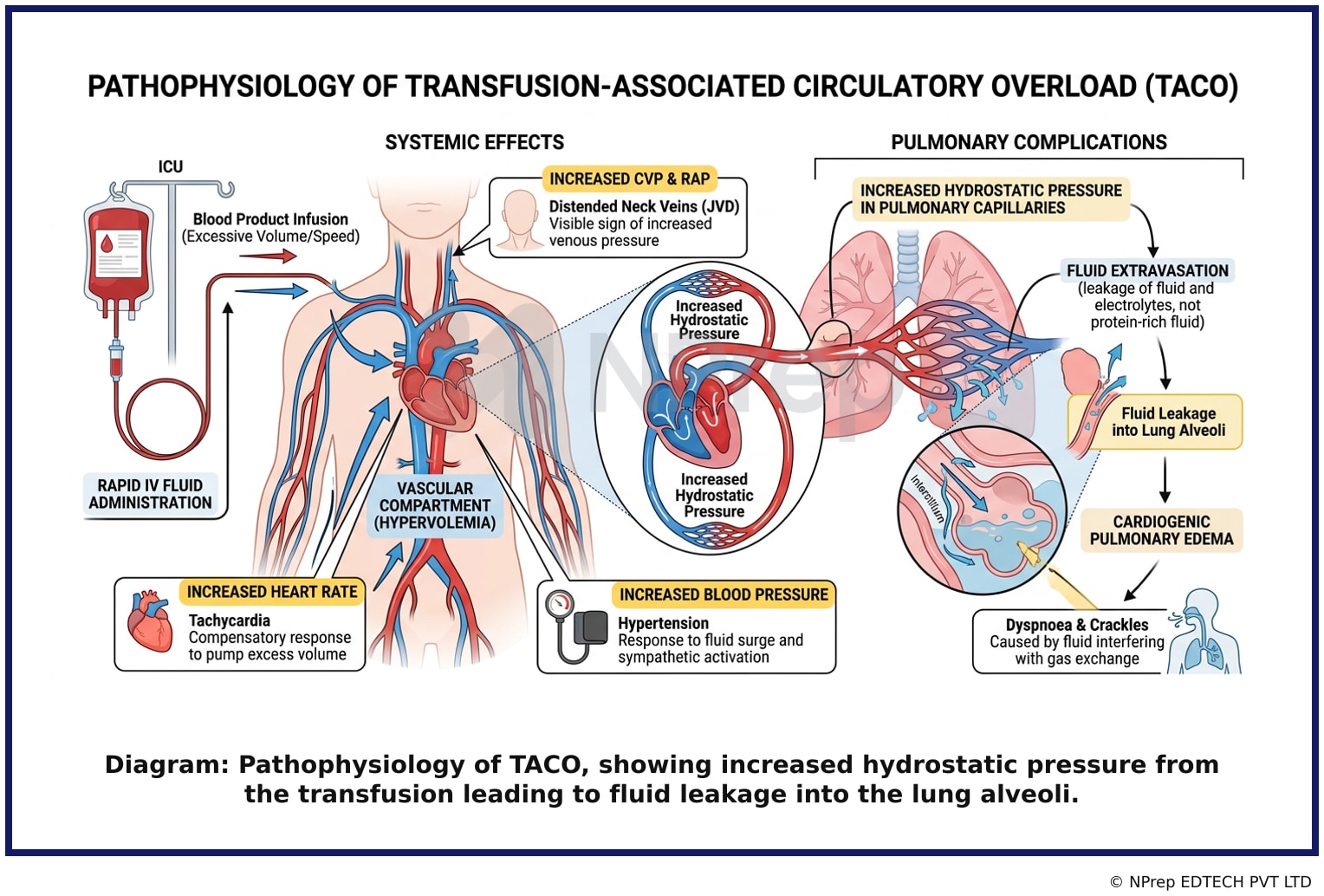
- Visual 1: Diagram: Pathophysiology of TACO, showing increased hydrostatic pressure from the transfusion leading to fluid leakage into the lung alveoli.
- Visual 2: Illustration: A patient exhibiting key signs of fluid overload, including distended neck veins (JVD) and labored breathing in an upright position.
Clinical Relevance
- Nursing practice connection: Prioritize focused assessment, early escalation, and real-time monitoring when managing Signs and symptoms of transfusion-associated circulatory overload (TACO) in acute care settings.
- Nurses must be able to rapidly identify the signs of TACO to intervene early and prevent progression to severe respiratory distress, pulmonary edema, and cardiac failure.
- A key nursing responsibility is to differentiate TACO from Transfusion-Related Acute Lung Injury (TRALI). While both cause respiratory distress, TACO is associated with hypertension and signs of fluid overload, whereas TRALI often presents with hypotension and fever.
- What if? If the patient had a known history of congestive heart failure (CHF), the nurse should anticipate the risk of TACO. The standard of care would be to advocate for a slower infusion rate (e.g., over 3-4 hours per unit) and potentially administer a diuretic like furosemide before or between units as a preventive measure.
How to Approach the Question
- First, identify the core concept: The question asks for signs of 'circulatory overload' during a blood transfusion.
- Recall the pathophysiology of fluid overload: It means there is too much fluid volume (hypervolemia) in the blood vessels.
- Predict the body's response to excess fluid: The heart must work harder (tachycardia), blood pressure increases (hypertension), fluid can back up into the lungs causing shortness of breath (dyspnoea), and the increased pressure becomes visible in the neck veins (distention).
- Evaluate each option against this physiological model.
- Options A and C include 'hypotension,' which is the opposite of the expected hypertension in fluid overload. Discard these options.
- Option B includes 'hypertension' but also the non-specific symptom 'dizziness.' It is less precise.
Concept Tested & Keywords
- Concept Tested: Signs and symptoms of transfusion-associated circulatory overload (TACO)
- Stem keywords: blood transfusion, ICU, circulatory overload, indicators
- Lead-in keywords: Which of the following
- Clinical cues: Patient is in the ICU, which implies a higher risk for complications and closer monitoring.
- Clinical cues: The event is a blood transfusion, which carries known risks including fluid overload.
Question ID
QGEKfcd-tXwtTmVvE_7mSy
Practise the full NORCET-7 Mains-2024
Attempt every question from this paper in a timed mock, then review the full solution for each one.
More Cardiovascular, Circulatory, and Hematologic Function Questions
- A patient is undergoing blood transfusion and suddenly shows complaints of transfusion reaction. What will be the priority nursing intervention?
- The following all are blood transfusion complications from; EXCEPT:
- Identify the use of following machine used in pneumatic compression device:
- In iron deficiency anemia, the fingernails become spoon shaped, this condition is referred to as:
- Which gauze cannula is commonly used for blood transfusion?
- If 'P' wave is absent in ECG rhythm, it is an indication of:
- Normal compression to ventilation ratio:
- Trans-illumination procedure is done with:
- A patient in the ward experiences sudden cardiac arrest. What is the most appropriate technique for opening the airway to facilitate endotracheal int…
- A patient experiences complications after a blood transfusion. Which of the following signs and symptoms is indicative of circulatory overload?
More NORCET-7 Mains-2024 Questions
- What is the correct statement regarding pre-oxygenation in children before intubation?
- A pregnant woman is ready for caesarean section and transferred to labor room. Which is the best position for the woman during caesarean section?
- A woman comes in labor room with 3 cm cervical dilation, 80% effacement and energetic and excited. The women in which phase of labor?
- The ambient temperature of the labor room should maintain?
- The recommended dose of iron and folic acid for adolescent girls under Weekly Iron & Folic Acid Supplementation (WIFS) program?
- A 14-week Rh-negative pregnant woman presents with mild vaginal bleeding and abdominal pain. Ultrasound shows a viable intrauterine pregnancy. Her hu…
- A new newborn care unit is inaugurated in the hospital. The child health nurse known about iKMC. What mean I in iKMC?
- A nurse teaching to a woman regarding breast feeding. Which statement is incorrect about breast feeding?
- Swenson and Duhamel procedure used to correction of?
- Cohort study also known as?