
RRB Nsg. Superintendent-2026 (Shift -3rd)
Nursing Foundation
Easy
A nurse is educating a group of patients about diabetes management but notices that several participants are distracted due to background noises in the ward. Which barrier of communication is affecting the session?
Appeared in: RRB Nsg. Superintendent-2026 (Shift -3rd)
Explanation
- Environmental barriers are defined as external factors in the physical surroundings that hinder the communication process.
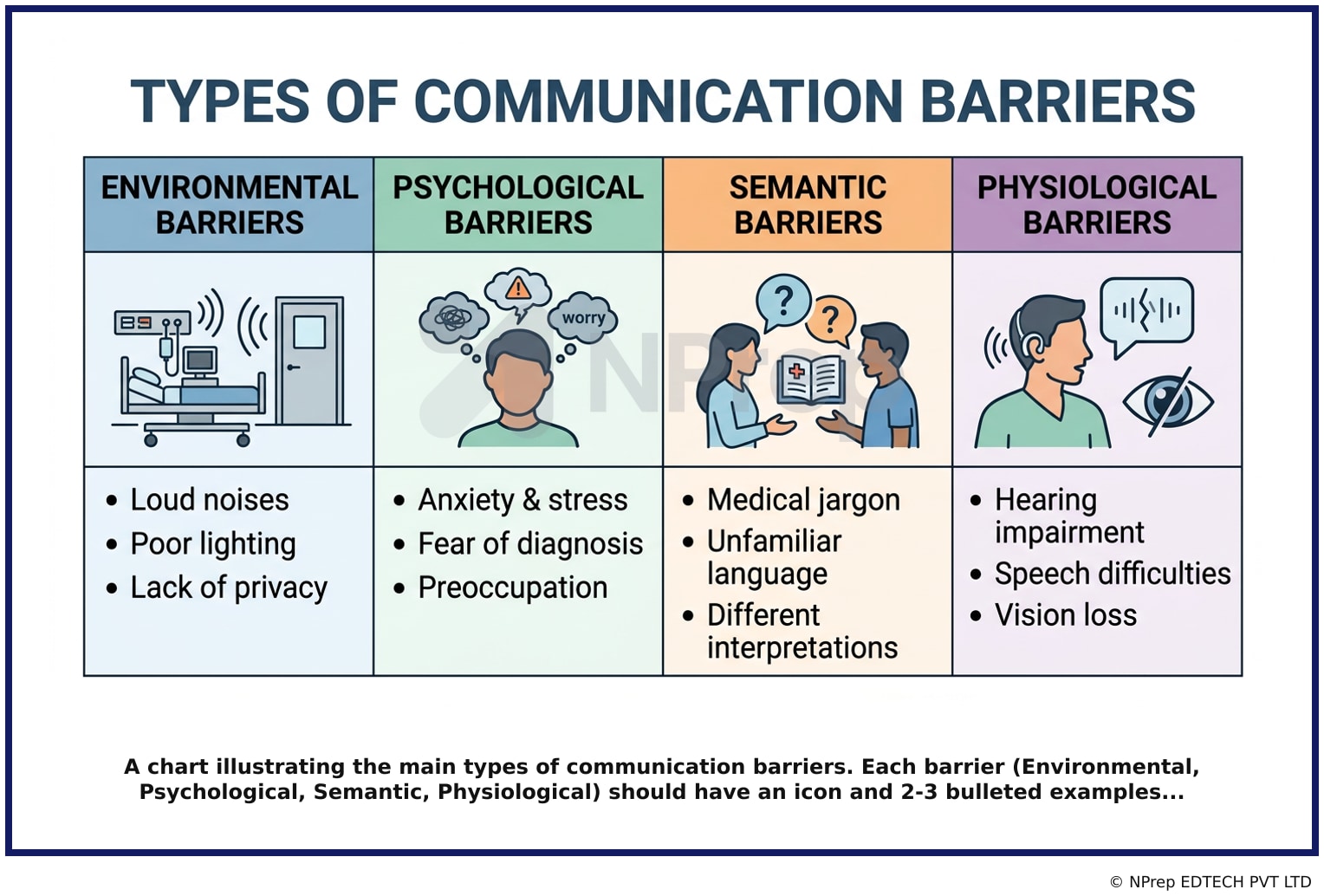
- The 'background noises in the ward' are a direct example of an environmental barrier, as they are part of the setting and create a distraction.
- Effective communication, especially in a teaching context, requires a conducive environment with minimal distractions to ensure the message is heard and understood correctly.
- Other common environmental barriers in a hospital include poor lighting, uncomfortable room temperature, and lack of privacy.
Why Other Options Were Wrong
- Option A: The problem described is external noise, not a misunderstanding of the meaning of words or the use of medical jargon.
- Option C: While noise exists in the physical environment, 'Environmental barrier' is a more specific and accurate classification for factors related to the surroundings. 'Physical barrier' more commonly refers to physiological issues (like a hearing impairment) or a literal object blocking communication (like a wall or curtain).
- Option D: The distraction is caused by an external factor (noise), not the internal emotional or cognitive state of the patients.
Related Visual
Clinical Relevance
- Nursing practice connection: Knowing Classification of communication barriers in a healthcare setting helps nurses interpret findings accurately and avoid errors in routine assessment, medication administration, and patient teaching.
- A primary nursing responsibility during patient education is to create a conducive learning environment. This involves proactively identifying and mitigating barriers like noise to ensure patient safety and comprehension.
- Failure to manage the environment can lead to critical misunderstandings about medications, diet, or follow-up care, potentially resulting in poor patient outcomes or adverse events.
- What if? If the noise was from an emergency alarm, the nurse's priority would be to first ensure patient safety, pause the teaching session, and then resume or reschedule only when the environment is safe and quiet.
How to Approach the Question
- First, identify the core problem in the scenario. The problem is 'background noises' causing patients to be 'distracted'.
- Analyze the nature of this problem. The noise is an external factor related to the physical setting, or environment.
- Review the options, which are different categories of communication barriers.
- Match the identified problem (external noise in the setting) to the most specific and accurate category. 'Environmental barrier' directly describes issues with the surroundings.
- Rule out the other options by checking if they fit. The issue is not about word meaning (Semantic), internal feelings (Psychological), or a physiological impairment (Physical).
Concept Tested & Keywords
- Concept Tested: Classification of communication barriers in a healthcare setting.
- Stem keywords: educating, distracted, background noises, barrier of communication
- Lead-in keywords: Which barrier
- Clinical cues: The key cue is 'background noises in the ward,' which points to an external, environmental factor interfering with communication.
Question ID
Qd0CFuABBwwSQwWaSWkdbW
Reference Book
E6 Psychology Applied Sreevani 6e Sem1 p. 256-258
E6 Psychology Applied Sreevani 5e p. 255-257
E6 Nursing Fundamentals Potter Perry 12e Part 2 p. 118-120
Practise the full RRB Nsg. Superintendent-2026 (Shift -3rd)
Attempt every question from this paper in a timed mock, then review the full solution for each one.
More Communication & Nurse-Patient Relationship Questions
- Which of the following means translating the message into verbal and non-verbal symbol to communicate the receiver?
- When using non-verbal communication in a nurse-client relationship, the nurse must be aware of:
- Which of the following techniques are examples of non-therapeutic communication?
- The following develops as a result of a nurse's experience in a specific clinical area, the time the nurse has been in practice, and the quality of r…
- Which type of communication barrier is related to poor pronunciation of the teacher"?
- Letter, e-mail, telephones are examples of?
- Non-verbal communication involved?
- In communicating with patients, the word "rapport" means:
- The use of "touch" to convey your feelings to a patient is called:
- The most difficult part of the nurse-client relationship is?
More RRB Nsg. Superintendent-2026 (Shift -3rd) Questions
- In a division problem, the divisor is 17 times the quotient and 11 times the remainder. If the remainder is 34, what is the dividend?
- Seven boxes H, I, J, P, Q, R, and S are stacked one above the other, but not necessarily in this order. H is placed second from the bottom. Only thre…
- A box is pushed on a horizontal floor with a force of 20 N for a distance of 5 m in the direction of the force. What is the work done by the force?
- \ \ \ \ \ \ won the Ranji Trophy title in 2024-25 by drawing the final against Kerala and winning on the basis of a first-innings lead.
- P sells a Laptop to Q at a loss of 40% and Q sells the laptop to R at a profit of 25%. If R purchased the laptop for ₹8946, then what was the cost pr…
- A ball of mass 0.5km is accelerated at 4m/s2 if a second ball of mass 1 kg is to achieve the same acceleration, what force must be applied to it?
- If a real and inverted image is formed by a convex lens on a screen 20cm away from the lens, and the object is placed 30cm from the lens, what is the…
- In this question, two statements numbered (I) and (II) are given after a question. Decide whether the information given in the statements is sufficie…
- Which of the following fundamental rights explicitly prohibits human trafficking, forced labor, and the employment of children in hazardous occupatio…
- In the word MANAGER, each vowel is replaced by the letter immediately following it in the English alphabet, and each consonant is replaced by the let…