
NORCET -4 , 2023
Child Health Nursing (Pediatrics)
Medium
A new born with 15.3 mg/dl Bilirubin level is admitted in the nursery (NICU) for the management of hyperbilirubinaemia. The baby need for phototherapy. Which of the following nursing intervention is correct?
Appeared in: NORCET -4 , 2023
Explanation
- Phototherapy is effective when a large surface area of the skin is exposed to the light.
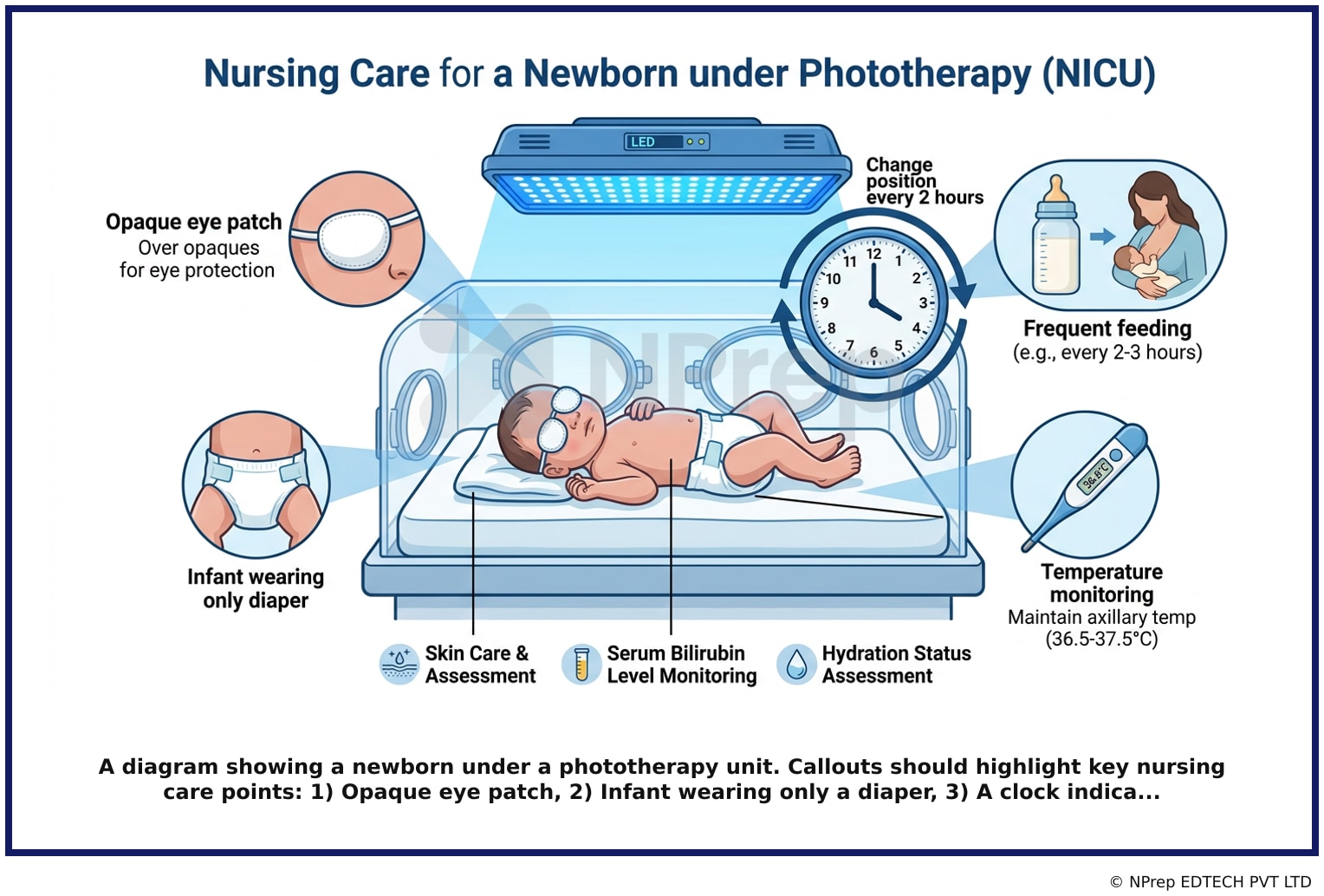
- Changing the infant's position every 2 hours ensures that different areas of the skin are exposed, maximizing the breakdown of bilirubin.
- This intervention also prevents complications such as skin irritation and pressure sores from lying in one position for too long.
Why Other Options Were Wrong
- Option B: Monitoring activity and vital signs every 4 hours is too infrequent for a neonate undergoing phototherapy. These infants are at risk for temperature instability and dehydration.
- Option C: Removing eye shields only twice a day is insufficient. It increases the risk of eye irritation, infection, and deprives the infant of visual stimulation and bonding during feeds.
- Option D: Feeding every 4 hours is not frequent enough. Adequate hydration is crucial to flush out the broken-down bilirubin. Infrequent feeding can lead to dehydration and worsen jaundice.
Related Visual
Clinical Relevance
- Nursing practice connection: Prioritize focused assessment, early escalation, and real-time monitoring when managing Nursing management of neonatal hyperbilirubinemia with phototherapy in acute care settings.
- The nurse's primary role in phototherapy is to maximize its effectiveness while ensuring the infant's safety and preventing complications.
- Failure to implement correct nursing interventions, such as frequent position changes and feeding, can delay the reduction of bilirubin levels and prolong the hospital stay.
- What if? If the infant's temperature becomes unstable (e.g., drops below 36.5°C or rises above 37.5°C), the nurse must intervene immediately. This could involve adjusting the room temperature, adding or removing blankets (if appropriate), or temporarily pausing phototherapy and notifying the physician, as temperature instability can be a sign of sepsis or a complication of the therapy itself.
How to Approach the Question
- First, identify the core of the question: it asks for the 'correct' nursing intervention for a newborn under phototherapy.
- Analyze the patient's condition: a newborn with significant hyperbilirubinemia (15.3 mg/dl) requiring phototherapy.
- Evaluate each option based on the principles of phototherapy management.
- Option A (position change q2h): Does this maximize light exposure and prevent harm? Yes.
- Option B (activity check q4h): Is this frequent enough for a vulnerable neonate under therapy? No, monitoring should be more frequent.
- Option C (eye shields removal 2x/day): Is this frequent enough for assessment and bonding? No, it should be with every feed (q2-3h).
Concept Tested & Keywords
- Concept Tested: Nursing management of neonatal hyperbilirubinemia with phototherapy.
- Stem keywords: new born, Bilirubin level, hyperbilirubinaemia, phototherapy, nursing intervention
- Lead-in keywords: correct
- Clinical cues: Bilirubin level of 15.3 mg/dl indicates the need for treatment in a newborn.
Question ID
QVmbJQ3CJkwvEOJCv76sfy
Reference Book
E6 Text Book Of Pediatric Nursing 3rd Panchali Pal — Part 1 (pp 36-238 of 713) p. 193-195
E6 Ghai Essential Pediatrics(pp 26-904 of 913) p. 173-175
E6 Nelson Textbook of Pediatrics(2024) — Volume 1 p. 1124-1126
Practise the full NORCET -4 , 2023
Attempt every question from this paper in a timed mock, then review the full solution for each one.
More Newborn Infants Questions
- When palpating the abdomen of hypertrophic pyloric stenosis infant, the Nurse finds:
- A pre-eclampsia woman's baby is lying with her mother. Neonate is born in 37 weeks. After 57 hours, when nurse is monitoring vital signs of baby, tem…
- Normally enteral feedings are flushed with water to open blocked tube and ease feeding. In which area it is done with air?
- A nurse is advised to give injection vitamin K for new born baby. The route and dose of Vitamin K is:
- Identify the following instrument used in hyperbilirubinemia monitoring based on the image:
- Which of the following equipment is used in Neonatal Resuscitation program?
- All of the following are the benefits of KMC (Kangaroo mother care); EXCEPT:
- Waxy or cheese like white substance found coating the skin of newborn human baby is known as:
- Identify 'at risk' infants from the following:-
- What is the normal length of the neonate body?
More NORCET -4 , 2023 Questions
- A pregnant client comes to the office for her first prenatal examination at 10 weeks. She has been pregnant twice before, the first delivery produced…
- A client is admitted to the hospital for an induction of labor owing to a gestation of 42 weeks confirmed by dates and ultrasound. When she is dilate…
- Which of the following step is not included in surgical safety checklist?
- All of the following are correct about WHO 5 hand hygiene movement, EXCEPT?
- After liver biopsy, the patient should be placed in?
- What is the best position to keep a 12-year-old child after a lumbar puncture to assess CSF?
- When teaching a mother of a 4-month-old with diarrhoea about the importance of preventing dehydration, the nurse would inform the mother about the im…
- Prior to administration of antibiotics there is need to sensitivity test. Which of the following antibiotic is not required sensitivity test?
- A client with a cervical spine fracture at C, level has just arrived in the emergency room. The primary nursing intervention would be?
- A client is being discharged with albuterol and beclomethasone dipropionate to be administered via inhalation three times a day and at bedtime. Clien…