
NORCET 2 - 2021 (shift-1)
Medical & Surgical Nursing
Easy
A high-pitched harsh sound heard during inspiration is known as?
Appeared in: NORCET 2 - 2021 (shift-1)
Explanation
- Stridor is defined as a high-pitched, harsh, monophonic (single-note) sound heard primarily during inspiration.
- This sound is generated by turbulent airflow passing through a narrowed or partially obstructed upper airway, specifically the larynx or trachea.
- Its distinct harsh and inspiratory nature differentiates it from other breath sounds like wheezing, which is typically musical and expiratory, or rales, which are discontinuous popping sounds.
Why Other Options Were Wrong
- Option A: Rhonchi are low-pitched, coarse, snoring, or gurgling sounds, not high-pitched and harsh. They are caused by secretions in the larger airways.
- Option C: Wheezing is a high-pitched sound, but it is described as 'musical' or 'whistling,' not 'harsh.' It is also predominantly heard during expiration due to lower airway narrowing.
- Option D: Rales (also known as crackles) are discontinuous, brief, popping sounds, similar to Velcro being pulled apart. They are not the continuous, harsh sound described in the question.
Related Visual
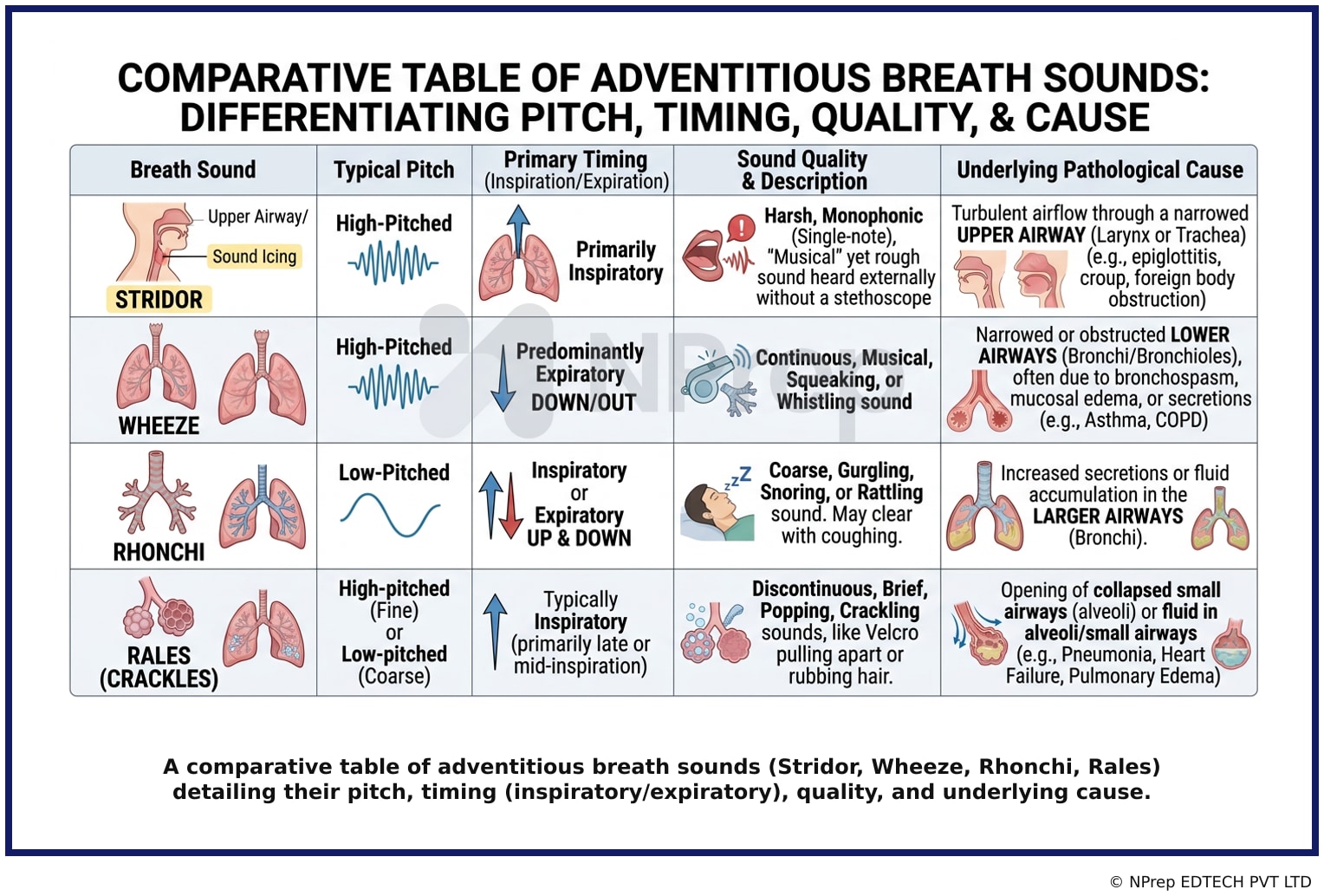
- Visual 1: Infographic - A comparative table of adventitious breath sounds (Stridor, Wheeze, Rhonchi, Rales) detailing their pitch, timing (inspiratory/expiratory), quality, and underlying cause.
- Visual 2: Diagram - An anatomical illustration showing the upper and lower respiratory tracts, highlighting the location of obstruction for stridor (larynx/trachea) versus wheezing (bronchioles).
Clinical Relevance
- Nursing practice connection: This is primarily an exam-oriented knowledge point with limited direct bedside application, so retain Identification and differentiation of adventitious breath sounds as background academic context rather than a clinical decision trigger.
- The ability to accurately identify stridor is a critical nursing skill, as it signals a potential airway emergency requiring immediate assessment and intervention to prevent respiratory failure.
- Differentiating stridor (upper airway) from wheezing (lower airway) is vital for guiding appropriate treatment. For example, stridor may require interventions like racemic epinephrine or securing the airway, while wheezing is treated with bronchodilators.
- What if? - If the sound was described as a 'low-pitched snoring sound that clears with coughing,' the correct answer would be Rhonchi, and the nursing priority would be to encourage coughing and deep breathing or perform suctioning to clear secretions.
How to Approach the Question
- Step 1: Deconstruct the question stem to identify the key descriptors of the sound: 'high-pitched,' 'harsh,' and 'during inspiration.'
- Step 2: Systematically review the definitions of each option provided.
- Step 3: Compare the characteristics of each option with the descriptors from the stem.
- Step 4: Eliminate options that do not match. 'Rhonchi' is low-pitched. 'Wheezing' is musical and primarily expiratory. 'Rale' is a popping/crackling sound.
- Step 5: Conclude that 'Stridor' is the only term that accurately fits all three descriptors: high-pitched, harsh, and inspiratory, indicating an upper airway obstruction.
Concept Tested & Keywords
- Concept Tested: Identification and differentiation of adventitious breath sounds.
- Stem keywords: high-pitched, harsh sound, inspiration
- Lead-in keywords: known as
- Negative lead-in flag: false
Question ID
QCtd45z7pBeU2TXwmxd3FY
Practise the full NORCET 2 - 2021 (shift-1)
Attempt every question from this paper in a timed mock, then review the full solution for each one.
More Gas Exchange and Respiratory Function Questions
- Which is the most relevant knowledge about oxygen administration to a client with COPD?
- Patient in emergency department diagnosed to have fluid and air present in lung. What is the above-mentioned condition known as?
- Patient is suffering from dyspnea. Which position will you provide for patient to relieve?
- Which of the following is not involved in chest physiotherapy?
- Respiration which is abnormally shallow for two or three breaths followed by irregular period of apnea is termed:
- Identify the following instrument which is used in diagnostic procedures:
- Identify the instrument shown in the following image:
- Identify the tube in the following image:
- A patient suddenly develops respiratory difficulties such as dyspnea, what is the first priority of the nursing officer?
- Which of the following method is used for high flow oxygen administration:
More NORCET 2 - 2021 (shift-1) Questions
- Which type of bandage used in ankle injury?
- A nurse knows that under the National Family Health Program, the duration of Copper T 380A is?
- Which diet should be avoided in acute renal failure disease?
- What was the first indigenous vaccine in India?
- Which bone is known as the breast bone?
- What is the most common type of episiotomy performed during labor?
- A child comes to the emergency room with acute bronchospasm after a bee sting. What is the most preferred route of adrenaline administration?
- What is the chemical name of Baking soda?
- Which solution is used in the COVID area for disinfection?
- A client is scheduled for a total gastrectomy. The on-duty nursing officer knows that after surgery, this client may be at risk for what condition?