
NORCET -4 , 2023
Obstetrics & Gynaecology
Medium
A 35-weeks-pregnant client is undergoing a non-stress test (NST). During the 20-minute examination, the nurse notes three foetal movements accompanied by accelerations of the foetal heart rate, each 15 bpm, and lasting for 15 seconds. The nurse interprets this test to be?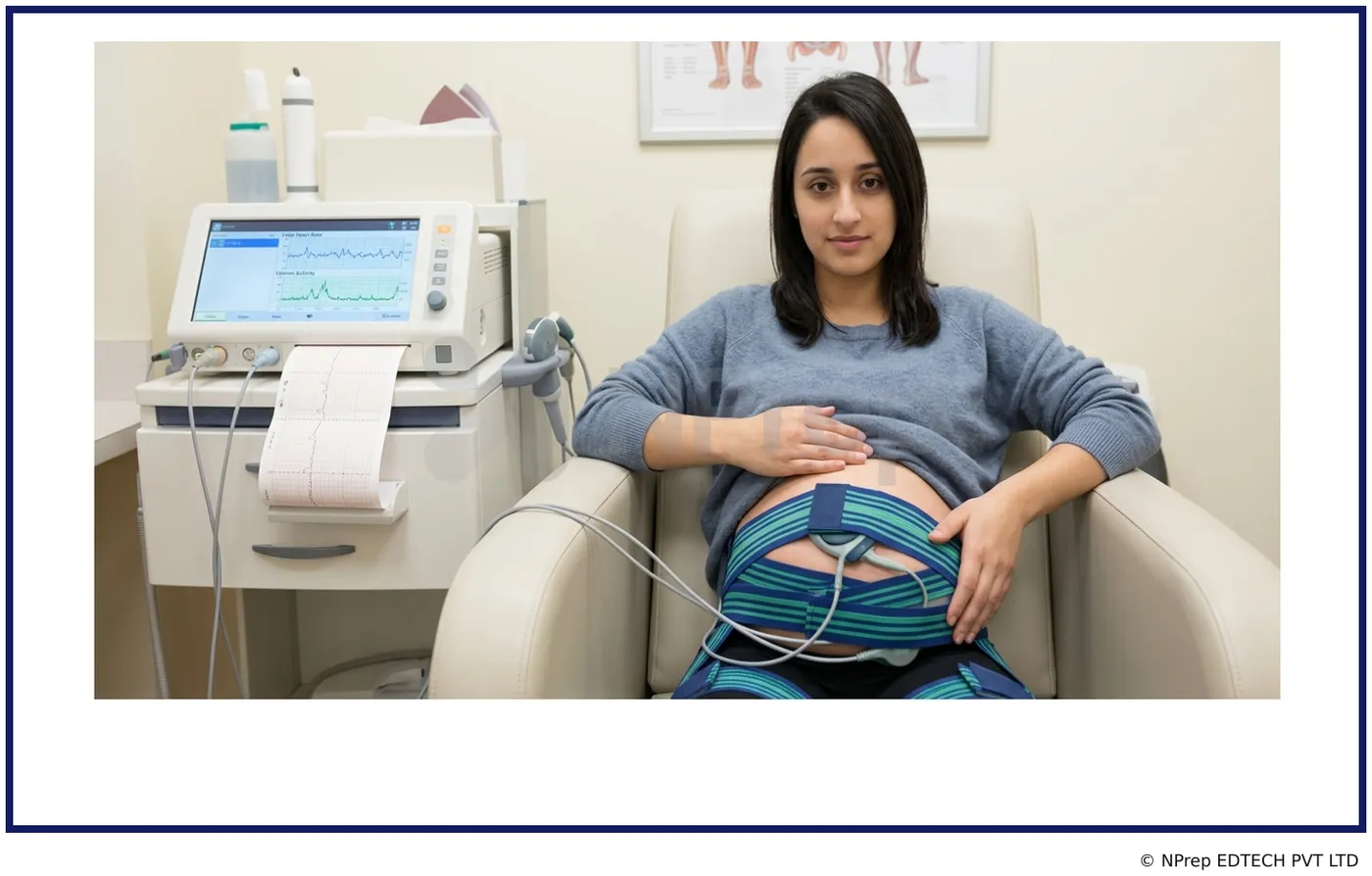
Appeared in: NORCET -4 , 2023
Explanation
- A reactive Non-Stress Test (NST) is a normal finding that indicates good fetal oxygenation and an intact central nervous system.
- For a fetus at 32 weeks of gestation or more, a reactive test is defined by the presence of at least two fetal heart rate (FHR) accelerations within a 20-minute window.
- Each acceleration must have an amplitude of at least 15 beats per minute (bpm) above the baseline and a duration of at least 15 seconds (the '15x15' rule).
- The client in the scenario is at 35 weeks and had three accelerations that met the 15x15 criteria, thus confirming a reactive NST.
Why Other Options Were Wrong
- Option A: A nonreactive result is defined as having fewer than two qualifying accelerations over a 20-minute period (or 40 minutes if extended). This scenario describes three accelerations, which meets the criteria for a reactive test.
- Option C: The term 'Positive' is used to describe an abnormal result of a Contraction Stress Test (CST), where late decelerations are present with contractions. It is not used for interpreting an NST.
- Option D: The term 'Negative' is used to describe a normal, reassuring result of a Contraction Stress Test (CST), where no late or significant variable decelerations are observed. It is not used for interpreting an NST.
Related Visual

- Visual 1: Table - A comparative table outlining the key differences between a Non-Stress Test (NST) and a Contraction Stress Test (CST), including their purpose, procedure, normal results (Reactive vs. Negative), and abnormal results (Nonreactive vs. Positive).
Clinical Relevance
- Nursing practice connection: Use the key finding related to Interpretation of Non-Stress Test (NST) results in antepartum fetal surveillance to guide bedside assessment, documentation, and the next nursing action.
- A reactive NST is a reassuring sign of fetal well-being, suggesting the absence of fetal acidemia at the time of the test. It typically indicates that the risk of fetal death within the next week is very low.
- Nurses are responsible for correctly applying the fetal monitors, documenting the findings, and accurately interpreting the NST results to report to the provider for timely decision-making.
- What if? If the NST was nonreactive after 40 minutes of monitoring, the nurse should anticipate the need for further fetal assessment. This would likely involve a biophysical profile (BPP) or a contraction stress test (CST) to get a more complete picture of fetal health.
How to Approach the Question
- First, identify the clinical test being described in the question, which is a Non-Stress Test (NST).
- Note the key parameters provided: the client's gestational age (35 weeks), the duration of the test (20 minutes), and the FHR findings (three accelerations of 15 bpm lasting 15 seconds).
- Recall the standard criteria for interpreting an NST for a pregnancy at or beyond 32 weeks gestation.
- The criteria for a 'Reactive' NST are: at least two FHR accelerations, with an amplitude of at least 15 bpm, and a duration of at least 15 seconds, all occurring within a 20-minute period.
- Compare the findings in the question to these criteria. The client had three such accelerations, which exceeds the minimum requirement.
- Conclude that the test is 'Reactive'. Eliminate 'Nonreactive' because the criteria were met, and eliminate 'Positive' and 'Negative' as these terms apply to the Contraction Stress Test (CST).
Concept Tested & Keywords
- Concept Tested: Interpretation of Non-Stress Test (NST) results in antepartum fetal surveillance.
- Stem keywords: 35-weeks-pregnant, non-stress test (NST), foetal movements, accelerations, foetal heart rate, 15 bpm, 15 seconds
- Lead-in keywords: interprets this test to be
- Clinical cues: Gestational age of 35 weeks, which means the standard '15x15' criteria apply.
- Clinical cues: Three accelerations noted, which is more than the minimum of two required for a reactive test.
Question ID
QHgc-ndjInCRkIhy_jCqB2
Practise the full NORCET -4 , 2023
Attempt every question from this paper in a timed mock, then review the full solution for each one.
More Special Topics in Obstetrics Questions
- Which Leopold maneuver is used to assess the fetal attitude during abdominal palpation of an ANC mother?
- Fetal monitoring machine is used to:
- Which maneuver used to empty the urine bladder?
- Identify the device shown here:
- A 35-weeks-pregnant client is undergoing a nonstress test (NST). During the 20-minute examination, the nurse notes three fetal movements accompanied…
- A non-stress test is prescribed for pregnant mother and nurse informs the woman about the procedure. The nurse tells that?
- Which of the following vaccine is routinely given in pregnancy?
- Look at the picture and identify the procedure usually done in a labor room? & x20;
- With an ordinary stethoscope, the fetal heart sounds can be detected earliest between \ \ \ \ \ \ weeks of pregnancy?
- Most reliable sign to assess fetal condition is?
More NORCET -4 , 2023 Questions
- A pregnant client comes to the office for her first prenatal examination at 10 weeks. She has been pregnant twice before, the first delivery produced…
- A client is admitted to the hospital for an induction of labor owing to a gestation of 42 weeks confirmed by dates and ultrasound. When she is dilate…
- Which of the following step is not included in surgical safety checklist?
- All of the following are correct about WHO 5 hand hygiene movement, EXCEPT?
- After liver biopsy, the patient should be placed in?
- What is the best position to keep a 12-year-old child after a lumbar puncture to assess CSF?
- When teaching a mother of a 4-month-old with diarrhoea about the importance of preventing dehydration, the nurse would inform the mother about the im…
- Prior to administration of antibiotics there is need to sensitivity test. Which of the following antibiotic is not required sensitivity test?
- A client with a cervical spine fracture at C, level has just arrived in the emergency room. The primary nursing intervention would be?
- A client is being discharged with albuterol and beclomethasone dipropionate to be administered via inhalation three times a day and at bedtime. Clien…