
KGMU 2023
Applied Physiology
Easy
Which type of lens is used to correct myopia (nearsightedness)?
Appeared in: KGMU 2023
Explanation
- Myopia, or nearsightedness, is a refractive error where the eye focuses images in front of the retina instead of directly on it.
- This condition causes distant objects to appear blurry because the eyeball may be too long or the eye's lens system too powerful.
- A concave lens is a diverging lens, which means it spreads out light rays before they reach the eye's lens.
- This divergence effectively moves the focal point backward, allowing it to land correctly on the retina and thereby clarifying distant vision.
Why Other Options Were Wrong
- Option B: Convex lenses are converging lenses that increase the eye's refractive power. This would worsen myopia by causing light to focus even further in front of the retina.
- Option C: Cylindrical lenses correct refractive power in only one specific plane (meridian) and do not address the overall spherical focusing error seen in simple myopia.
- Option D: While a person with myopia can also have bifocals, the bifocal aspect itself addresses a different issue. The fundamental correction for their distance vision (myopia) within that lens is still a concave power.
Related Visual
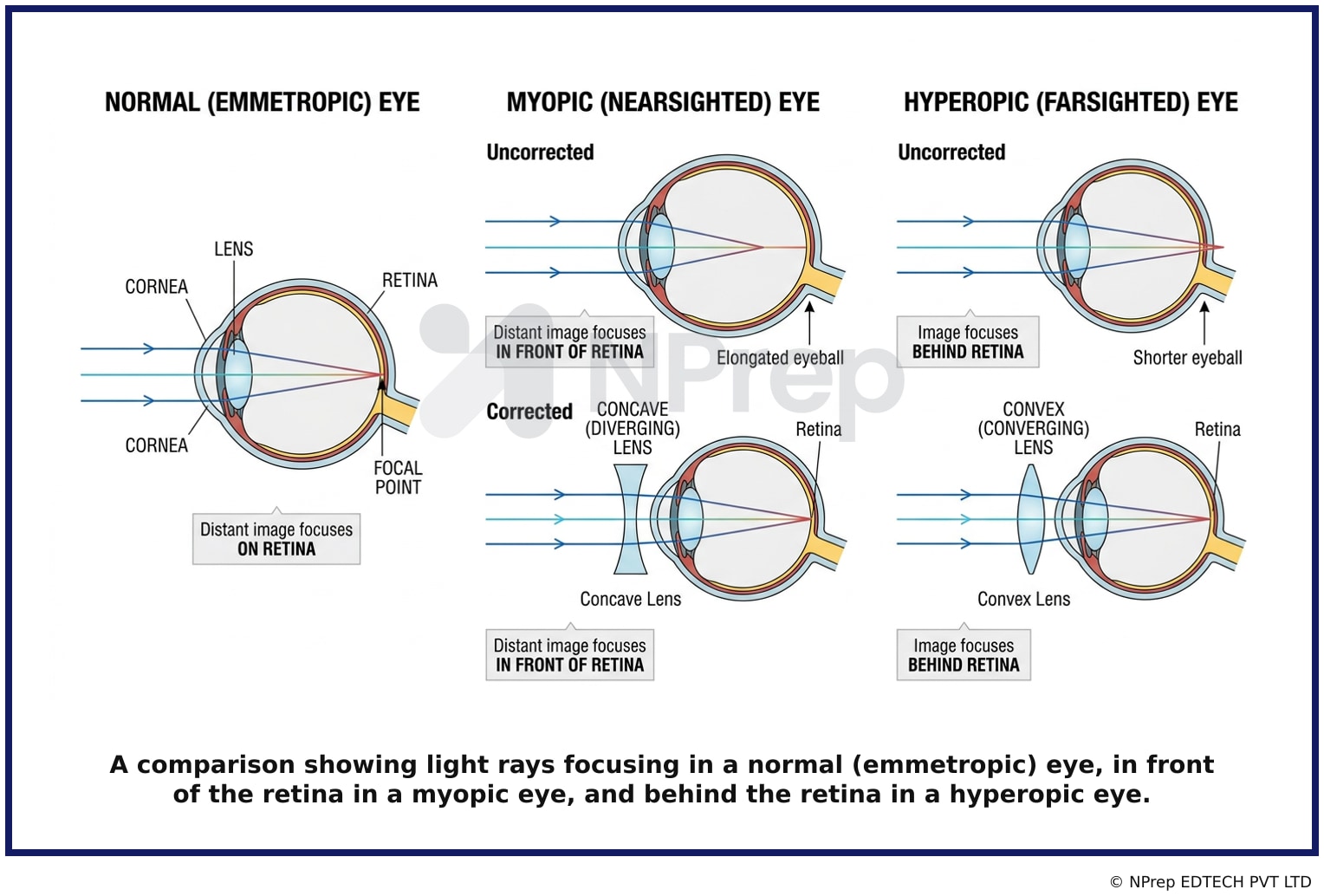
- Visual 1: Diagram - A comparison showing light rays focusing in a normal (emmetropic) eye, in front of the retina in a myopic eye, and behind the retina in a hyperopic eye.
- Visual 2: Diagram - An illustration of how a concave (diverging) lens spreads light rays to move the focal point backward onto the retina, correcting myopia.
- Visual 3: Diagram - An illustration of how a convex (converging) lens bends light rays to move the focal point forward onto the retina, correcting hyperopia.
Clinical Relevance
- Nursing practice connection: This is primarily an exam-oriented knowledge point with limited direct bedside application, so retain Corrective lenses for refractive errors of the eye as background academic context rather than a clinical decision trigger.
- Nurses play a key role in health screening and patient education. Understanding the basics of refractive errors helps in identifying potential vision problems in patients and explaining the purpose of their corrective lenses.
- During patient assessment, observing a patient squinting or holding reading material very close can be an indicator of uncorrected myopia, prompting a referral for a vision test.
- What if? - If a patient with myopia is accidentally given convex lenses, their distant vision will become significantly worse. The converging power of the convex lens would cause the light to focus even earlier (further in front of the retina), increasing the blur.
How to Approach the Question
- First, identify the key term in the question: 'myopia' (nearsightedness).
- Recall the basic pathophysiology of myopia: light from distant objects focuses in front of the retina.
- Determine the goal of the corrective lens: to move the focal point backward so it lands on the retina.
- Consider the properties of different lenses. A concave lens diverges (spreads) light, which will move the focal point backward. A convex lens converges (focuses) light, which would move it forward.
- Based on this, select the concave lens as the correct option for myopia.
- Rule out the other options by recalling their specific uses: convex for hyperopia, cylindrical for astigmatism, and bifocal for presbyopia.
Concept Tested & Keywords
- Concept Tested: Corrective lenses for refractive errors of the eye.
- Stem keywords: lens, correct, myopia, nearsightedness
- Lead-in keywords: Which type
Question ID
QVKst9aA5Nza65mHcpRxUU
Practise the full KGMU 2023
Attempt every question from this paper in a timed mock, then review the full solution for each one.
More Sensory organs Questions
- Which of the following helps prevent water loss through skin?
- Which of the following response is anticipated in a mother during suckling the baby?
- Anosmia is?
- Which is transmission of sound vibrations to the internal ear?
- What is the normal intraocular pressure in an adult?
- The size of which part of the eye contributes to controlling the amount of light entering the eye?
- The main function of sweda is:
- It is a type of refractive error in which light rays are focused in front of the retina?
- Which of the following photoreceptors helps in "bright light vision"?
- The Rods and Cones of the eye retinal layer are modified?
More KGMU 2023 Questions
- The teacher scalded Aruna in front of her classmates during Project submission. Conclusion I: Aruna was not as popular as her other classmates. Concl…
- Aruna leaves and goes 8 meters in the North direction from a certain point. Then she turns right and travels for 12 meters. She again turns right and…
- Kiran is Sister of Raj. Raj is Son of Suresh and Vinita is Mother of Suresh then what is relation between Vinita and Kiran?
- A person who lives at the same time with another?
- Select the most appropriate meaning of the below idiom. A black sheep?
- The train has arrived...the station.
- A vendor sold 20 kg of potato at 18 Rs. per kg. He bought 2-liter milk at the rate of 46 Rs./liter, 2 kg sugar at the rate of 35 Rs./kg and 10 packet…
- Which one is the perfect square?
- A is the smallest. C is taller than B and D. E is neither the tallest nor the smallest. Find which one is the tallest?
- From an entrance, a person walks 28 meters left, then turns right and walks 13 meters. They turn right again and walk 12 meters, and then walk 16 met…