
KGMU 2023
Applied Microbiology & Infection control
Easy
Which organism is a key target for destruction during the pasteurization of milk?
Appeared in: KGMU 2023
Explanation
- Pasteurization is a heat-treatment process designed to eliminate pathogenic microorganisms from milk to make it safe for consumption.
- The process is standardized to ensure the destruction of the most heat-resistant, non-spore-forming pathogen commonly found in raw milk.
- Historically, Mycobacterium tuberculosis (the agent of tuberculosis) was the benchmark organism. Its high thermal resistance means that any process sufficient to kill it will also eliminate other common non-spore-forming pathogens like Salmonella and Listeria.
- Modern pasteurization standards are often based on killing the even more heat-resistant Coxiella burnetii (the agent of Q fever), but M. tuberculosis remains a classic and correct answer as a key target.
Why Other Options Were Wrong
- Option A: This bacterium forms highly heat-resistant spores that are not destroyed by standard pasteurization temperatures.
- Option C: Similar to Clostridium, this is a spore-forming bacterium. Its spores survive pasteurization and can cause food poisoning (emetic or diarrheal types) if the milk is stored improperly, allowing the spores to germinate and multiply.
- Option D: This group of bacteria (e.g., Lactobacillus, Streptococcus lactis) is generally non-pathogenic and is responsible for the natural fermentation (souring) of milk. They are not the pathogenic targets of pasteurization.
Related Visual
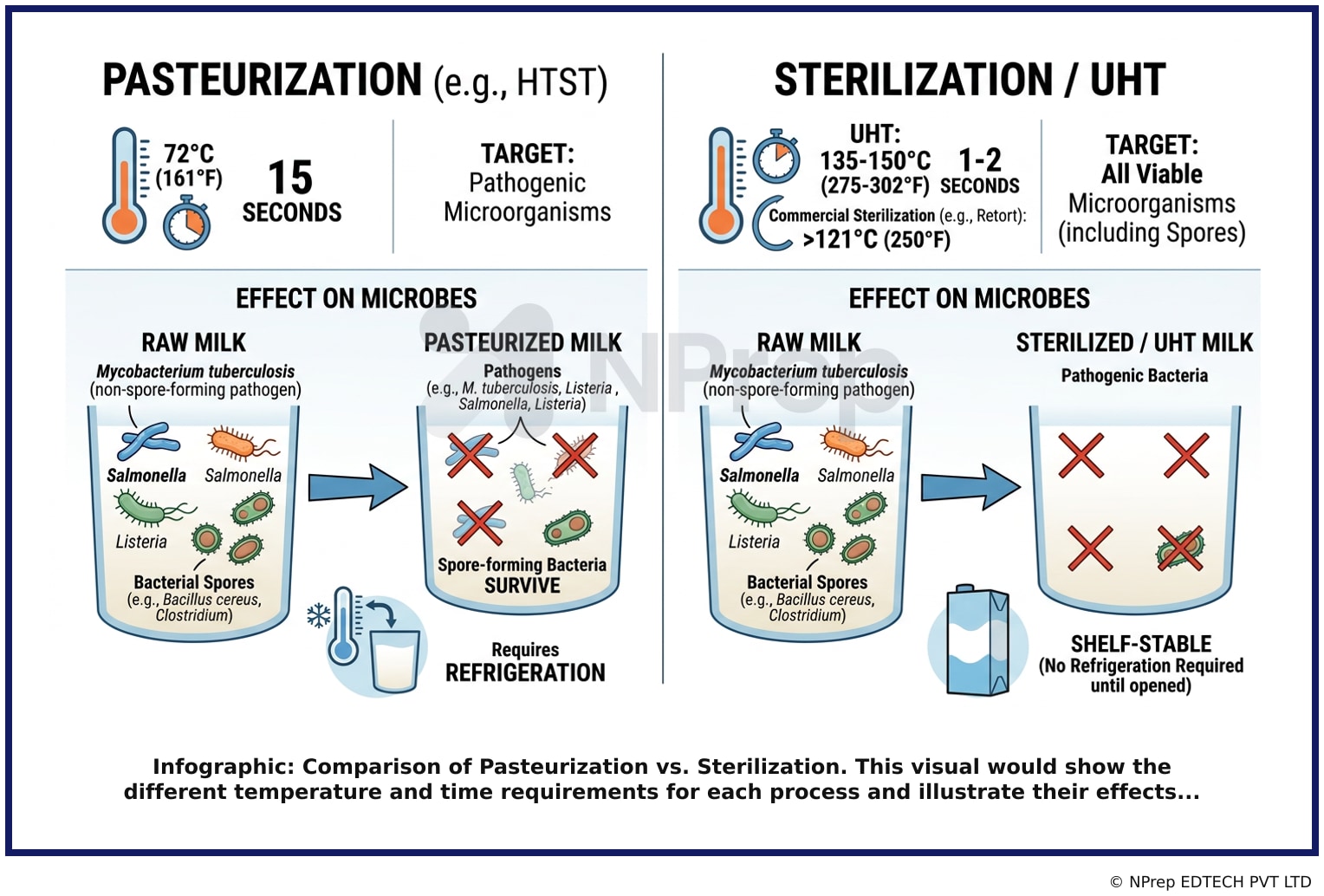
- Visual 1: Infographic: Comparison of Pasteurization vs. Sterilization. This visual would show the different temperature and time requirements for each process and illustrate their effects on vegetative bacteria versus bacterial spores.
- Visual 2: Diagram: The process flow of High-Temperature Short-Time (HTST) pasteurization, showing the raw milk intake, heating section, holding tube, cooling section, and packaging, to help visualize the industrial process.
Clinical Relevance
- Nursing practice connection: This is primarily an exam-oriented knowledge point with limited direct bedside application, so retain Target organism for milk pasteurization as background academic context rather than a clinical decision trigger.
- Pasteurization is a cornerstone of food safety and public health, credited with a dramatic reduction in milk-borne diseases like tuberculosis, brucellosis, listeriosis, and salmonellosis.
- Nurses have a key role in patient education, particularly advising vulnerable populations (pregnant women, young children, the elderly, and immunocompromised individuals) to avoid raw (unpasteurized) milk and products made from it due to the risk of serious infection.
- What if the goal was to create a shelf-stable milk that doesn't require refrigeration? In that case, the process would be Ultra-High Temperature (UHT) treatment or sterilization, which uses higher temperatures to kill spores, something pasteurization is not designed to do.
How to Approach the Question
- First, identify the core concept from the question: the 'key target' for 'pasteurization of milk'.
- Recall the purpose of pasteurization: to kill disease-causing (pathogenic) microbes, making the food safe to consume, while minimizing damage to its quality. This is distinct from sterilization, which aims to kill all microbes.
- Analyze the options based on their microbial characteristics. Note that Clostridium and Bacillus are well-known spore-formers.
- Remember that bacterial spores are highly resistant to heat and are not reliably killed by pasteurization temperatures. This makes options A and C unlikely targets for this specific process.
- Evaluate the remaining options. Lactic acid bacteria are generally non-pathogenic and used in making yogurt/cheese, so they are not a primary target for destruction.
- This leaves Mycobacterium tuberculosis, a famous heat-resistant pathogen historically linked to raw milk. Its elimination serves as a benchmark for the effectiveness of pasteurization, making it the most logical answer.
Concept Tested & Keywords
- Concept Tested: Target organism for milk pasteurization
- Stem keywords: organism, key target, destruction, pasteurization of milk
- Lead-in keywords: Which
- Negative lead-in flag: false
Question ID
QkdqcO3YCaVC_B14hbf0Ak
Practise the full KGMU 2023
Attempt every question from this paper in a timed mock, then review the full solution for each one.
More Pathogenic Organisms Questions
- An acid-fast bacillus which is pathogenic:
- Causative organism of infectious mononucleosis is:
- Which among the following is a Gram-positive organism?
- What is the causative organism for Syphilis?
- Who discovered virus in biology?
- Which vector causes Zika virus disease?
- All of the following diseases caused by viruses, except?
- What does SARS stand for?
- What is the name of the organism responsible for tuberculosis?
- What causes the spread of chickenpox?
More KGMU 2023 Questions
- The teacher scalded Aruna in front of her classmates during Project submission. Conclusion I: Aruna was not as popular as her other classmates. Concl…
- Aruna leaves and goes 8 meters in the North direction from a certain point. Then she turns right and travels for 12 meters. She again turns right and…
- Kiran is Sister of Raj. Raj is Son of Suresh and Vinita is Mother of Suresh then what is relation between Vinita and Kiran?
- A person who lives at the same time with another?
- Select the most appropriate meaning of the below idiom. A black sheep?
- The train has arrived...the station.
- A vendor sold 20 kg of potato at 18 Rs. per kg. He bought 2-liter milk at the rate of 46 Rs./liter, 2 kg sugar at the rate of 35 Rs./kg and 10 packet…
- Which one is the perfect square?
- A is the smallest. C is taller than B and D. E is neither the tallest nor the smallest. Find which one is the tallest?
- From an entrance, a person walks 28 meters left, then turns right and walks 13 meters. They turn right again and walk 12 meters, and then walk 16 met…