
NVS Staff Nurse - 2022
Mental Health Nursing
Easy
Which one of the following is called an Obsessive Compulsive Disorder (OCD)?
Appeared in: NVS Staff Nurse - 2022
Explanation
- Obsessive-Compulsive Disorder (OCD) is fundamentally defined by the presence of obsessions and/or compulsions.
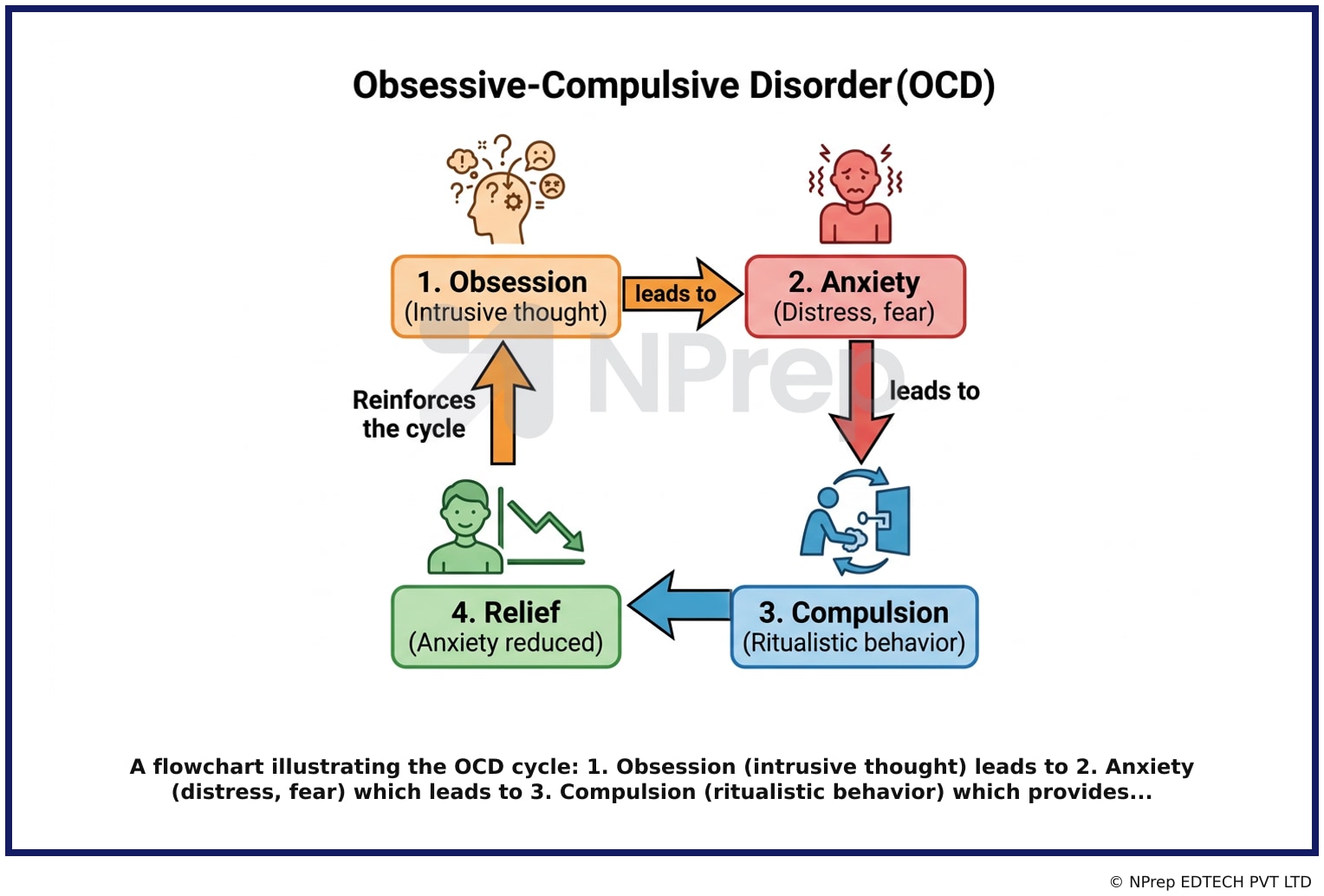
- Obsessions are repetitive and persistent thoughts, urges, or images that are intrusive and cause distress.
- Compulsions are repetitive behaviors or mental acts that the individual feels driven to perform in response to an obsession.
- This combination of repetitive thoughts (obsessions) and repetitive behaviors (compulsions) is the core feature of the disorder.
Why Other Options Were Wrong
- Option B: This describes Impulse Control Disorders, not OCD. While compulsions in OCD can feel irresistible, the primary driver is to neutralize an obsession, whereas in impulse control disorders, the act itself is the focus, often preceded by a sense of tension and followed by pleasure or relief.
- Option C: Bipolar disorder is a mood disorder characterized by extreme shifts in mood, energy, and activity levels, cycling between periods of mania (or hypomania) and depression. It is not primarily defined by repetitive thoughts and behaviors.
- Option D: False perceptions, such as hallucinations (seeing or hearing things that aren't there) or delusions (fixed false beliefs), are hallmark symptoms of psychotic disorders like schizophrenia. While a person with OCD can have poor insight, their obsessions are recognized as their own thoughts, not external realities.
Related Visual
Clinical Relevance
- Nursing practice connection: This is primarily an exam-oriented knowledge point with limited direct bedside application, so retain Definition and characteristics of Obsessive-Compulsive Disorder (OCD) as background academic context rather than a clinical decision trigger.
- Nurses must be able to differentiate OCD from other psychiatric disorders to ensure appropriate care planning and therapeutic communication. For example, arguing with an OCD patient about the logic of their ritual is ineffective.
- A key nursing intervention is Exposure and Response Prevention (ERP). Nurses can support patients by encouraging them to delay or modify rituals, helping them tolerate the anxiety until it subsides naturally.
- Patient safety is a concern. Compulsions can be harmful, such as excessive handwashing leading to skin breakdown, or checking rituals causing exhaustion and preventing normal daily activities.
How to Approach the Question
- First, identify the core concept in the question stem, which is 'Obsessive Compulsive Disorder (OCD)'.
- This is a factual recall question that asks for a definition.
- Break down the term 'Obsessive-Compulsive'. 'Obsessive' relates to thoughts, and 'Compulsive' relates to behaviors or actions.
- Evaluate each option against this understanding.
- Option A, 'Repetitive thoughts and behavior pattern,' directly matches the two core components of OCD.
- Compare this with the other options to confirm they describe different conditions (Impulse Control Disorder, Bipolar Disorder, Psychosis) to solidify your choice.
Concept Tested & Keywords
- Concept Tested: Definition and characteristics of Obsessive-Compulsive Disorder (OCD).
- Stem keywords: Obsessive Compulsive Disorder, OCD
- Lead-in keywords: Which one
- Negative lead-in flag: false
Question ID
QWzZIvgXAY0-9HWNp0Mqbq
Reference Book
E6 Kaplan Sadock's Synopsis of Psychiatry-2022 (pp 1-3768 of 3768) pp. 1341-1343, 1324-1326
E6 Robert Boland, Marcia L. Verduin - Kaplan and Sadock's Comprehensive Text of Psychiatry-Wolters Kluwer Health (2024) (pp 1-16525 of 16525) p. 3797-3799
Practise the full NVS Staff Nurse - 2022
Attempt every question from this paper in a timed mock, then review the full solution for each one.
More Neurotic, stress related and somatisation disorders Questions
- Following are associated with post traumatic stress disorder except?
- Which of the following disorder is commonly seen in rape victim girl?
- Which of the following is NOT a sign/symptom of the obsessive-compulsive disorder?
- The La Belle indifference is related to?
- A person suffering from, a severe anxiety disorder, is able to speak freely with certain people only and is not able to speak with others, especially…
- Anxiety is caused by?
- What is the term coined for circumscribed fear of a discrete object or situation?
- Which of the following options describes transient situational disturbances?
- What is the term used to explain the condition in which a patient perceives that his/her face is distorted and his/her legs have become short?
- The level of anxiety that enhances the individual's power of perception is?
More NVS Staff Nurse - 2022 Questions
- When Alok did not get a ticket to contest the election he was very disturbed and felt \qquad .
- Joseph is an ardent fan of Rohit Sharma.
- A bad workman always......?
- The roots of the tree had gone deep into the ground.
- In connection with the ragging, have you found out against \qquad the Principal has ordered an enquiry?
- Why does the writer say that the old lady's basket had grown heavier with every step?
- Why does the writer compare the old lady with a bird using the expression 'veritable magpie'?
- Which of the following options is not an example of a compound pronominal adjective?
- Which of the following idioms means 'great effort'?
- 'Lekin' (but) is an example of which type of coordinating conjunction?