
ESIC Nursing Officer - 2019 (Shift-2)
Applied Physiology
Easy
Which of the following is the most abundant type of blood cells?
Appeared in: ESIC Nursing Officer - 2019 (Shift-2)
Explanation
- Erythrocytes (Red Blood Cells) are the most numerous blood cells, with counts typically ranging from 4 to 6 million cells per microliter (µL) of blood.
- The primary role of these cells is to carry oxygen, and their high numbers ensure adequate oxygen-carrying capacity throughout the body.
- The cellular component of blood, known as the formed elements, is composed of about 40-45% erythrocytes by volume (hematocrit), highlighting their dominance.
- The bone marrow produces approximately 175 billion erythrocytes each day to replenish the supply, far exceeding the production rate of other blood cells.
Why Other Options Were Wrong
- Option A: Lymphocytes are a type of white blood cell (leukocyte). The total white blood cell count is only 4,000-11,000 per µL, and lymphocytes make up just a fraction of that (typically 20-40%), making them far less abundant than erythrocytes.
- Option B: Monocytes are another type of white blood cell. They are the largest type of leukocyte but are one of the least numerous, typically comprising only 2-8% of the total white blood cell count.
- Option C: Thrombocytes, or platelets, are the second most abundant formed element in the blood, with counts around 150,000-400,000 per µL. While this is much higher than the white blood cell count, it is still significantly lower than the millions of erythrocytes.
Related Visual
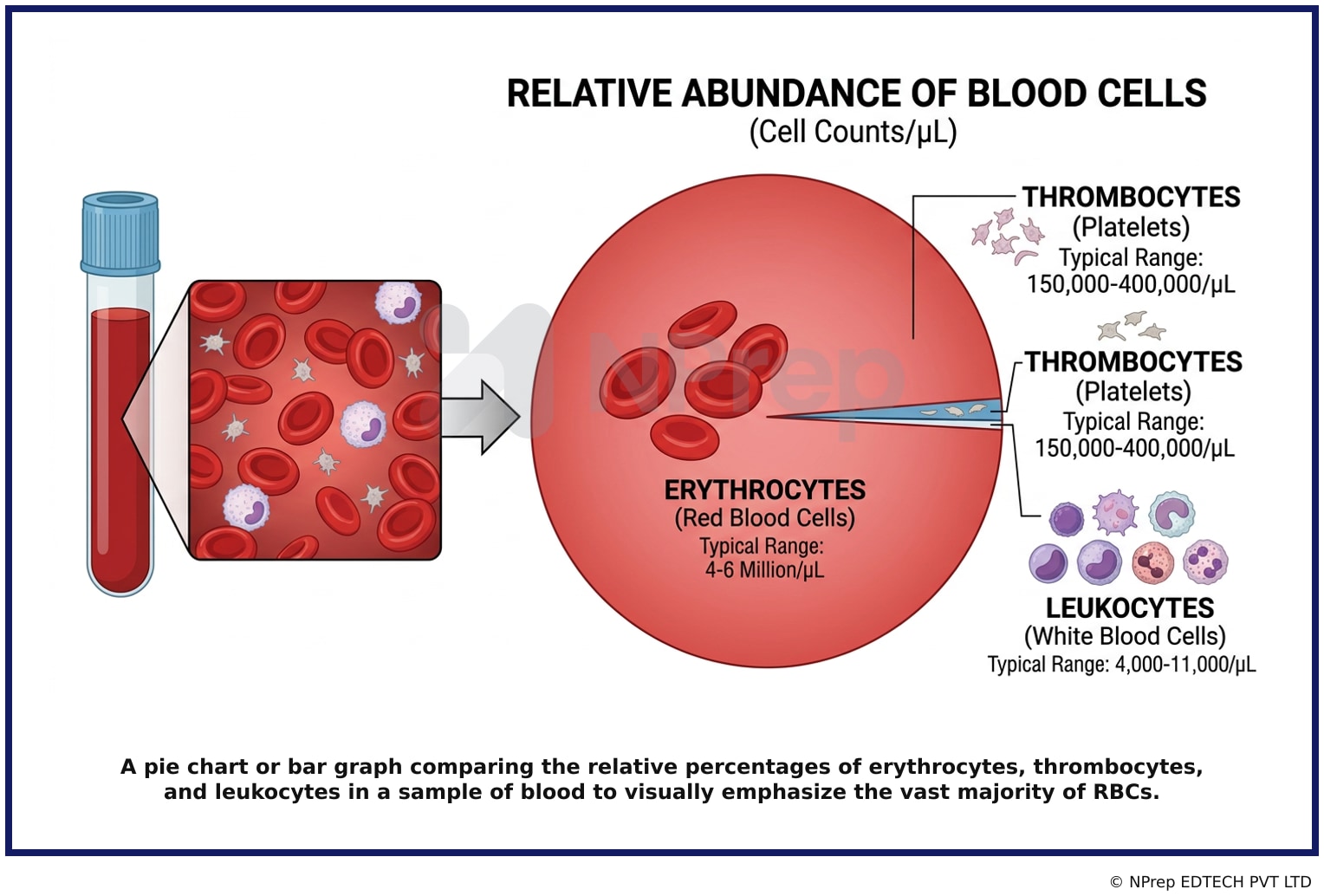
- Visual 1: Diagram - A pie chart or bar graph comparing the relative percentages of erythrocytes, thrombocytes, and leukocytes in a sample of blood to visually emphasize the vast majority of RBCs.
- Visual 2: Infographic - An illustration of a blood vessel showing the different blood cells to scale, with a large number of small, red, biconcave discs (erythrocytes) alongside a few larger, varied white blood cells and small platelet fragments.
Clinical Relevance
- Nursing practice connection: Knowing Relative abundance of different types of blood cells helps nurses interpret findings accurately and avoid errors in routine assessment, medication administration, and patient teaching.
- Understanding the normal abundance of blood cells is fundamental for interpreting a Complete Blood Count (CBC), a common diagnostic test. An abnormal RBC count is a key indicator of conditions like anemia (low count) or polycythemia (high count).
- The sheer number of erythrocytes is directly related to the blood's oxygen-carrying capacity. This is why symptoms of anemia, such as fatigue and shortness of breath, are directly linked to a reduced number of these cells.
- What if? If a patient's lab report showed a critically low erythrocyte count (e.g., 2.0 million/µL), the nurse's priority would be to assess for signs of hypoxia (e.g., confusion, tachycardia, low oxygen saturation), notify the healthcare provider immediately, and prepare for a potential blood transfusion.
How to Approach the Question
- First, identify the core of the question, which is asking to compare the quantity ('most abundant') of different blood cell types.
- Recall the three main categories of formed elements in the blood: red blood cells (erythrocytes), white blood cells (leukocytes), and platelets (thrombocytes).
- Remember the general order of magnitude for each: RBCs are in the millions, platelets are in the hundreds of thousands, and WBCs are in the thousands per microliter.
- Recognize that 'Lymphocyte' and 'Monocyte' are specific types of white blood cells, so their individual counts must be lower than the total WBC count.
- Based on this hierarchy (millions > hundred thousands > thousands), conclude that erythrocytes are the most abundant.
- Select the option corresponding to erythrocytes.
Concept Tested & Keywords
- Concept Tested: Relative abundance of different types of blood cells.
- Stem keywords: most abundant, blood cells
- Lead-in keywords: Which
- Negative lead-in flag: false
Question ID
Qxmd4M9X8fWI5oK3g2kExm
Practise the full ESIC Nursing Officer - 2019 (Shift-2)
Attempt every question from this paper in a timed mock, then review the full solution for each one.
More Blood Questions
- Universal blood donor?
- What is the average lifespan of Red blood cells?
- In the clotting mechanism, prothrombin is changed into thrombin in the presence of?
- What is the synonym of Clotting Factor II?
- Antibodies are produced by?
- What is the approximate normal level of haematocrit/ packed cell volume in men?
- An individual with which of the following blood groups is a universal donor?
- Which blood cells increase during an infection?
- Antibodies are produced by?
- Chief regulatory among the immune cells are?
More ESIC Nursing Officer - 2019 (Shift-2) Questions
- Gestational diabetes increases risk for the following, EXCEPT
- The nurse is assigned to a patient who has bacterial pneumonia and is under droplet precautions. Which personal protective equipment (PPE) will s/he…
- Artificially acquired immunity is obtained by
- Which of the following would not promote trust in the nurse-patient relationship?
- Refrigerated breastmilk should not be used if it is beyond:
- In the liver, bacteria that found their way into portal circulation are destroyed by
- The Three Features of a Community
- Medical asepsis differs from surgical asepsis in that it is aimed at:
- Cerclage (encircling cervix with suture) is done for patients with
- The most significant characteristic experienced by a patient with depression is: