
UPRVUNL - 2021
Applied Microbiology & Infection control
Easy
Which of the following is the causative agent of lymphatic filariasis?
Appeared in: UPRVUNL - 2021
Explanation
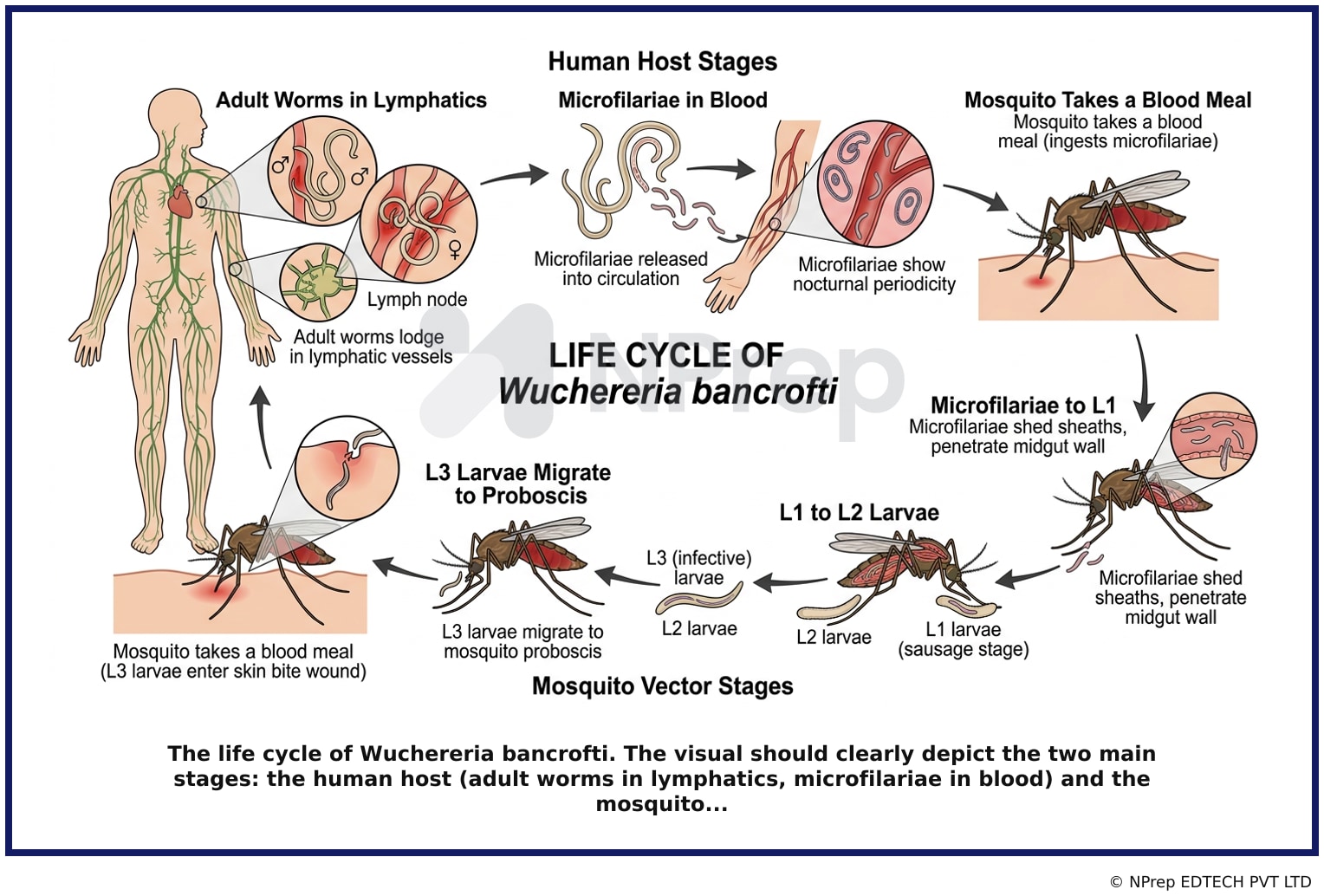
- Wuchereria bancrofti is a filarial nematode (roundworm) that is the primary causative agent of lymphatic filariasis, accounting for about 90% of cases.
- The parasite is transmitted to humans by the bite of infected mosquitoes.
- Adult worms lodge in the lymphatic system, impairing lymph drainage and causing chronic inflammation, which leads to lymphedema and elephantiasis.
- The offspring of the worms, called microfilariae, circulate in the blood, typically at night, and can be ingested by a mosquito during a blood meal, continuing the life cycle.
Why Other Options Were Wrong
- Option A: Plasmodium is a genus of protozoan parasites, not a helminth. It infects red blood cells and liver cells.
- Option C: Trichomonas, specifically Trichomonas vaginalis, is a protozoan parasite that infects the urogenital tract.
- Option D: Entamoeba histolytica is a protozoan parasite that primarily infects the large intestine, causing intestinal and extra-intestinal amoebiasis.
Related Visual
Clinical Relevance
- Nursing practice connection: This is primarily an exam-oriented knowledge point with limited direct bedside application, so retain Causative agents of parasitic diseases as background academic context rather than a clinical decision trigger.
- Nurses play a crucial role in public health campaigns for Mass Drug Administration (MDA) to eliminate lymphatic filariasis, ensuring community participation and adherence.
- Patient education is a key nursing function, involving teaching about mosquito bite prevention (using nets, repellents) and recognizing early signs of the disease.
- For patients with chronic lymphedema (elephantiasis), nurses provide care focused on meticulous hygiene, skin care, exercise, and limb elevation to manage swelling, prevent secondary bacterial infections, and improve quality of life.
How to Approach the Question
- First, identify the key terms in the question: 'causative agent' and 'lymphatic filariasis'. This signals a need to match a specific disease with its pathogen.
- This is a factual recall question, relying on your knowledge of microbiology and infectious diseases.
- Systematically review each option. For each organism, recall the primary disease it causes.
- Option A, Plasmodium, causes malaria.
- Option C, Trichomonas, causes trichomoniasis.
- Option D, Entamoeba histolytica, causes amoebiasis.
Concept Tested & Keywords
- Concept Tested: Causative agents of parasitic diseases
- Stem keywords: causative agent, lymphatic filariasis
- Lead-in keywords: Which
Question ID
Qerr2RPou6YovpmmrxBvZ6
Reference Book
E6 Medicine Harrison 22e Part 1 p. 1860-1862
E6 Parks TextBook of Preventive & Social Medicine part 1 — Subpart B (pp 202-403 of 604) p. 132-134
E6 Pathology- ROBBINS & COTRAN PATHOLOGIC BASIS OF DISEASE 10TH Ed p. 405-407
Practise the full UPRVUNL - 2021
Attempt every question from this paper in a timed mock, then review the full solution for each one.
More Pathogenic Organisms Questions
- An acid-fast bacillus which is pathogenic:
- Causative organism of infectious mononucleosis is:
- Which among the following is a Gram-positive organism?
- What is the causative organism for Syphilis?
- Who discovered virus in biology?
- Which vector causes Zika virus disease?
- All of the following diseases caused by viruses, except?
- What does SARS stand for?
- What is the name of the organism responsible for tuberculosis?
- What causes the spread of chickenpox?
More UPRVUNL - 2021 Questions
- There is a swelling in a diffuse area. It is characterized by edema that appears at birth, disappears in several days, and crosses suture lines. This…
- The drug of choice for the treatment of manic episode is?
- The agent that causes smallpox is?
- Which of the following deficiency disease is also known as "rice eater's" disease?
- Illusion is a disorder of?
- Interstitial implantation of fertilized ovum is completed on the?
- Diaphragm is a/an?
- The bacteria that grow between 20 to 50 degrees Celsius temperature are called?
- The time period of pregnancy defined as the third trimester of pregnancy is?
- Which of the following was not discovered by Louis Pasteur?