
UPUMS Nsg officer-2023
Biochemistry & Nutrition
Easy
Which of the following is NOT a chain breaking anti-oxidant?
Appeared in: UPUMS Nsg officer-2023
Explanation
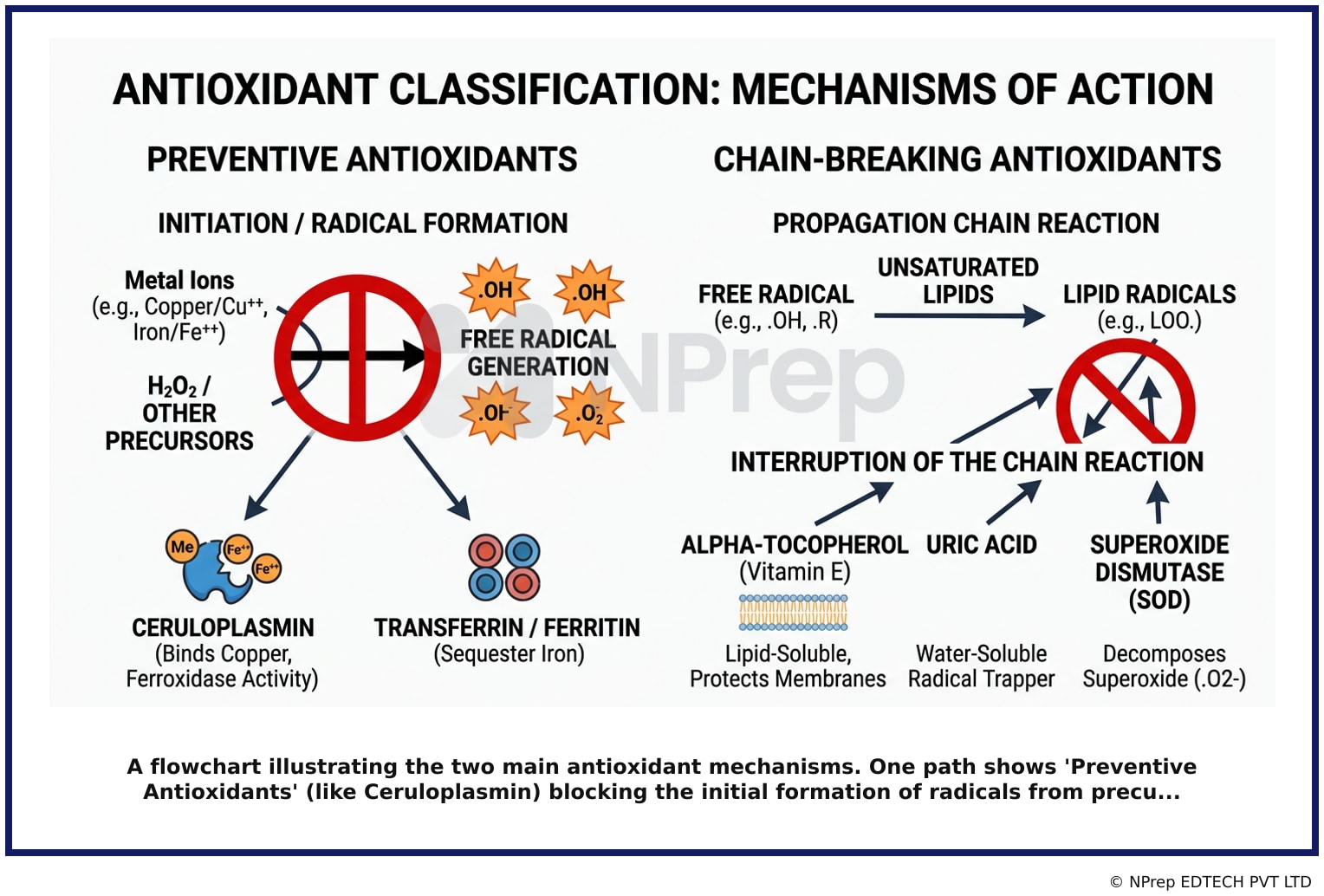
- Ceruloplasmin is classified as a preventive antioxidant, not a chain-breaking one.
- Its primary mechanism is to bind copper and exhibit ferroxidase activity, which prevents metal-catalyzed formation of free radicals (like in the Fenton reaction).
- This preventive action differs from chain-breaking antioxidants, which directly neutralize already-formed free radicals to stop a propagating chain reaction.
Why Other Options Were Wrong
- Option A: Uric acid is a well-known chain-breaking antioxidant. It acts as a water-soluble radical-trapping compound.
- Option B: Superoxide dismutase (SOD) is an enzyme that functions as a chain-breaking antioxidant by catalyzing the breakdown of the superoxide radical.
- Option C: Alpha-tocopherol (Vitamin E) is a classic example of a lipid-soluble, chain-breaking antioxidant that protects cell membranes from peroxidation.
Related Visual
Clinical Relevance
- Nursing practice connection: This is primarily an exam-oriented knowledge point with limited direct bedside application, so retain Classification of antioxidants based on their mechanism of action (Preventive vs. Chain-Breaking) as background academic context rather than a clinical decision trigger.
- Understanding the different types of antioxidants is crucial in appreciating the body's complex defense system against oxidative stress, which is implicated in aging, atherosclerosis, cancer, and neurodegenerative diseases.
- Nurses can educate patients on the importance of a balanced diet rich in various antioxidants (from fruits, vegetables, whole grains) rather than relying on high-dose single-antioxidant supplements, as different antioxidants work in different cellular compartments and through different mechanisms.
- What if the question asked for a lipid-soluble chain-breaking antioxidant? The answer would be Alpha-tocopherol, as it specifically functions within cell membranes, whereas Uric acid and SOD are primarily water-soluble.
How to Approach the Question
- First, identify the negative keyword 'NOT' in the question. This means you are looking for the exception among the options.
- Next, define the key term: 'chain-breaking anti-oxidant'. This is a substance that stops a free radical chain reaction after it has already started.
- Evaluate each option against this definition.
- Uric acid, Superoxide dismutase, and Alpha-tocopherol are all known to directly interact with and neutralize free radicals, fitting the definition of chain-breaking.
- Ceruloplasmin's role is to bind metals to prevent them from creating radicals in the first place. This is a preventive, not a chain-breaking, mechanism.
- Therefore, Ceruloplasmin is the correct answer as it is the one that is NOT a chain-breaking antioxidant.
Concept Tested & Keywords
- Concept Tested: Classification of antioxidants based on their mechanism of action (Preventive vs. Chain-Breaking).
- Stem keywords: anti-oxidant, chain breaking
- Lead-in keywords: NOT
- Negative lead-in flag: The question uses the negative keyword 'NOT', requiring identification of the option that does not fit the specified category.
Question ID
QuhUrFcVU3x-AERz9q3I3D
Reference Book
E6 Textbook of Biochemistry for medical StudentsDM Vasudevan Part 2 — Subpart A (pp 1-239 of 478) p. 107-109
E6 Biochemistry U Satyanarayana— Part 2 (pp 421-820 of 840) p. 288-290
E6 Harper's Illustrated Biochemistry2023 (pp 26-793 of 813) p. 536-538
Practise the full UPUMS Nsg officer-2023
Attempt every question from this paper in a timed mock, then review the full solution for each one.
More Immunochemistry Questions
- Elimination of free radicals occurs with the help of:
- A bacteriocidal enzyme found in nasal, intestinal secretion is?
- Fruits, Vegetables and cereals are potent source of?
- An essential component of glutathione peroxidase is?
- Which process leads to the formation of a positive ion?
- Which of the following shows oxidation?
- A biologically important peptide for the maintenance RBC structure:
- Regarding Chemiluminescent assays, which statement is true?
More UPUMS Nsg officer-2023 Questions
- The nurse on assessing the pulse rate of an adult client, observes that the pulse rate is increased. Which of the following factors could have contri…
- Screening test is NOT useful when?
- Which of the following is the cause of asymmetric IUGR?
- Mrs. Raji complains that her new born gets hiccups after breastfeeding. She is worried that the baby has some problem. As a nurse, which of the follo…
- 1000 grams (g) is equal to pounds (lb).
- Which of the following is NOT the correct sign of good attachment during breastfeeding?
- The researcher asks questions in person. This is known as?
- Major cause of neonatal mortality rate in India in 2026 ?
- Red colour vaginal discharge for the initial 1-4 days during puerperium is?
- What type of counselling is Gestalt therapy?