
INI-CET EXAM -2025
Child Health Nursing (Pediatrics)
Medium
Which of the following hearing tests is not performed in infants?
Appeared in: INI-CET EXAM -2025
Explanation
- Pure Tone Audiometry (PTA) is a subjective behavioral test that requires the patient to understand instructions and signal when a sound is heard.
- Infants are developmentally unable to provide this type of conscious, cooperative response.
- This test is typically reserved for children aged 4-5 years and older, who can reliably participate in the testing procedure.
Why Other Options Were Wrong
- Option A: Otoacoustic Emissions (OAE) is a standard, non-invasive hearing screening test performed on newborns and infants. It is an objective test that does not require any response from the baby.
- Option B: Brainstem Evoked Response Audiometry (BERA), also known as Auditory Brainstem Response (ABR), is an objective test used to assess the hearing pathway from the inner ear to the brainstem. It is a key diagnostic tool for infants, especially those who fail the initial OAE screening, and can be done while the baby is asleep.
- Option D: Free-field audiometry is a form of behavioral testing used for infants and young children (typically 6 months to 2.5 years). It involves presenting sounds through speakers and observing the child's reaction, such as turning their head towards the sound (a technique called Visual Reinforcement Audiometry).
Related Visual
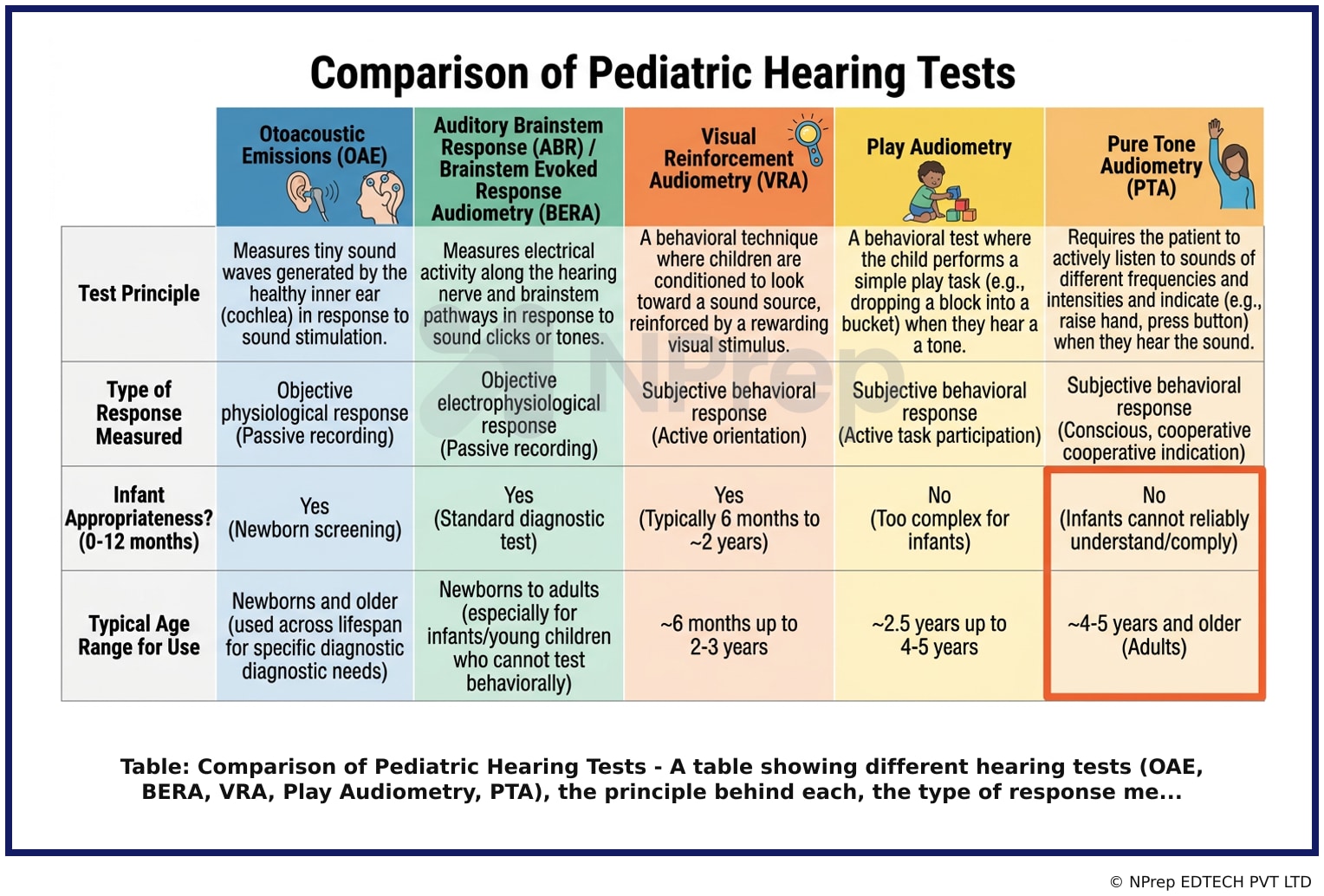
- Visual 1: Table: Comparison of Pediatric Hearing Tests - A table showing different hearing tests (OAE, BERA, VRA, Play Audiometry, PTA), the principle behind each, the type of response measured (objective vs. behavioral), and the typical age range for which each test is appropriate.
Clinical Relevance
- Nursing practice connection: This is primarily an exam-oriented knowledge point with limited direct bedside application, so retain Hearing assessment methods in infants and children as background academic context rather than a clinical decision trigger.
- Early detection of hearing loss is critical for a child's speech, language, and cognitive development. The '1-3-6' rule is a guideline: screen by 1 month, diagnose by 3 months, and begin intervention by 6 months.
- Nurses play a vital role in ensuring newborns undergo hearing screening before hospital discharge and in educating parents about the importance of follow-up if the infant does not pass.
- What if? If an infant fails both OAE and BERA tests, it indicates a high probability of sensorineural hearing loss. The next step is a comprehensive audiological evaluation to determine the degree of loss and plan for early intervention, such as hearing aids or cochlear implant evaluation.
How to Approach the Question
- First, understand the question is asking which test is not suitable for infants. This is a negative-framing question, so you are looking for the outlier.
- Consider the developmental capabilities of an infant. They cannot follow complex instructions or provide voluntary, conditioned responses.
- Evaluate each option based on this consideration. Differentiate between objective tests (which measure a physiological response without the patient's cooperation) and subjective/behavioral tests (which require a conscious response).
- OAE and BERA are objective tests, making them suitable for infants.
- Free-field audiometry relies on a natural reflex (head turn), making it suitable for slightly older infants.
- PTA requires a learned, voluntary response, making it unsuitable for infants. This identifies it as the correct answer.
Concept Tested & Keywords
- Concept Tested: Hearing assessment methods in infants and children.
- Stem keywords: hearing tests, infants
- Lead-in keywords: not performed
- Negative lead-in flag: The question asks to identify the test that is NOT used for infants.
Question ID
Q_77AD5Jyb8RsTutGoq2Ra
Practise the full INI-CET EXAM -2025
Attempt every question from this paper in a timed mock, then review the full solution for each one.
More Otolaryngology Questions
- You are assessing the nutrition of a 3-year-old child in your pediatric clinic. The child is developmentally normal and has no known food allergies o…
- What is choanal atresia?
- While administering ear drops in a 2 years old child. Which of the following is done by the nursing officer while giving ear drops ear pinna is?(Imag…
- A child undergoes heart surgery to repair the defects associated with Tetralogy of Fallot. What behavior is essential for the nurse to prevent postop…
- What is the nurse's priority intervention when preparing for admission of a child with acute laryngotracheobronchitis?
- When feeding an 18-month-old child two days after he underwent a cleft palate repair, a nurse would offer liquid nutrition using a?
- A five-year-old child gets admitted to the hospital with the diagnosis of Bronchopulmonary Dysplasia (BPD). If the child is at the third stage, what…
- How should you instruct the student nurse to modify the examination for a 7-year-old child?
- What is the most appropriate way to assess the effectiveness of nebulization therapy in a 4-year-old child?
- Which is the earliest sign of rickets?
More INI-CET EXAM -2025 Questions
- The highlighted structure in the provided image articulates with which bone?& x20;
- Through which of the following foramina does the nerve supplying the muscles of mastication pass?& x20;
- In the given image, which region is correctly paired with its corresponding brain structure? • Middle cerebellar peduncle • Fasciculus cuneatus • Sup…
- Which of the following muscles is NOT typically associated with dysphagia or dysarthria?
- A muscle of mastication involved in opening the mouth exhibits the following characteristics. Identify the incorrect statement about it:
- In the illustrated image, which of the following structures is NOT associated with the area marked by the arrow?& x20;
- Match the following embryonic aortic arches with their respective adult derivatives: A. 1st Arch 1. Maxillary artery& x20; B. 2nd Arch 2. Common caro…
- Which of the following histology image is not an endocrine structure?& x20;
- Marked structure separates which of the following:
- Which of the following bones of the skull gives passage to a nerve arising from the brain & x20;