
KGMU 2023
Applied Microbiology & Infection control
Hard
Which of the following disinfectants is recommended for cleaning clothes soiled with blood from an HIV-positive patient?
Appeared in: KGMU 2023
Explanation
- Sodium hypochlorite is a halogen-based disinfectant with broad-spectrum antimicrobial activity, including being a potent virucide effective against HIV.
- Unlike many other disinfectants, its efficacy is maintained in the presence of organic matter, which is critical when cleaning items soiled with blood.
- It is the standard recommendation in healthcare settings for managing blood spills and decontaminating items to prevent the transmission of bloodborne pathogens.
- It is inexpensive, fast-acting, and effectively removes fixed organisms from surfaces and fabrics.
Why Other Options Were Wrong
- Option B: Dettol, which contains chloroxylenol, is a phenolic antiseptic that is significantly inactivated by organic matter such as blood, rendering it ineffective for this task.
- Option C: Savlon, a combination of cetrimide and chlorhexidine, is an antiseptic primarily used for skin cleansing and disinfecting clean medical equipment like thermometers. It is not formulated to handle heavy bio-burdens like blood on clothing.
- Option D: Spirit (alcohol) evaporates too quickly from surfaces to provide the necessary contact time to kill all pathogens, especially on absorbent materials like cloth. It is also flammable and not practical for large items.
Related Visual
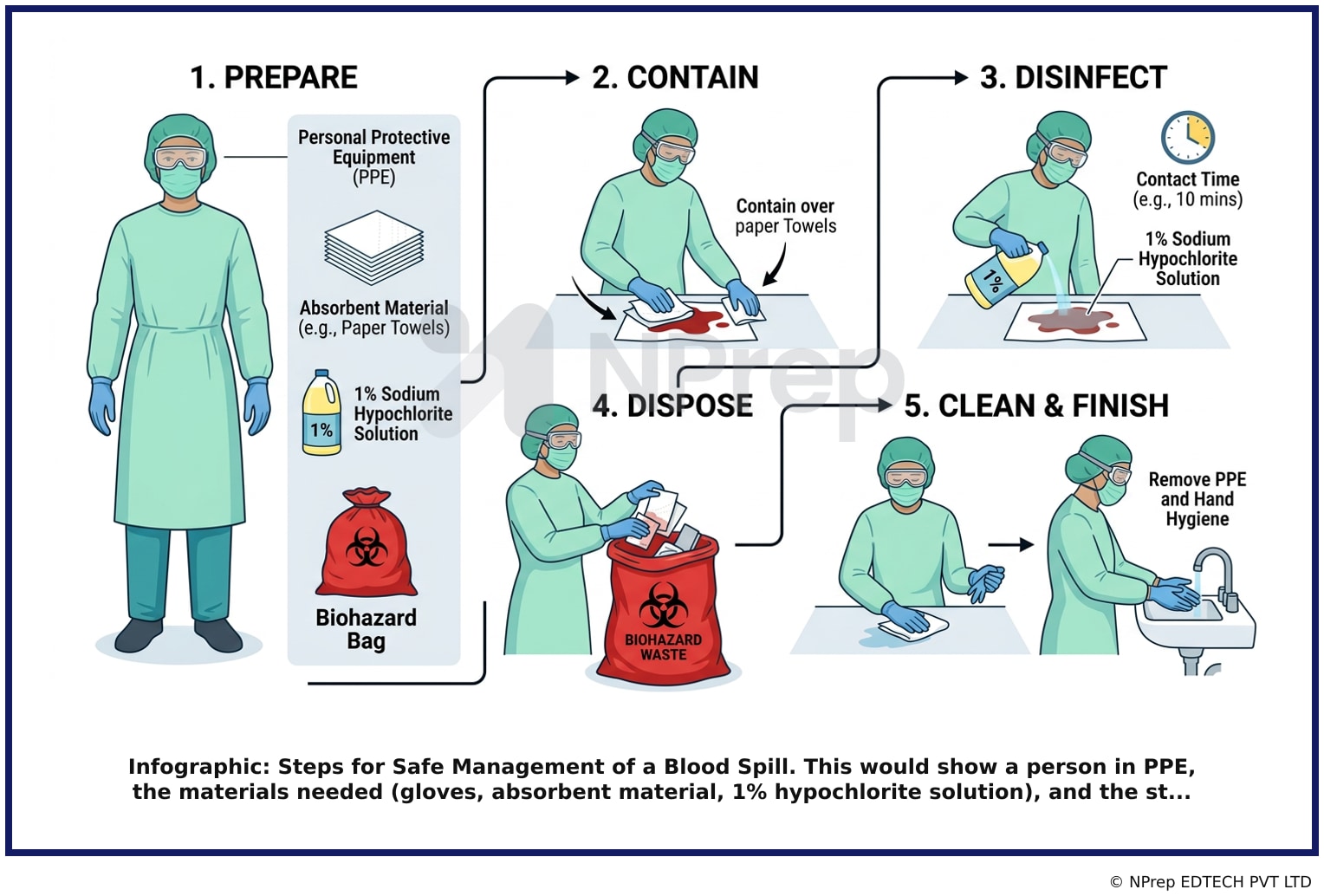
- Visual 1: Infographic: Steps for Safe Management of a Blood Spill. This would show a person in PPE, the materials needed (gloves, absorbent material, 1% hypochlorite solution), and the step-by-step process of containing, disinfecting, and disposing of the waste.
- Visual 2: Chart: Comparison of Disinfectant Levels (High, Intermediate, Low). This would classify Sodium Hypochlorite as an intermediate-to-high level disinfectant, while placing the other options in lower categories in terms of efficacy against resistant pathogens and in the presence of organic matter.
Clinical Relevance
- Nursing practice connection: Use the key finding related to Infection control and decontamination of biohazardous materials to guide bedside assessment, documentation, and the next nursing action.
- This question reinforces the principle of Universal Precautions: all blood and body fluids must be treated as potentially infectious, regardless of the patient's known status. The choice of disinfectant is not just about cleaning, but about breaking the chain of infection.
- Incorrect disinfectant choice can lead to the survival of pathogens and pose a significant risk of occupational exposure and transmission to healthcare workers and other patients.
- Nurses are responsible for ensuring proper decontamination procedures are followed, including using the correct agent at the correct concentration (e.g., 1% sodium hypochlorite for blood spills).
How to Approach the Question
- First, identify the core of the question: selecting a disinfectant for a specific contamination scenario.
- Analyze the contaminant: It's blood, which is organic matter, and potentially contains a virus (HIV). This means the disinfectant must be virucidal and effective in the presence of organic material.
- Analyze the object to be cleaned: Clothes (fabric), which are porous and absorbent.
- Evaluate each option based on these requirements:
- Does it kill viruses?
- Does it work when blood is present?
Concept Tested & Keywords
- Concept Tested: Infection control and decontamination of biohazardous materials
- Stem keywords: disinfectant, cleaning clothes, soiled with blood, HIV-positive
- Lead-in keywords: Which
Question ID
QVxYSXx0rUSy0TEb4oWbVB
Practise the full KGMU 2023
Attempt every question from this paper in a timed mock, then review the full solution for each one.
More Sterilisation & Disinfection Questions
- Identify the following machine:
- Who among the following devised the autoclave used for sterilization?
- Endoscope is sterilized by?
- Which of the following item is NOT sterilized by antiseptic solution?
- The method of reducing the number of pathogens from any article, surface or medium is known as?
- Sharp instruments should not be sterilized by?
- The following instruments can be sterilized by boiling except?
- A process of complete elimination or destruction of all forms of microbial life (i.e., both, vegetative and spore forms) is called:
- Which solution is used to disinfect the bed linen of HIV positive patient?
- An example of moist heat is?
More KGMU 2023 Questions
- The teacher scalded Aruna in front of her classmates during Project submission. Conclusion I: Aruna was not as popular as her other classmates. Concl…
- Aruna leaves and goes 8 meters in the North direction from a certain point. Then she turns right and travels for 12 meters. She again turns right and…
- Kiran is Sister of Raj. Raj is Son of Suresh and Vinita is Mother of Suresh then what is relation between Vinita and Kiran?
- A person who lives at the same time with another?
- Select the most appropriate meaning of the below idiom. A black sheep?
- The train has arrived...the station.
- A vendor sold 20 kg of potato at 18 Rs. per kg. He bought 2-liter milk at the rate of 46 Rs./liter, 2 kg sugar at the rate of 35 Rs./kg and 10 packet…
- Which one is the perfect square?
- A is the smallest. C is taller than B and D. E is neither the tallest nor the smallest. Find which one is the tallest?
- From an entrance, a person walks 28 meters left, then turns right and walks 13 meters. They turn right again and walk 12 meters, and then walk 16 met…