
RRB Nsg. Superintendent-20 July 2019 (Shift-3rd)
Applied Nutrition & Dietetics
Medium
Which mineral deficiency causes abnormal blood cell development and bone demineralization?
Appeared in: RRB Nsg. Superintendent-20 July 2019 (Shift-3rd)
Explanation
- Copper is an essential trace element required for the function of several key enzymes in the body.
- Its deficiency leads to hematological abnormalities, including microcytic anemia and neutropenia, because copper-dependent enzymes like ceruloplasmin are necessary for normal iron metabolism and transport.
- Simultaneously, copper is a cofactor for lysyl oxidase, an enzyme critical for building the collagen matrix of bone. A lack of copper impairs this process, causing skeletal rarefaction (bone demineralization) and increasing the risk of osteoporosis.
Why Other Options Were Wrong
- Option A: Magnesium deficiency primarily affects neuromuscular and cardiovascular function, leading to symptoms like muscle cramps, tetany, and cardiac arrhythmias.
- Option C: Zinc deficiency is classically associated with a different set of symptoms, including skin lesions (acrodermatitis enteropathica), hair loss (alopecia), impaired growth, and immune dysfunction.
- Option D: While calcium deficiency is a well-known cause of bone demineralization (leading to osteoporosis and rickets), it does not directly cause abnormal blood cell development.
Related Visual
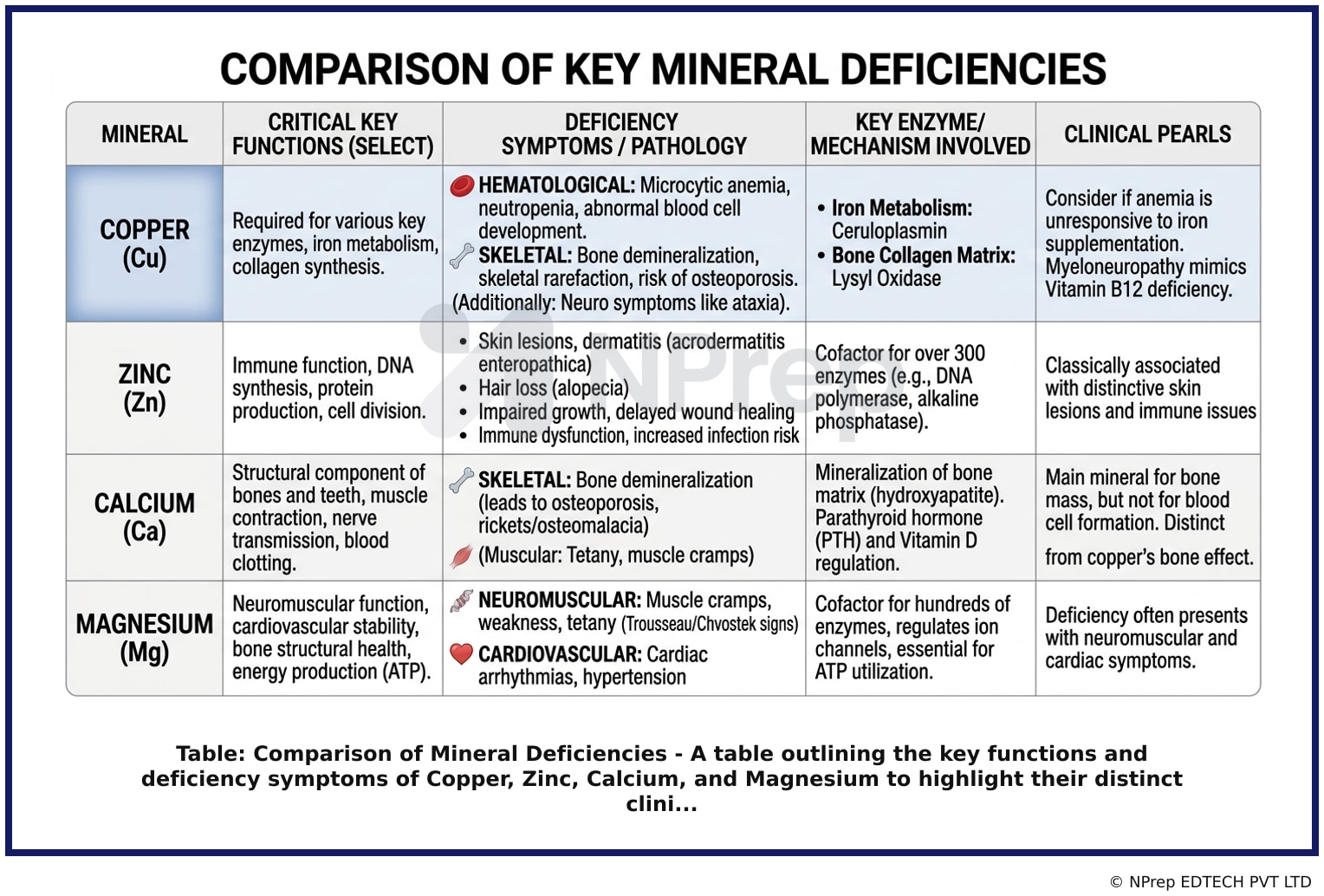
- Visual 1: Table: Comparison of Mineral Deficiencies - A table outlining the key functions and deficiency symptoms of Copper, Zinc, Calcium, and Magnesium to highlight their distinct clinical pictures.
Clinical Relevance
- Nursing practice connection: Knowing Clinical manifestations of mineral deficiencies helps nurses interpret findings accurately and avoid errors in routine assessment, medication administration, and patient teaching.
- Nurses must be vigilant for signs of copper deficiency in at-risk populations, such as patients with malabsorption syndromes (e.g., celiac disease, post-bariatric surgery), infants fed exclusively on cow's milk, and individuals on long-term total parenteral nutrition (TPN) without adequate supplementation.
- The hematological signs of copper deficiency (anemia, neutropenia) can be mistaken for other conditions. If a patient's anemia does not respond to iron supplementation, copper deficiency should be considered as a differential diagnosis.
- What if? If the patient presented with anemia and prominent neurological symptoms like ataxia and peripheral neuropathy (mimicking Vitamin B12 deficiency), copper deficiency would still be a very strong possibility, as it can cause a myeloneuropathy in addition to its hematological and skeletal effects.
How to Approach the Question
- First, break down the question into its two core components: 1) 'abnormal blood cell development' and 2) 'bone demineralization'.
- Next, systematically evaluate each mineral option against both of these criteria.
- Analyze Calcium: You know it's essential for bones, so it fits 'bone demineralization'. However, it's not primarily linked to blood cell formation. This makes it an incomplete match.
- Analyze Magnesium and Zinc: Recall their main roles. Magnesium is crucial for muscle/nerve function, and Zinc is key for skin, immunity, and growth. Neither is known for causing both of the specific problems in the question.
- This process of elimination leaves Copper. Recall or deduce that copper is involved in iron metabolism (affecting blood cells) and connective tissue synthesis (affecting bones), making it the only option that satisfies both conditions.
Concept Tested & Keywords
- Concept Tested: Clinical manifestations of mineral deficiencies.
- Stem keywords: mineral deficiency, abnormal blood cell development, bone demineralization
- Lead-in keywords: Which
Question ID
QavyJchO4SPJq2cSOnqe4J
Practise the full RRB Nsg. Superintendent-20 July 2019 (Shift-3rd)
Attempt every question from this paper in a timed mock, then review the full solution for each one.
More Minerals Questions
- Which food item is rich in iron?
- Zinc deficiency causes, EXCEPT?
- For better iron absorption, which food item is most preferably recommended?
- Which of the following trace elements is essential for the synthesis of insulin?
- Which of the following content increases iron absorption, except?
- Which is a macro-mineral that the body needs to work properly?
- Which of the following foods is the richest source of heme iron?
- How much iodine is needed daily for Growth and Development?
- Osteoporosis is caused by the deficiency of which mineral?
- How much sodium does the human body need in a day?
More RRB Nsg. Superintendent-20 July 2019 (Shift-3rd) Questions
- Where is oxytocin synthesized?
- What is the name of the muscle that extends from the sphenoid bone to the mandible?
- Complementary feeding should be initiated at the completion of \ \ \ \ \ \
- Where is kidney located?
- Psychosocial development stage for infants is \ \ \ \ \ \ \ \ \ \
- What immunization is given at birth?
- Functional nursing is a method of providing
- Which disease is the dementia associated with asymmetric atrophy of the frontal and temporal lobes?
- Thromboangiitis obliterans is also known as
- What is the other name of pyridoxine?