
KGMU 2023
Child Health Nursing (Pediatrics)
Easy
Which gauge of intravenous cannula is most appropriate for delivering IV fluids to a neonate?
Appeared in: KGMU 2023
Explanation
- Neonates have very small, fragile, and superficial veins, making IV access challenging.
- A 24-gauge cannula has a very small diameter, which is ideal for minimizing trauma to the delicate veins of a newborn.
- Using a smaller gauge (larger number) reduces the risk of complications such as phlebitis (vein inflammation) and infiltration (fluid leaking into surrounding tissue).
- The 24 G and 26 G cannulas are the standard of care for providing IV therapy to neonates and infants.
Why Other Options Were Wrong
- Option B: A 20 G cannula is too large for a neonate's veins and would cause significant trauma and likely be impossible to insert.
- Option C: An 18 G cannula is a large-bore catheter that is completely inappropriate for a neonate. It would cause severe damage to the vein and surrounding tissues.
- Option D: A 16 G cannula is one of the largest gauges available and is used for major trauma and rapid resuscitation in adults. It is far too large for a neonate.
Related Visual
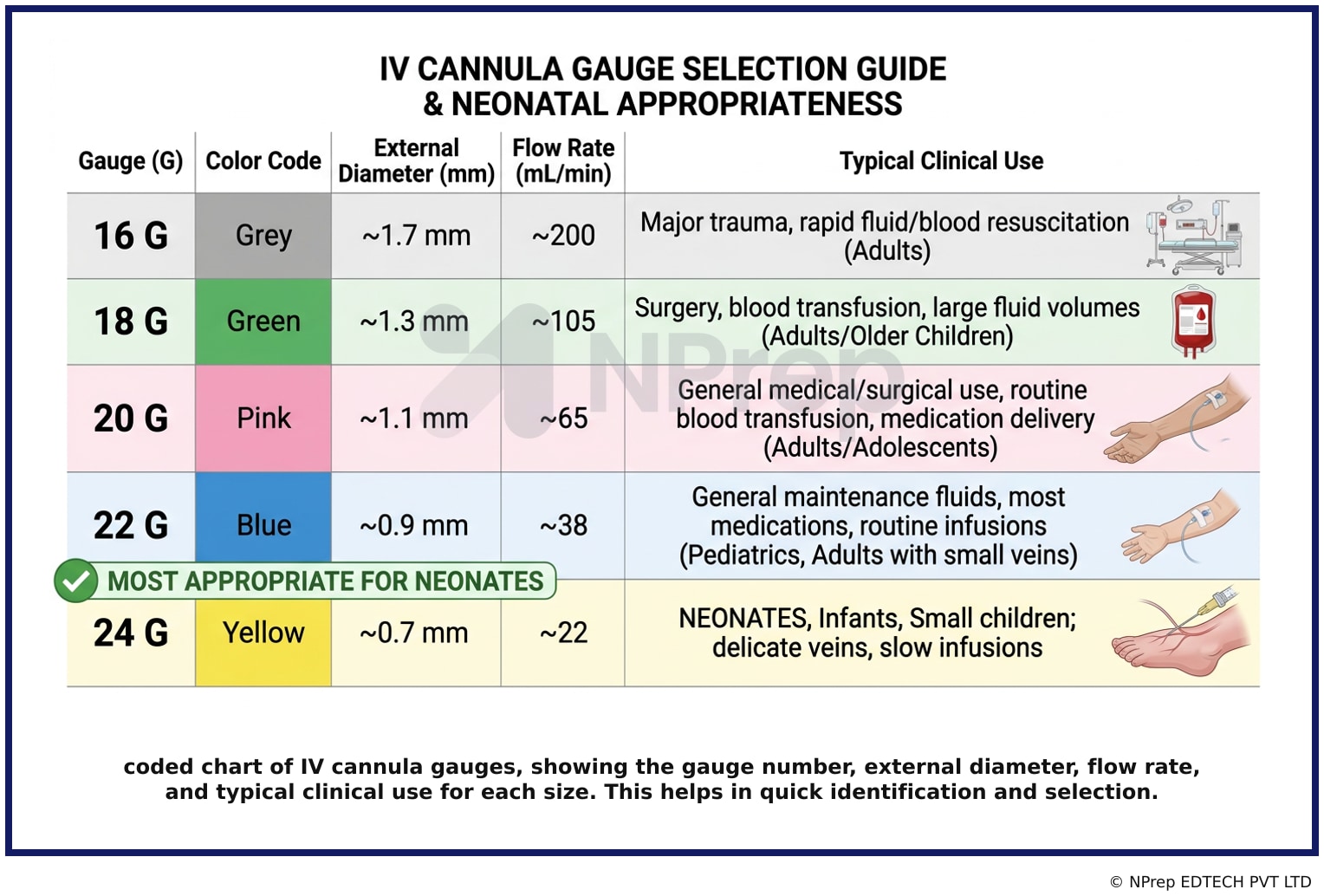
- Visual 1: Chart - A color-coded chart of IV cannula gauges, showing the gauge number, external diameter, flow rate, and typical clinical use for each size. This helps in quick identification and selection.
- Visual 2: Diagram - An illustration comparing the relative sizes of 16G, 18G, 20G, and 24G cannulas to emphasize the significant difference in diameter.
Clinical Relevance
- Nursing practice connection: This is primarily an exam-oriented knowledge point with limited direct bedside application, so retain Selection of appropriate intravenous (IV) cannula gauge for a neonatal patient as background academic context rather than a clinical decision trigger.
- Selecting the correct cannula size is a critical nursing skill that directly impacts patient safety and comfort, especially in vulnerable populations like neonates.
- Improper cannula size can lead to failed IV attempts, causing unnecessary pain and distress to the infant, and can result in serious complications like extravasation of vesicant drugs, leading to tissue necrosis.
- A key patient-safety principle in neonatal care is 'start small.' This applies to medication doses, fluid volumes, and equipment like IV cannulas.
How to Approach the Question
- Identify the key patient characteristic in the question stem: 'neonate'.
- Recall the physiological characteristics of a neonate's vasculature: veins are very small and fragile.
- Understand the principle of IV cannula sizing: the gauge number is inversely related to the cannula's diameter (a higher gauge number means a smaller diameter).
- Apply this principle to the patient: a neonate requires a cannula with a very small diameter to match their vein size and prevent injury.
- Evaluate the options provided. The options are 16 G, 18 G, 20 G, and 24 G.
- Select the option with the highest gauge number, as this corresponds to the smallest cannula diameter, which is the most appropriate choice for a neonate.
Concept Tested & Keywords
- Concept Tested: Selection of appropriate intravenous (IV) cannula gauge for a neonatal patient.
- Stem keywords: intravenous cannula, gauge, neonate, IV fluids
- Lead-in keywords: most appropriate
- Clinical cues: Patient is a neonate, which indicates very small and fragile veins.
Question ID
QR2-DeQcPVGkGcTi0kxTSl
Practise the full KGMU 2023
Attempt every question from this paper in a timed mock, then review the full solution for each one.
More Neonatology Questions
- Which of the following intervention demonstrates the nurse understand about the newborn's thermoregulatory ability?
- A nurse in a delivery room is assisting delivery of a newborn. After delivery, which of the following intervention would be appropriate to prevent he…
- Oxygen toxicity in pre-term babies causes?
- Which of the following injections is routinely administered to a newborn to prevent bleeding?
- The preterm infant's elbow may easily be brought across the chest with no resistance. This is the?
- Newborn maturity rating is done using:
- The nurse evaluates the adequacy of the neonate's oxygen by monitoring?
- Identify the image below, which is used in the NICU during phototherapy?& x20;
- Babies who are born before the end of 37 weeks of gestation and have a normal rate of intrauterine growth are called \ \ \ \ \ \ .
- Preventive method of thick meconium stained liquor is?
More KGMU 2023 Questions
- The teacher scalded Aruna in front of her classmates during Project submission. Conclusion I: Aruna was not as popular as her other classmates. Concl…
- Aruna leaves and goes 8 meters in the North direction from a certain point. Then she turns right and travels for 12 meters. She again turns right and…
- Kiran is Sister of Raj. Raj is Son of Suresh and Vinita is Mother of Suresh then what is relation between Vinita and Kiran?
- A person who lives at the same time with another?
- Select the most appropriate meaning of the below idiom. A black sheep?
- The train has arrived...the station.
- A vendor sold 20 kg of potato at 18 Rs. per kg. He bought 2-liter milk at the rate of 46 Rs./liter, 2 kg sugar at the rate of 35 Rs./kg and 10 packet…
- Which one is the perfect square?
- A is the smallest. C is taller than B and D. E is neither the tallest nor the smallest. Find which one is the tallest?
- From an entrance, a person walks 28 meters left, then turns right and walks 13 meters. They turn right again and walk 12 meters, and then walk 16 met…