
RRB Nsg. Superintendent-20 July 2019 (Shift-3rd)
Applied Physiology
Easy
Which cranial nerve is affected in a Bell's Palsy?
Appeared in: RRB Nsg. Superintendent-20 July 2019 (Shift-3rd)
Explanation
- Bell's Palsy is an idiopathic, acute paralysis affecting the facial nerve (Cranial Nerve VII).
- This condition results in a lower motor neuron lesion, causing weakness or paralysis of all muscles on one side of the face, including the forehead.
- Key signs include facial drooping, inability to close the eye, and disappearance of the nasolabial fold on the affected side.
- It may also be associated with impaired taste, sensitivity to sound (hyperacusis), and pain around the ear.
Why Other Options Were Wrong
- Option A: Cranial nerve IX (Glossopharyngeal) is primarily involved in swallowing, the gag reflex, and taste sensation from the posterior third of the tongue. Its dysfunction does not cause facial paralysis.
- Option B: Cranial nerve IV (Trochlear) is a motor nerve that controls a single eye muscle, the superior oblique. Damage to this nerve affects eye movement, specifically the ability to look down and inward.
- Option D: Cranial nerve XII (Hypoglossal) is a motor nerve that controls the muscles of the tongue. Damage causes the tongue to deviate toward the side of the lesion upon protrusion.
Related Visual
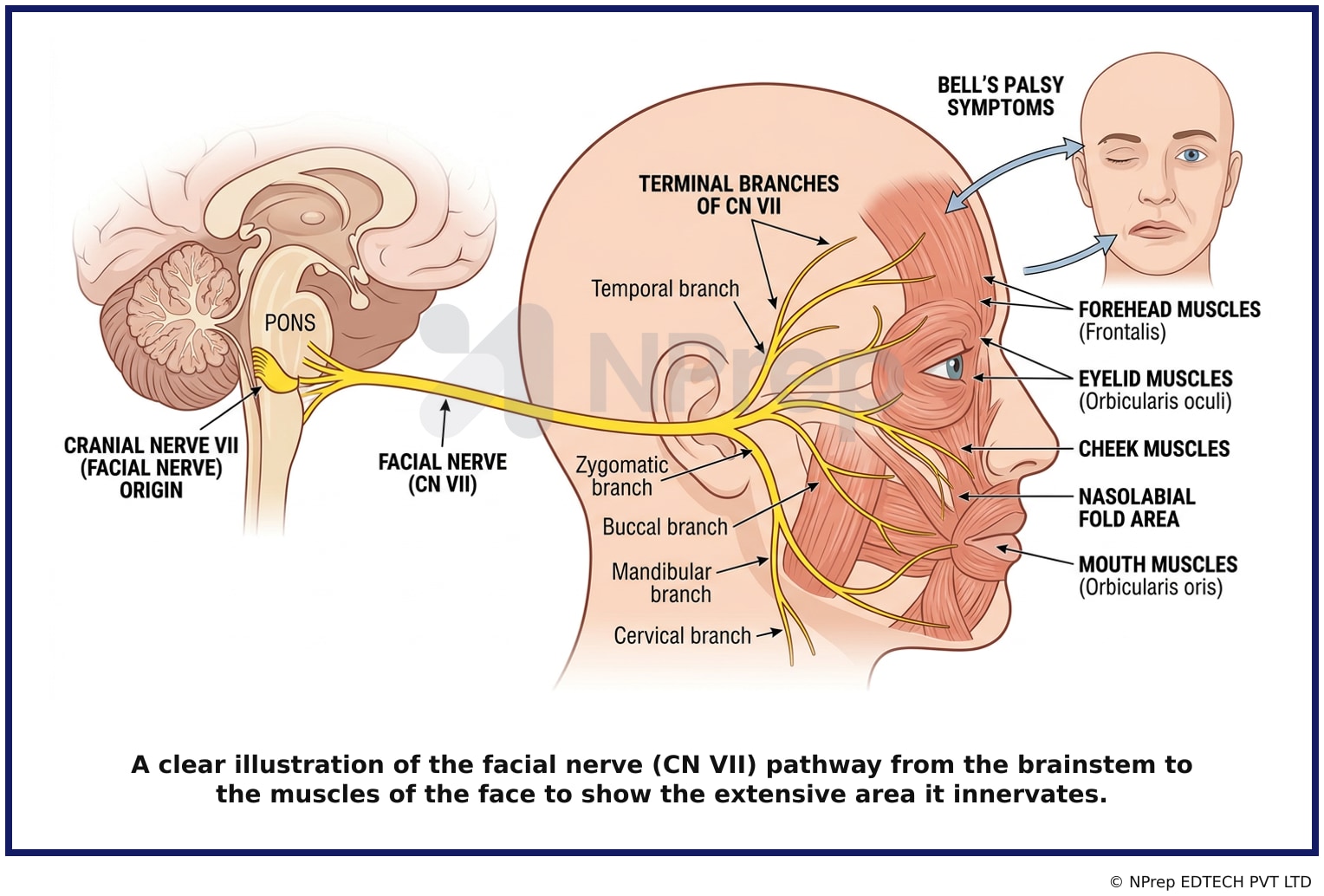
- Visual 1: Diagram - A clear illustration of the facial nerve (CN VII) pathway from the brainstem to the muscles of the face to show the extensive area it innervates.
- Visual 2: Clinical Photo - A comparison of a person's face at rest and while attempting to smile, showing the classic signs of unilateral Bell's Palsy (e.g., drooping mouth, inability to close eye, smooth forehead).
- Visual 3: Flowchart - A simple flowchart differentiating between an upper motor neuron (UMN) and lower motor neuron (LMN) facial palsy, highlighting that Bell's Palsy is an LMN lesion affecting the entire side of the face.
Clinical Relevance
- Nursing practice connection: This is primarily an exam-oriented knowledge point with limited direct bedside application, so retain Identification of the cranial nerve affected in Bell's Palsy as background academic context rather than a clinical decision trigger.
- A primary nursing responsibility for a patient with Bell's Palsy is protecting the affected eye. Since the patient cannot blink or close their eye completely, the cornea is at high risk for drying, ulceration, and injury. Meticulous eye care is crucial.
- Nutritional assessment is important. Difficulty chewing and controlling food in the mouth can lead to poor intake, weight loss, and risk of aspiration. Nurses should provide dietary counseling and strategies for safe eating.
- What if? If the patient's facial weakness only affected the lower part of their face (sparing the forehead), the nurse should suspect an upper motor neuron lesion, such as from a stroke, rather than Bell's Palsy. This is a critical distinction as it points to a central (brain) cause and requires immediate neurological workup.
How to Approach the Question
- First, identify the key pathology mentioned in the question stem, which is "Bell's Palsy".
- Second, access your knowledge of neurological disorders and the cranial nerves.
- Recall the specific cranial nerve associated with Bell's Palsy. This is a direct recall question linking a condition to a specific anatomical structure.
- Systematically review the options provided. Eliminate the nerves whose primary functions do not align with the signs of facial paralysis.
- Confirm your answer by selecting the cranial nerve responsible for innervating the muscles of facial expression.
Concept Tested & Keywords
- Concept Tested: Identification of the cranial nerve affected in Bell's Palsy.
- Stem keywords: Bell's Palsy, cranial nerve
- Lead-in keywords: Which
- Negative lead-in flag: false
Question ID
Q1PTS477-y0TxPBIAK_r6z
Reference Book
Guyton & Hall Textbook of Medical Physiology 13e — Part 2 p. 711-712
Practise the full RRB Nsg. Superintendent-20 July 2019 (Shift-3rd)
Attempt every question from this paper in a timed mock, then review the full solution for each one.
More Nervous System Questions
- One function of parasympathetic nervous system is:
- What is the normal Intracranial pressure?
- Lumbar puncture for adults is done at:
- In healthy adults, the normal plantar flexion causes a:
- Which are the main functions of the hypoglossal nerve?
- Which is mainly responsible for fight (or) flight reactions?
- Nervous tissue is made of \ \ \ \ that receive and conduct impulses
- Which cortical area is responsible for the formulation of speech?
- Which reflex should check when death of the brain stem occurs, except?
- A patient is not able to sleep. On duty nurse what will suggest to do him?
More RRB Nsg. Superintendent-20 July 2019 (Shift-3rd) Questions
- Where is oxytocin synthesized?
- What is the name of the muscle that extends from the sphenoid bone to the mandible?
- Complementary feeding should be initiated at the completion of \ \ \ \ \ \
- Where is kidney located?
- Psychosocial development stage for infants is \ \ \ \ \ \ \ \ \ \
- What immunization is given at birth?
- Functional nursing is a method of providing
- Which disease is the dementia associated with asymmetric atrophy of the frontal and temporal lobes?
- Thromboangiitis obliterans is also known as
- What is the other name of pyridoxine?