
BTSC Staff Nurse 1 August-2025
Obstetrics & Gynaecology
Easy
When does the external rotation of a newborn usually occur in the birth process?
Appeared in: BTSC Staff Nurse 1 August-2025
Explanation
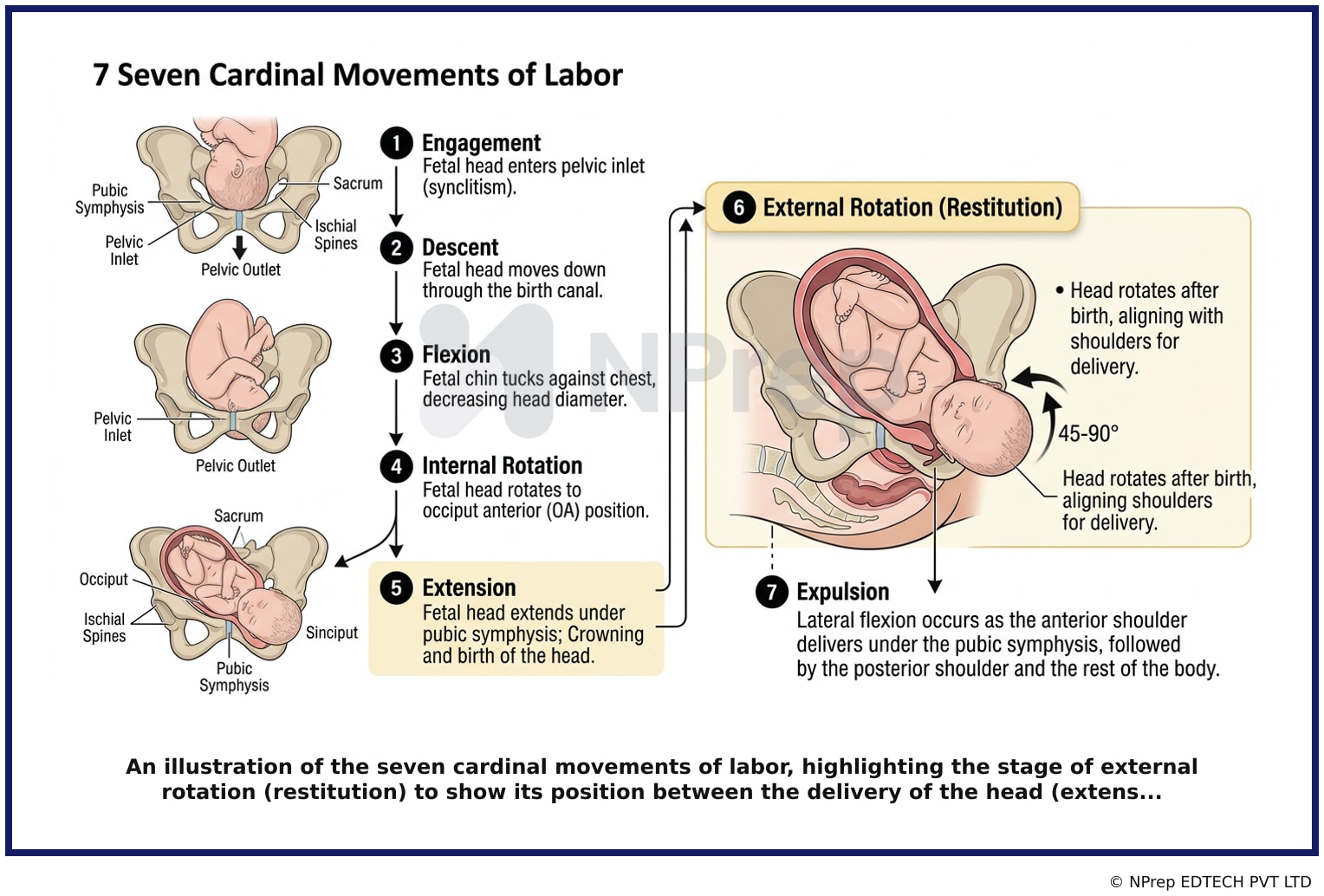
- The correct option describes that external rotation occurs after the head is born but before the delivery of the shoulders.
- This movement, also called restitution, involves the fetal head rotating back to its original position in alignment with the fetal back and shoulders.
- This rotation is necessary for the shoulders to align with the anteroposterior diameter of the pelvic outlet, which is the largest diameter, facilitating their passage.
- As described in Williams Obstetrics, after the head is delivered, it undergoes restitution, which aligns the shoulders for delivery, followed by the expulsion of the rest of the body.
Why Other Options Were Wrong
- Option A: This is incorrect. The delivery of the entire baby is the final step, known as expulsion, which occurs after external rotation and the delivery of the shoulders.
- Option B: This is incorrect. Engagement is one of the first cardinal movements, where the fetal head enters the pelvic inlet. External rotation happens much later in the process.
- Option C: This is incorrect. Internal rotation happens before the head is delivered. It is followed by extension and crowning, which result in the birth of the head. External rotation occurs only after the head is completely out.
Related Visual
Clinical Relevance
- Nursing practice connection: This is primarily an exam-oriented knowledge point with limited direct bedside application, so retain The concept tested is the sequence of the cardinal movements of labor, specifically the timing of external rotation (restitution) as background academic context rather than a clinical decision trigger.
- Understanding the cardinal movements of labor is fundamental for nurses and midwives to accurately assess labor progress and identify abnormalities.
- Failure of the head to undergo spontaneous external rotation after delivery is a key warning sign of shoulder dystocia, an obstetric emergency where the anterior shoulder is impacted behind the pubic symphysis.
- A nurse observing the absence of restitution should immediately alert the provider and prepare for shoulder dystocia maneuvers, such as the McRoberts maneuver and suprapubic pressure.
How to Approach the Question
- This is a process-based recall question that tests your knowledge of the sequence of events in childbirth.
- First, identify the core concept being asked: the timing of 'external rotation' within the birth process.
- Recall or visualize the seven cardinal movements of labor in their correct order: Engagement, Descent, Flexion, Internal Rotation, Extension, External Rotation, and Expulsion.
- Locate 'External Rotation' in this sequence. It occurs after 'Extension' (the delivery of the head) and before 'Expulsion' (the delivery of the shoulders and body).
- Evaluate each option against this established sequence. Option A is too late, Option B is too early, and Option C describes events that happen before the head is even born.
- Select the option that accurately places external rotation after the head is delivered but before the shoulders emerge.
Concept Tested & Keywords
- Concept Tested: The concept tested is the sequence of the cardinal movements of labor, specifically the timing of external rotation (restitution).
- Stem keywords: external rotation, newborn, birth process
- Lead-in keywords: When does
Question ID
QBpQ2nBRrjVnx8_fZy_ZYz
Reference Book
E6 Obstetrics Williams pp. 20-38, 27-45
Practise the full BTSC Staff Nurse 1 August-2025
Attempt every question from this paper in a timed mock, then review the full solution for each one.
More Normal Labor Questions
- At how much interval BP measurement for a mother should be done during second stage of labor?
- How long do contractions last during second stage of labor at an interval of 3-5 minutes of rest?
- Braxton-Hicks are:-
- The third stage of labour comprises:-
- According to the World Health Organization (WHO), which of the following is recommended in the management of the second stage of labor?
- The process by which muscular fibres of the cervix are pulled upwards and merged with the fibres of the lower uterine segment is known as
- What reflex is an expulsive uterine contraction experienced by the mother during labor?
- Episiotomy should be done at?
- The second stage of labor starts?
- A newborn's assessment at 1 minute include muscle tone moderately active, body pink extremity blue, well cry, heart rate 110. Calculate the APGAR sco…
More BTSC Staff Nurse 1 August-2025 Questions
- Dextrose 5% in water (D5W) is classified as which type of intravenous (IV) fluid?
- What does 'I' stand for in the SOAPIE progress notes format used for documentation?
- Hirschsprung disease is associated with a defect in which of the following developmental processes involving the enteric nervous system?
- What is FFQ in the context of dietary assessment tools?
- Formulating a family health and nursing care plan comes under which phase of the Nursing Process?
- What is the indication for aversion therapy?
- Which of the following is NOT a typical symptom of somatoform autonomic disorder?
- Which neurological disease can be caused by the prolonged consumption of khesari dal over a period of 2-6 months?
- Which of the following principles is primarily followed when transferring a patient onto a stretcher using a blanket (blanket lift)?
- Which of the following is a primary benefit of using Electronic Health Records (EHR) in patient care?