
KGMU 2023
Applied Microbiology & Infection control
Easy
What is the correct standard method for the short-term storage of microbiological specimens such as urine, stool, and swabs?
Appeared in: KGMU 2023
Explanation
- The standard method for short-term preservation of common microbiological specimens (urine, stool, swabs) is refrigeration at 2-8°C, with 4°C being a common set point.
- Refrigeration slows down the metabolic rate of bacteria, which prevents the rapid overgrowth of commensal (normal flora) organisms.
- This preservation method ensures that the viability of potential pathogens is maintained without altering the original microbial balance in the sample, leading to more accurate diagnostic culture results.
- Specimens like urine can be stored for up to 24 hours at 4°C, and stool for up to 72 hours at 4°C, if immediate processing is not possible.
Why Other Options Were Wrong
- Option A: Freezing at -80°C is a method for long-term preservation (archiving) of pure bacterial isolates or viruses, not for short-term storage of clinical specimens. The process of freezing and thawing can damage or kill many types of bacterial cells, leading to a false-negative culture.
- Option C: Storing specimens at room temperature (around 25°C) allows for the rapid and uncontrolled multiplication of bacteria. This can cause commensal organisms to overgrow the actual pathogens, making isolation and identification difficult or impossible.
- Option D: An incubator at 37°C is used to actively grow bacteria on culture plates in the laboratory. Placing a raw specimen directly in an incubator would promote rapid, non-selective growth of all bacteria present, spoiling the sample for diagnostic purposes.
Related Visual
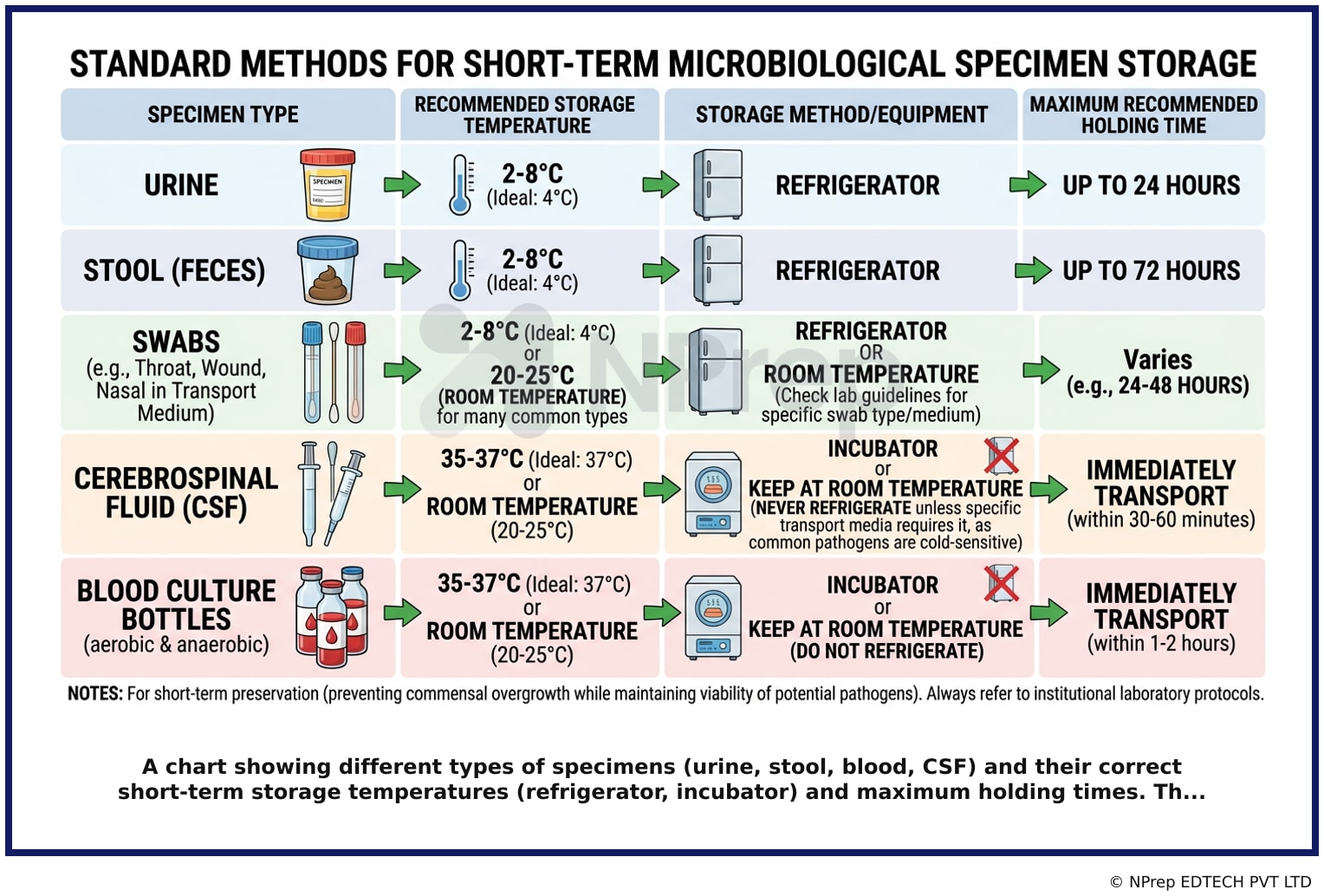
- Visual 1: Infographic - A chart showing different types of specimens (urine, stool, blood, CSF) and their correct short-term storage temperatures (refrigerator, incubator) and maximum holding times. This visually reinforces the correct procedures for each specimen type.
Clinical Relevance
- Nursing practice connection: This is primarily an exam-oriented knowledge point with limited direct bedside application, so retain Short-term storage of microbiological specimens as background academic context rather than a clinical decision trigger.
- Proper specimen handling is a critical nursing responsibility that directly impacts diagnostic accuracy and patient treatment. An incorrect storage method can lead to a missed diagnosis or inappropriate antibiotic therapy.
- Nurses must ensure that specimens are labeled correctly and transported to the lab promptly. If a delay is unavoidable, the nurse is responsible for storing the specimen at the correct temperature.
- What if? If a urine sample for culture is left at room temperature for 4 hours before being sent to the lab, the bacterial count could be falsely elevated due to the multiplication of contaminants, potentially leading to a misdiagnosis of a urinary tract infection and unnecessary antibiotic treatment.
How to Approach the Question
- First, identify the core question: It asks for the 'standard method' for 'short-term storage' of common microbiological samples (urine, stool, swabs).
- Think about the goal of short-term storage: to preserve the sample as it is, without letting bacteria die or multiply.
- Evaluate the temperature options based on this goal:
- -80°C (freezer): This is extreme cold, likely for long-term preservation, and might kill bacteria.
- 37°C (incubator): This is body temperature, ideal for growing bacteria, not preserving a sample.
- 25°C (room temp): This is warm enough for many bacteria to multiply, which would alter the sample.
Concept Tested & Keywords
- Concept Tested: Short-term storage of microbiological specimens
- Stem keywords: short-term storage, microbiological specimens, urine, stool, swabs
- Lead-in keywords: correct standard method
- Negative lead-in flag: false
Question ID
Qa5YB5aZPdbrBvd7Ks-Zv_
Practise the full KGMU 2023
Attempt every question from this paper in a timed mock, then review the full solution for each one.
More Review of Specimen Collection Questions
- Wound culture sample should be taken from?
- In case of delay in transportation of cerebrospinal fluid (CSF) sample, it should be?
- What is the full form of 'VTM' in microbiology?
- Regarding COVID-19, which one is not correct?
- Specimen required for the diagnosis of Swine Flu is:
- What type of sample can be used to isolate polio virus?
- Which was the first vaccine prepared by India for COVID-19?
- Which is a most reliable method for collection of urine?
- For optimal results in microbial examination, when is the most appropriate time to collect a specimen?
- Which first vaccine prepared by India for COVID-19?
More KGMU 2023 Questions
- The teacher scalded Aruna in front of her classmates during Project submission. Conclusion I: Aruna was not as popular as her other classmates. Concl…
- Aruna leaves and goes 8 meters in the North direction from a certain point. Then she turns right and travels for 12 meters. She again turns right and…
- Kiran is Sister of Raj. Raj is Son of Suresh and Vinita is Mother of Suresh then what is relation between Vinita and Kiran?
- A person who lives at the same time with another?
- Select the most appropriate meaning of the below idiom. A black sheep?
- The train has arrived...the station.
- A vendor sold 20 kg of potato at 18 Rs. per kg. He bought 2-liter milk at the rate of 46 Rs./liter, 2 kg sugar at the rate of 35 Rs./kg and 10 packet…
- Which one is the perfect square?
- A is the smallest. C is taller than B and D. E is neither the tallest nor the smallest. Find which one is the tallest?
- From an entrance, a person walks 28 meters left, then turns right and walks 13 meters. They turn right again and walk 12 meters, and then walk 16 met…