
AIIMS Jodhpur SNO-2023
Applied Microbiology & Infection control
Medium
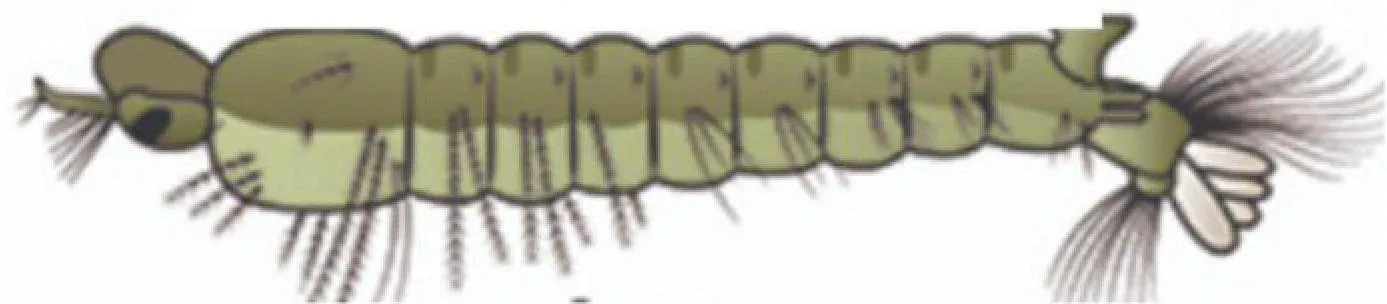 Water surface Identify the larva of the mosquito shown in the given picture.
Appeared in: AIIMS Jodhpur SNO-2023
Explanation
- The larva shown in the image is correctly identified as Culex.
- The key distinguishing feature is the presence of a long, slender respiratory siphon at the posterior end of its body.
- This siphon is used for breathing at the water's surface, which causes the larva to hang at an angle with its head downwards.
- The presence of a siphon immediately rules out Anopheles, and the long, slender nature of the siphon is characteristic of Culex, distinguishing it from Aedes.
Why Other Options Were Wrong
- Option A: Mansonia larvae have a specialized, pointed siphon that is adapted to pierce the roots and stems of aquatic plants to obtain oxygen, rather than breathing at the water's surface. The larva in the image does not show this type of specialized siphon.
- Option B: Aedes larvae, while also possessing a siphon and hanging at an angle in the water, are characterized by a siphon that is short and stout (barrel-shaped). The larva in the image clearly has a long and slender siphon.
- Option C: Anopheles larvae are unique in that they lack a respiratory siphon altogether. They breathe through spiracular openings on their abdomen, which requires them to lie flat and parallel to the water's surface.
Related Visual

- Visual 1: Diagram - A comparative chart showing the larvae of Anopheles, Culex, and Aedes. The diagram should clearly illustrate the presence/absence of the siphon, the shape of the siphon, and the corresponding resting position of each larva in the water.
- Visual 2: Infographic - The life cycle of the Culex mosquito, highlighting the egg, larva, pupa, and adult stages, with a focus on the larval habitat (stagnant, dirty water).
Clinical Relevance
- Nursing practice connection: This is primarily an exam-oriented knowledge point with limited direct bedside application, so retain Identification of mosquito larvae based on morphological features as background academic context rather than a clinical decision trigger.
- Identifying mosquito genera is critical for public health and disease control, as different types of mosquitoes are vectors for different diseases.
- Culex mosquitoes are primary vectors for diseases like Japanese Encephalitis, West Nile Fever, and Bancroftian filariasis (Elephantiasis).
- Knowing the type of mosquito larva prevalent in an area helps community health nurses and officials to predict disease outbreaks and implement targeted control measures (e.g., managing stagnant drains for Culex vs. cleaning stored water containers for Aedes).
How to Approach the Question
- First, carefully observe the image of the mosquito larva provided.
- Focus on the key anatomical features, especially at the posterior (tail) end. Ask yourself: 'Is there a breathing tube (siphon)?'
- If a siphon is present, note its characteristics: Is it long or short? Slender or stout?
- The larva in the image clearly has a long, slender siphon.
- Compare this observation with the known characteristics of the larvae listed in the options: Anopheles (no siphon), Aedes (short, stout siphon), Mansonia (piercing siphon), and Culex (long, slender siphon).
- The visual evidence directly matches the description of a Culex larva, making it the correct answer.
Concept Tested & Keywords
- Concept Tested: Identification of mosquito larvae based on morphological features.
- Stem keywords: mosquito larva, identify, picture
- Lead-in keywords: Identify
Question ID
Q6ONB0h-Ng0IxAJkhhsaVu
Practise the full AIIMS Jodhpur SNO-2023
Attempt every question from this paper in a timed mock, then review the full solution for each one.
More Pathogenic Organisms Questions
- An acid-fast bacillus which is pathogenic:
- Causative organism of infectious mononucleosis is:
- Which among the following is a Gram-positive organism?
- What is the causative organism for Syphilis?
- Who discovered virus in biology?
- Which vector causes Zika virus disease?
- All of the following diseases caused by viruses, except?
- What does SARS stand for?
- What is the name of the organism responsible for tuberculosis?
- What causes the spread of chickenpox?
More AIIMS Jodhpur SNO-2023 Questions
- A short-term goal for a patient with Alzheimer's disease is:
- The primary fever in malaria corresponding to the development of the parasites in the red blood cells comprise all of the following EXCEPT:
- Second component (other than NST) in Modified Biophysical Profile is:
- What is the best position for a patient in anaphylactic shock?
- The year 2023 has been declared as The International Year of:
- Low molecular weight heparin should be administered:
- Epigenic factors play an important role in schizophrenia. In genetically vulnerable people, environmental factors may increase the risk and trigger s…
- Identify the contraceptive device shown in the given picture.
- A nurse posted in a paediatric cardiology unit noted that the assessment findings of an infant reveal a continuous machinery murmur on the auscultati…
- At the Central level, the Union Ministry of Health and Welfare is headed by a Cabinet Minister, a Minister of State and a Deputy Health Minister. The…