
NVS- 2025
Applied Physiology
Easy
The sum of residual volume and expiratory reserve volume is:
Appeared in: NVS- 2025
Explanation
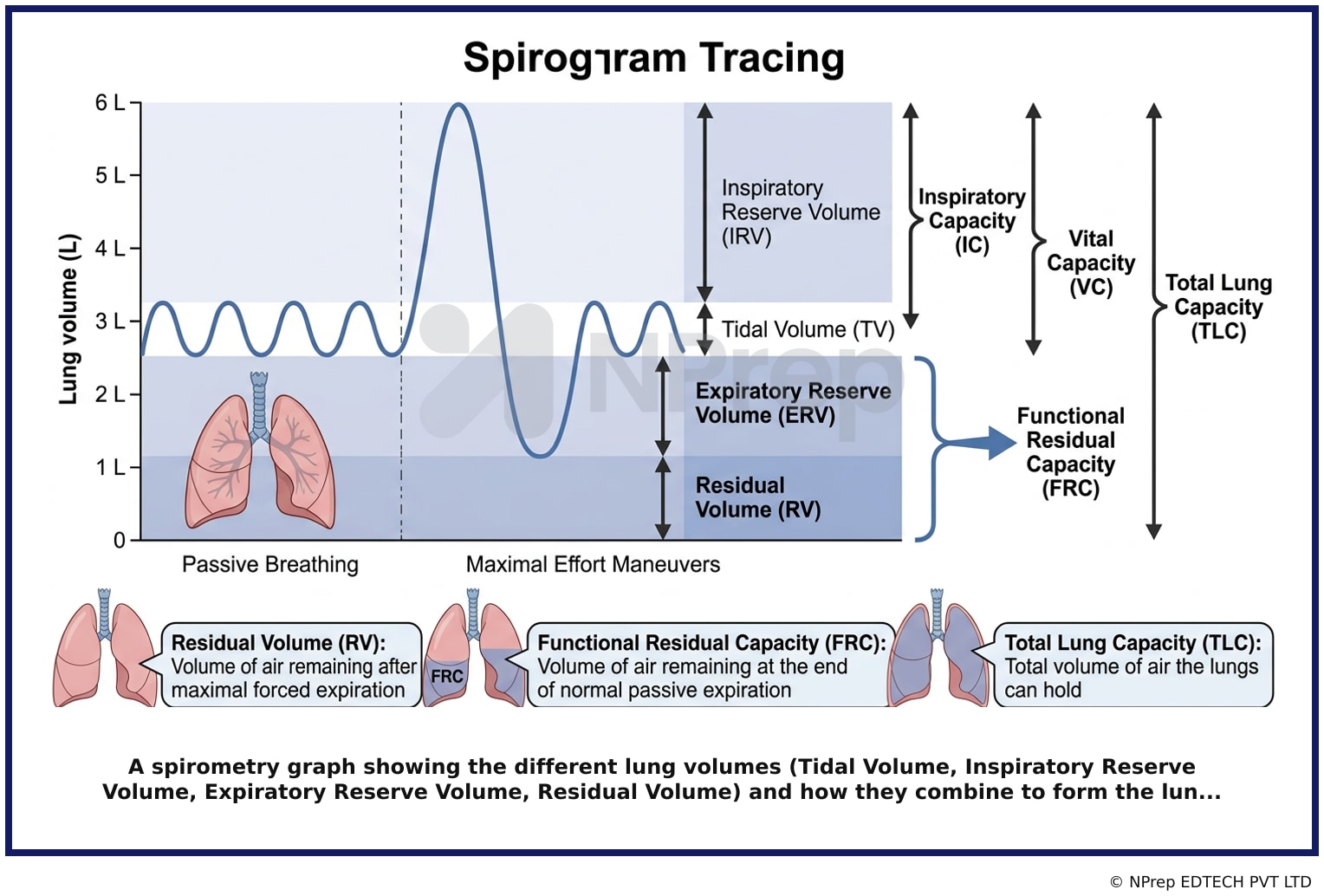
- Functional Residual Capacity (FRC) is defined as the volume of air remaining in the lungs at the end of a normal, passive expiration.
- It is calculated by adding the Expiratory Reserve Volume (ERV) and the Residual Volume (RV).
- FRC represents the equilibrium point where the outward elastic recoil of the chest wall is balanced by the inward elastic recoil of the lungs.
- This volume of air acts as a crucial buffer, preventing drastic fluctuations in alveolar oxygen and carbon dioxide levels with each breath.
Why Other Options Were Wrong
- Option A: Vital Capacity is the total amount of air that can be forcibly exhaled after a maximal inhalation, not the air remaining after a normal breath.
- Option B: Total Lung Capacity is the entire volume of air the lungs can possibly hold, including the air taken in during a maximal inhalation.
- Option D: Inspiratory Capacity is the maximum amount of air that can be inhaled starting from the end of a normal exhalation.
Related Visual
Clinical Relevance
- Nursing practice connection: This is primarily an exam-oriented knowledge point with limited direct bedside application, so retain Definitions and components of pulmonary lung capacities as background academic context rather than a clinical decision trigger.
- FRC is a key parameter in assessing respiratory function. A decreased FRC, seen in conditions like obesity, ascites, or restrictive lung diseases (e.g., fibrosis), can lead to airway closure and impaired gas exchange.
- An increased FRC is a hallmark of obstructive lung diseases like emphysema and chronic bronchitis, where air trapping occurs due to loss of elastic recoil or airway obstruction.
- In critical care, nurses manage ventilator settings, particularly Positive End-Expiratory Pressure (PEEP), to optimize a patient's FRC, which helps improve oxygenation and prevent ventilator-induced lung injury.
How to Approach the Question
- First, identify the keywords in the question: 'sum', 'residual volume', and 'expiratory reserve volume'.
- This is a factual recall question requiring knowledge of respiratory physiology definitions.
- Recall the definitions of the four main lung capacities: Vital Capacity, Total Lung Capacity, Functional Residual Capacity, and Inspiratory Capacity.
- Mentally formulate the equation for each capacity. For example, FRC = ERV + RV.
- Match the combination given in the question ('Residual Volume + Expiratory Reserve Volume') to its corresponding capacity.
- Select the option that correctly names this combination.
Concept Tested & Keywords
- Concept Tested: Definitions and components of pulmonary lung capacities.
- Stem keywords: residual volume, expiratory reserve volume, sum
- Lead-in keywords: is
Question ID
QNTbPChxXn5xq_mo6ORtVb
Reference Book
E6 Physiology Guyton 4SAE Part 2A p. 56-58
Practise the full NVS- 2025
Attempt every question from this paper in a timed mock, then review the full solution for each one.
More Respiratory system Questions
- Temporary cessation of breathing is:
- Functions of bartholin's glands?
- An example of an aerobic exercise is:
- The volume of air normally inhaled and exhaled with each regular breath is called:
- The Lung Volume / Capacity that does not change with pulmonary disease is:
- What is the approximate maximum air volume in the lung for a normal healthy adult?
- Lack of oxygen in the blood stream is called?
- Breathing that is normal in rate and depth is called?
- Isotonic exercises such as walking are intended to?
- Muscle of inspiration is?
More NVS- 2025 Questions
- The daily recommended intake of vitamin A for adults:
- A single rescuer performs both artificial respiration and compression at the ratio of:
- Semen has a pH of:
- Which of the following indicates ventricular repolarization?
- The World Health Organization (WHO) defined how many moments for hand hygiene?
- Which theory conceptualizes that the emotions result from our perception of the changes taking place in the body during emotional experience?
- Phallic stage of psychosexual development as per Sigmund Freud:
- Damage of which region of brain markedly impairs the understanding of speech and written language?
- The mechanism of ATP generation that links chemical reaction with pumping of hydrogen ions is called:
- The chamber of the heart with the thickest myocardium