
MP NHM CHO-2024 (Shift-1)
Nursing Foundation
Easy
The methods to calculate paediatric doses of drug administration are:
A. Body weight method
B. Body surface area method
C. Body height method
Appeared in: MP NHM CHO-2024 (Shift-1)
Explanation
- Pediatric drug doses are most commonly calculated based on the child's body weight (mg/kg) or body surface area (BSA) in m².
- The body weight method is practical and the most commonly used method for many medications.
- The BSA method is considered more accurate as it correlates better with physiological functions and is preferred for potent drugs like chemotherapy agents.
- Height is a variable used to calculate BSA but is not a standalone method for dose calculation.
Why Other Options Were Wrong
- Option A: This is incomplete. While the body weight method is very common, the body surface area (BSA) method is also a standard and often more accurate method.
- Option C: This is incomplete. The body weight method is also a standard and is, in fact, more frequently used for general medications than the BSA method.
- Option D: Body height alone is not a method for calculating drug dosages. It is a variable used in the formula to determine Body Surface Area (BSA), but it is not a direct calculation method itself.
Related Visual
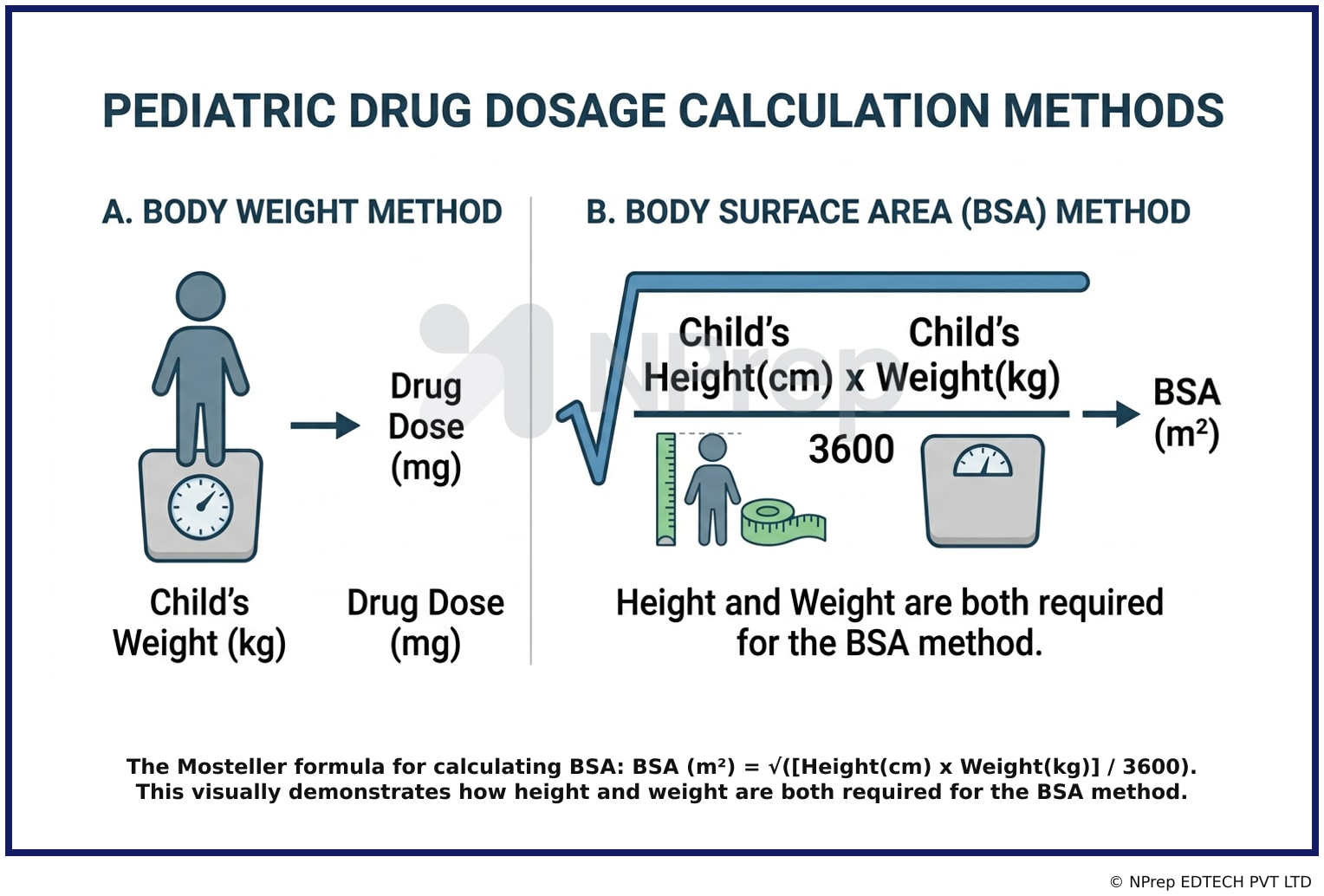
- Visual 1: Formula - The Mosteller formula for calculating BSA: BSA (m²) = √([Height(cm) x Weight(kg)] / 3600). This visually demonstrates how height and weight are both required for the BSA method.
- Visual 2: Infographic - A comparison chart showing the pros and cons of the Body Weight vs. BSA methods, highlighting when each is preferred.
Clinical Relevance
- Nursing practice connection: Knowing Pediatric Drug Dosage Calculation Methods helps nurses interpret findings accurately and avoid errors in routine assessment, medication administration, and patient teaching.
- Accurate dosage calculation is a critical patient safety measure in pediatrics to prevent under-dosing (leading to therapeutic failure) or over-dosing (leading to toxicity).
- Always double-check calculations, especially for high-alert medications. Many hospital policies mandate a second nurse verification for pediatric doses.
- What if? If a child is obese, the BSA method is often preferred over the body weight method because it can provide a more accurate dose that avoids potential overdosing based on weight alone.
How to Approach the Question
- Read the question to identify the core concept: methods for pediatric dose calculation.
- Evaluate each statement (A, B, C) based on standard nursing pharmacology principles.
- Recall that body weight (mg/kg) is a very common and standard method.
- Recall that Body Surface Area (BSA) is another, more precise method, especially for certain drugs.
- Recognize that height is used to calculate BSA but is not a standalone method for drug dosing.
- Analyze the options to find the one that correctly combines the valid methods (A and B) and excludes the invalid one (C).
Concept Tested & Keywords
- Concept Tested: Pediatric Drug Dosage Calculation Methods
- Stem keywords: paediatric doses, drug administration, calculate
- Lead-in keywords: methods
- Negative lead-in flag: false
Question ID
Q_XPDYsRPjPnCWBO8l0-Kx
Reference Book
Potter & Perry Fundamentals of Nursing 9th Edition — Part 1 p. 243-254
Practise the full MP NHM CHO-2024 (Shift-1)
Attempt every question from this paper in a timed mock, then review the full solution for each one.
More Administration of medications Questions
- Which is the appropriate site to administer Intramuscular injections in children?
- The route of Mantoux skin test is:
- What is the size of needle for Intramuscular (IM) injection in adults?
- You are administering an intravenous medication to a patient, and the medication label instructs you to infuse 50 mL over 15 minutes. What is the cor…
- A physician orders a medication to be administered to a patient in a dose of 200mg twice daily (BD). The pharmacy provides tablets of the medication,…
- Desired dose of Morphine for a patient is 0.4 mg. Dose available is 1 mg/mL. The correct formulation for this patient is:
- Cefuroxime sodium, 1 g in 50 mL normal saline (NS), is to be administered over 30 minutes to a client with an infection. The drop factor is 15 drops…
- To ensure accurate medication administration and prevent errors, what is the most comprehensive method for verifying a patient's identity?
- Maximum chance of sciatic nerve injury during which site of I.M injection?
- Identify route of drug administration:
More MP NHM CHO-2024 (Shift-1) Questions
- Which of the following is a part of a dorsal cavity?
- The electron flow in the electron transport chain results in the pumping of protons from the matrix into the \ \ \ \ .
- Fibrinogen helps in \ \ \ \ \ \ \ \ .
- A characteristic of afibrinogenemia is the \ \ \ \ .
- Which is NOT a symptom associated with Crohn's disease?
- Which of the following is not one of the four mechanisms for temperature regulation?
- Where does a neuron receive input from other cells?
- The contraction phase of heart which leads to the ejection of blood into the arteries is called \ \ \ .
- Name the reflex action in which the flexer muscle contracts and the extensor muscle relax in withdrawing limb?
- Which structure is considered as a special nose for detecting chemical signals, facilitating the sense of smell?