
RRB Nsg. Superintendent-20 July 2019 (Shift-3rd)
Mental Health Nursing
Easy
The memory disorder that affects older adults is ______
Appeared in: RRB Nsg. Superintendent-20 July 2019 (Shift-3rd)
Explanation
- Dementia is a general term for a progressive and irreversible decline in intellectual functions, including memory, thinking, and language.
- It is not a normal part of aging, but its prevalence increases significantly with age, affecting a large percentage of the elderly population.
- Alzheimer's disease is the most common cause of dementia.
- Unlike delirium, consciousness is typically not affected in the early to moderate stages of dementia.
Why Other Options Were Wrong
- Option A: Insomnia is a sleep disorder characterized by difficulty initiating or maintaining sleep. While it can affect cognitive performance, it is not a primary memory disorder.
- Option C: Dyspnoea is the medical term for shortness of breath. It is a symptom of respiratory or cardiac disease, not a cognitive or memory disorder.
- Option D: Dystrophy refers to the progressive degeneration of a tissue or organ. A common example is muscular dystrophy, which affects muscle tissue, not cognitive function.
Related Visual
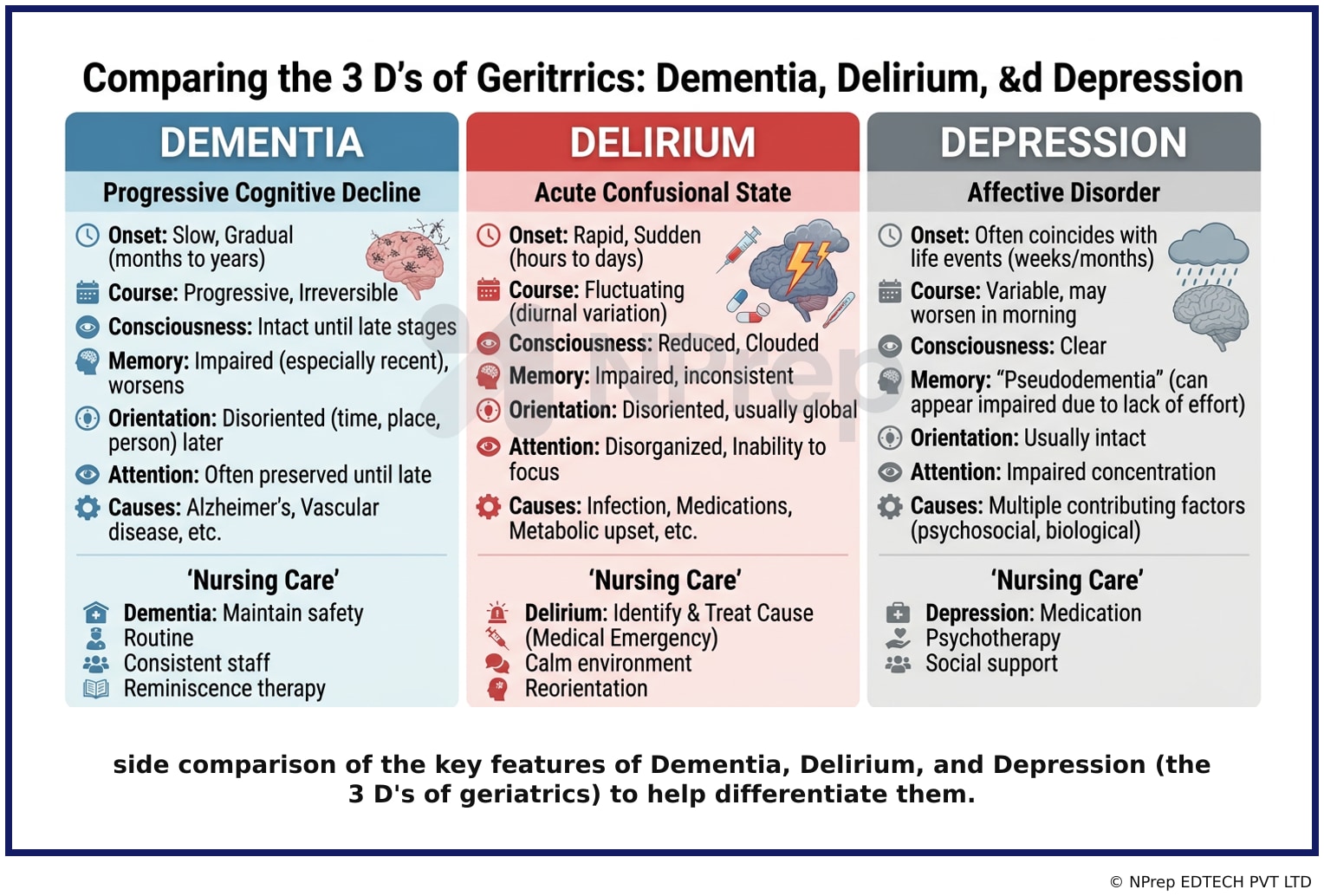
- Visual 1: Infographic - A side-by-side comparison of the key features of Dementia, Delirium, and Depression (the 3 D's of geriatrics) to help differentiate them.
- Visual 2: Diagram - A simplified illustration showing the progressive brain atrophy in Alzheimer's disease compared to a healthy brain, highlighting the shrinkage of the hippocampus.
Clinical Relevance
- Nursing practice connection: This is primarily an exam-oriented knowledge point with limited direct bedside application, so retain Identification of common memory disorders in the geriatric population as background academic context rather than a clinical decision trigger.
- Nurses play a crucial role in the early detection of cognitive changes in older adults by using screening tools like the Mini-Mental State Examination (MMSE) or the Montreal Cognitive Assessment (MoCA).
- For patients with dementia, ensuring safety is a top priority. This includes implementing fall precautions, preventing wandering, and managing behavioral symptoms like agitation.
- It is vital for nurses to differentiate between dementia and delirium, as delirium is often a medical emergency caused by an underlying acute issue (like an infection or medication side effect) and is frequently reversible with prompt treatment.
How to Approach the Question
- First, analyze the question to identify the key concepts: 'memory disorder' and 'older adults'.
- Next, evaluate each option based on its medical definition.
- Option A, Insomnia, is a sleep disorder.
- Option C, Dyspnoea, is difficulty breathing.
- Option D, Dystrophy, is tissue degeneration.
- Option B, Dementia, is a well-known syndrome involving memory loss that primarily affects the elderly.
Concept Tested & Keywords
- Concept Tested: Identification of common memory disorders in the geriatric population.
- Stem keywords: memory disorder, older adults
- Lead-in keywords: BEST, MOST RELEVANT CLUE
- Negative lead-in flag: false
Question ID
QRxaGr1jo6jRcbHCSk0Wrj
Practise the full RRB Nsg. Superintendent-20 July 2019 (Shift-3rd)
Attempt every question from this paper in a timed mock, then review the full solution for each one.
More Organic Brain Disorders Questions
- A patient admitted in a ward with the diagnosis of delirium. In first 24 to 48 hours what nurse plan according to priority:
- Which of the following are the causes of delirium?
- What is the most common cause of delirium in older adults?
- Most common cause of delirium in elderly person?
- An example of acute organic mental disorder?
- What is "sun drowning"?
- Which of the following features is present only in Dementia when compared with Delirium?
- A nurse enters the room of a patient with a cognitive impairment disorder and asks what day of the week it is; what the date, month and year are; and…
- A 75-year-old patient has dementia of the Alzheimer's type and confabulates. A nurse should understand that this patient?
- A 54-year-old male patient admitted with memory impairment. His Mini-Mental State Examination (MMSE) score ranges from 10 - 18 points, which indicate…
More RRB Nsg. Superintendent-20 July 2019 (Shift-3rd) Questions
- Where is oxytocin synthesized?
- What is the name of the muscle that extends from the sphenoid bone to the mandible?
- Complementary feeding should be initiated at the completion of \ \ \ \ \ \
- Where is kidney located?
- Psychosocial development stage for infants is \ \ \ \ \ \ \ \ \ \
- What immunization is given at birth?
- Functional nursing is a method of providing
- Which disease is the dementia associated with asymmetric atrophy of the frontal and temporal lobes?
- Thromboangiitis obliterans is also known as
- What is the other name of pyridoxine?