
RRB Nsg. Superintendent-20 July 2019 (Shift-3rd)
General Knowledge
Easy
The force acting on a unit area of a surface is called
Appeared in: RRB Nsg. Superintendent-20 July 2019 (Shift-3rd)
Explanation
- Pressure is the correct term for the force exerted on a specific area.
- The formula for pressure is P = F/A, where P is pressure, F is the force, and A is the area.
- This definition is a fundamental concept in physics with wide applications in medicine and nursing.
Why Other Options Were Wrong
- Option A: Friction is a force that opposes motion between two surfaces in contact. It does not describe force distributed over an area.
- Option B: Tension is a pulling force transmitted through a linear object like a rope, cable, or muscle tendon. It is not defined by its action on a surface area.
- Option D: Gravity is the fundamental force of attraction between any two objects with mass. While it creates a force (weight), it is not defined as force per unit area.
Related Visual
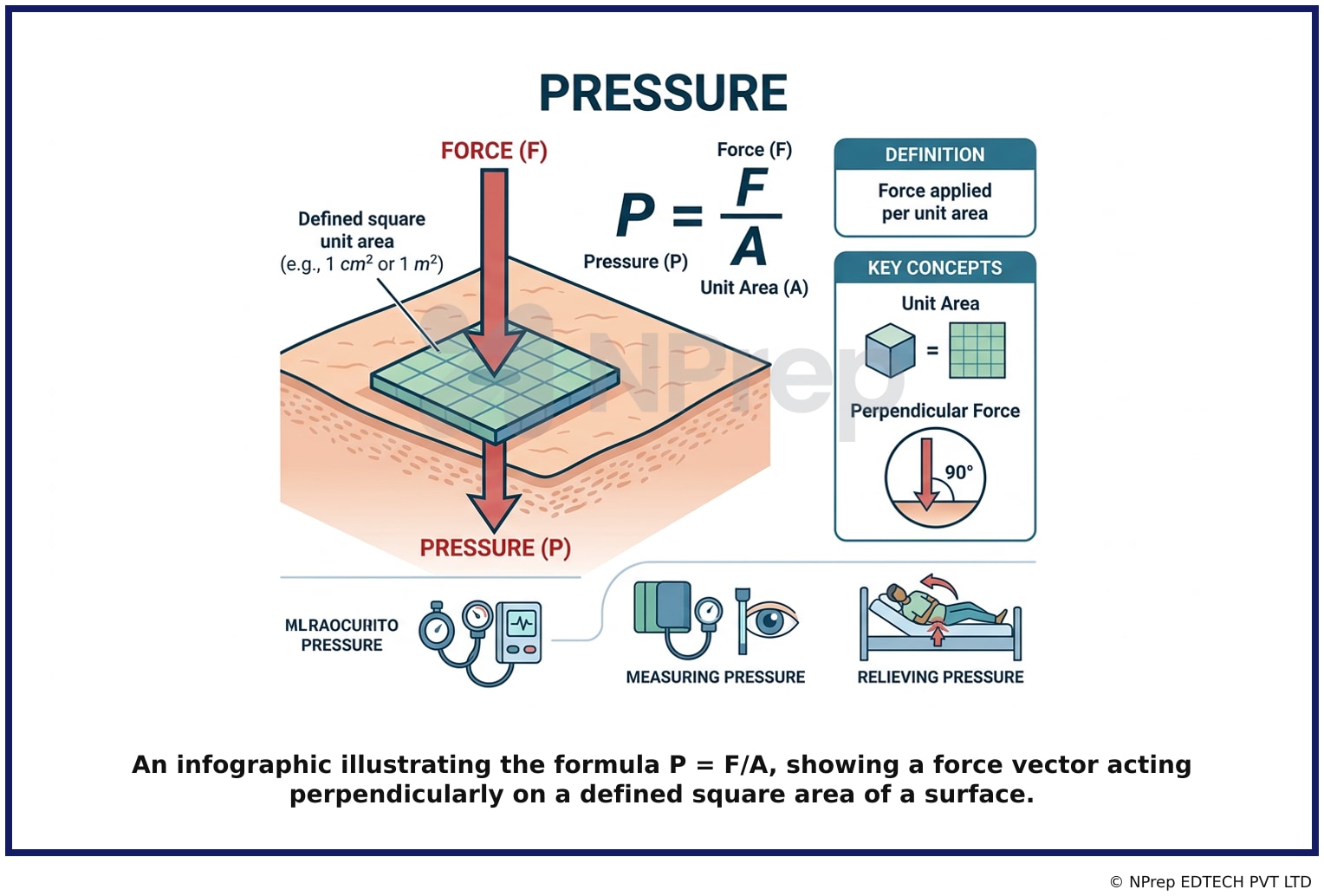
- Visual 1: Diagram - An infographic illustrating the formula P = F/A, showing a force vector acting perpendicularly on a defined square area of a surface.
- Visual 2: Chart - A comparison table showing the definitions, units, and clinical examples of Pressure, Friction, Tension, and Gravity.
Clinical Relevance
- Nursing practice connection: This is primarily an exam-oriented knowledge point with limited direct bedside application, so retain Definition of Pressure as background academic context rather than a clinical decision trigger.
- Understanding pressure is fundamental for nurses to monitor blood pressure, assess for glaucoma (intraocular pressure), and manage patients with increased intracranial pressure.
- A key nursing responsibility is the prevention of pressure injuries (bedsores) by regularly repositioning patients to relieve pressure on bony prominences, thereby preventing tissue ischemia.
- What if? If a patient is immobile and has poor nutrition, their tissue tolerance to pressure decreases significantly. This means the nurse must implement repositioning schedules more frequently (e.g., every 1-2 hours instead of every 2-4 hours) and use pressure-relieving surfaces to prevent rapid skin breakdown.
How to Approach the Question
- This is a factual recall question based on a fundamental physics definition.
- Identify the keywords in the stem: 'force' and 'unit area'.
- Recall the definitions of the four options provided.
- Match the keywords 'force per unit area' to the correct term, which is 'Pressure'.
- Mentally eliminate the other options by confirming their definitions do not match (Friction opposes motion, Tension is a pulling force, Gravity is an attractive force).
Concept Tested & Keywords
- Concept Tested: Definition of Pressure
- Stem keywords: force, unit area, surface
- Lead-in keywords: is called
- Negative lead-in flag: false
Question ID
Qz0HNqV5-TXI348wXYiD4W
Practise the full RRB Nsg. Superintendent-20 July 2019 (Shift-3rd)
Attempt every question from this paper in a timed mock, then review the full solution for each one.
More Basic Physics Questions
- What is the relation between Power (P), Voltage (V), and Resistance (R)?
- A prism produces how many colors when light is passed through it?
- A concave mirror with a focal length 'f' is cut into two equal halves along the principal axis. What happens to the focal length of each half?
- Which of the following factors determines the colour of scattered light in the atmosphere, according to the Tyndall effect?
- Which of the following statements is FALSE?
- What is the SI unit of electric field strength?
- What is called the time required for the satellite to complete one rotation?
- What is the SI unit of electric current?
- The kinetic energy possessed by an object of mass (m), and moving with a uniform velocity (v) is?
- The number of oscillations or vibrations per second is called the \ \ \ \ \ \ ?
More RRB Nsg. Superintendent-20 July 2019 (Shift-3rd) Questions
- Where is oxytocin synthesized?
- What is the name of the muscle that extends from the sphenoid bone to the mandible?
- Complementary feeding should be initiated at the completion of \ \ \ \ \ \
- Where is kidney located?
- Psychosocial development stage for infants is \ \ \ \ \ \ \ \ \ \
- What immunization is given at birth?
- Functional nursing is a method of providing
- Which disease is the dementia associated with asymmetric atrophy of the frontal and temporal lobes?
- Thromboangiitis obliterans is also known as
- What is the other name of pyridoxine?