
RRB Nsg. Superintendent - 29 April 2025 (Shift-3rd)
General Knowledge
Medium
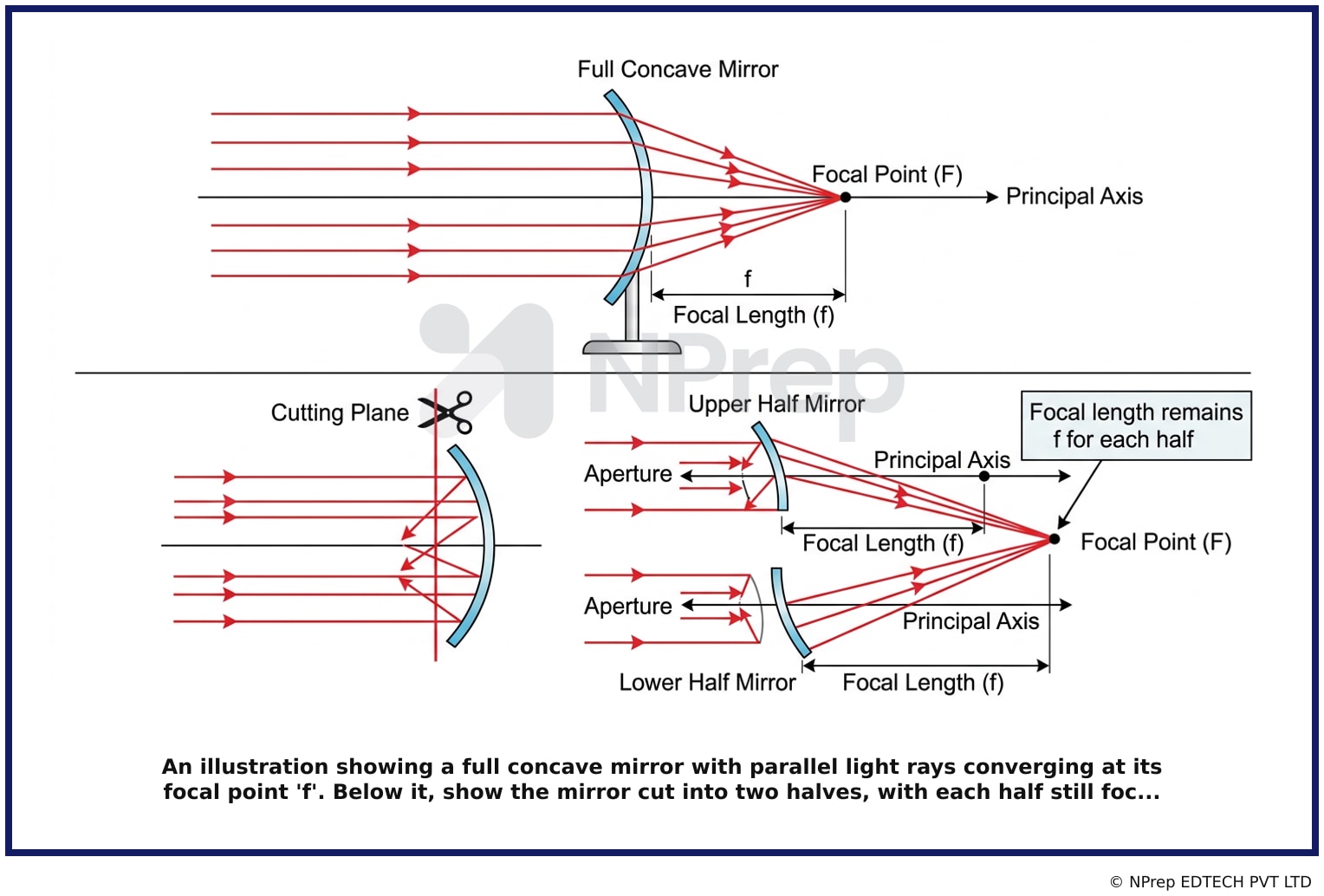
A concave mirror with a focal length 'f' is cut into two equal halves along the principal axis. What happens to the focal length of each half?
Appeared in: RRB Nsg. Superintendent - 29 April 2025 (Shift-3rd)
Explanation
- The focal length (f) of a spherical mirror is determined solely by its radius of curvature (R), according to the formula f = R/2.
- When a mirror is cut in half along its principal axis, the geometric shape or curvature of the reflecting surface does not change.
- Because the radius of curvature (R) remains the same for each resulting piece, the focal length (f) also remains unchanged.
Why Other Options Were Wrong
- Option A: This is incorrect. The focal length doubling to 2f would imply that the radius of curvature (R) also doubled, making the mirror less curved. Cutting the mirror does not change its curvature.
- Option C: This is incorrect. Each half of the mirror is still a functional curved mirror capable of focusing light to a specific point. Therefore, it has a well-defined focal length.
- Option D: This is incorrect. The focal length becoming f/2 would imply that the radius of curvature (R) was halved, meaning the mirror became significantly more curved. Cutting the mirror does not alter its curvature.
Related Visual
Clinical Relevance
- Nursing practice connection: This is primarily an exam-oriented knowledge point with limited direct bedside application, so retain Properties of Spherical Mirrors as background academic context rather than a clinical decision trigger.
- While this is a physics concept, understanding basic optics is fundamental to appreciating how various medical diagnostic instruments, such as endoscopes, ophthalmoscopes, and microscopes, function to magnify and focus images.
- The principles of reflection and focusing are applied in surgical headlights and examination lamps to concentrate light onto a specific area, improving visibility during procedures.
- What if? If the mirror were ground down to be shallower (i.e., its curvature was decreased), its radius of curvature would increase, and its focal length would become longer (greater than f). The action of cutting itself is not what matters, but how any action affects the mirror's curvature.
How to Approach the Question
- First, identify the core physics concept being tested: the focal length of a concave mirror.
- Recall the relationship between focal length (f) and the mirror's geometric properties. The key formula is f = R/2, where R is the radius of curvature.
- Analyze the action described: 'cut into two equal halves along the principal axis'.
- Determine how this action affects the variables in the formula. Cutting the mirror this way reduces its size (aperture) but does not change its curve. Therefore, the radius of curvature (R) is unchanged.
- Conclude the effect on the focal length. Since f depends only on R, and R is constant, f must also remain constant.
- Evaluate the options based on this conclusion. The only option stating the focal length remains 'f' is the correct one.
Concept Tested & Keywords
- Concept Tested: Properties of Spherical Mirrors
- Stem keywords: concave mirror, focal length, cut into two equal halves, principal axis
- Lead-in keywords: What happens
Question ID
Qm0Qx_8MVuyT9o6X5egTmy
Reference Book
E6 Physiology Guyton 4SAE Part 3 p. 138-140
Practise the full RRB Nsg. Superintendent - 29 April 2025 (Shift-3rd)
Attempt every question from this paper in a timed mock, then review the full solution for each one.
More Basic Physics Questions
- What is the relation between Power (P), Voltage (V), and Resistance (R)?
- A prism produces how many colors when light is passed through it?
- Which of the following factors determines the colour of scattered light in the atmosphere, according to the Tyndall effect?
- Which of the following statements is FALSE?
- What is the SI unit of electric field strength?
- What is called the time required for the satellite to complete one rotation?
- What is the SI unit of electric current?
- The kinetic energy possessed by an object of mass (m), and moving with a uniform velocity (v) is?
- The number of oscillations or vibrations per second is called the \ \ \ \ \ \ ?
- The liquid drops or gas bubbles are always spherical due to?
More RRB Nsg. Superintendent - 29 April 2025 (Shift-3rd) Questions
- Which of the following statements is true for displacement reactions?
- Which of the following statements about molecules of elements is correct?
- Which of the following describes the process by which the concentration of toxic substances, such as pesticides, increases in organisms at higher lev…
- In December 2024, Prime Minister Narendra Modi was honoured with Kuwait's highest civilian award. What is the name of the award?
- Which immediate cause triggered the Sanyasi Uprisings in Bengal lasting from 1770 to the 1820s?
- Under which of the following Constitutional Amendments were the Fundamental Duties incorporated into the Indian Constitution?
- Under which Indian government scheme launched in 2000 is additional central assistance given to states for basic services such as primary health, pri…
- Which notable water body is located to the south of the Mahanadi Delta on the Eastern Coastal Plains of India?