
RRB Nsg. Superintendent-20 July 2019 (Shift-3rd)
Applied Sociology
Easy
The family includes relatives in addition to the nuclear family is ______
Appeared in: RRB Nsg. Superintendent-20 July 2019 (Shift-3rd)
Explanation
- An extended family is defined as a family unit that extends beyond the nuclear family.
- This structure includes relatives such as grandparents, aunts, uncles, and cousins who may or may not live in the same household but are part of the family network.
- The key characteristic is the inclusion of kin beyond the immediate parent-child relationship.
Why Other Options Were Wrong
- Option A: A single-parent family is defined by the number of parents (one) raising children, not by the inclusion of a wider network of relatives.
- Option B: A joint family is a specific type of extended family with stricter criteria (e.g., three or more generations, same roof, common property). 'Extended family' is the broader, more general term that fits the question's definition.
- Option D: A blended family is formed by the remarriage of parents, bringing together children from previous relationships. Its definition is based on formation through remarriage, not the inclusion of extended relatives.
Related Visual
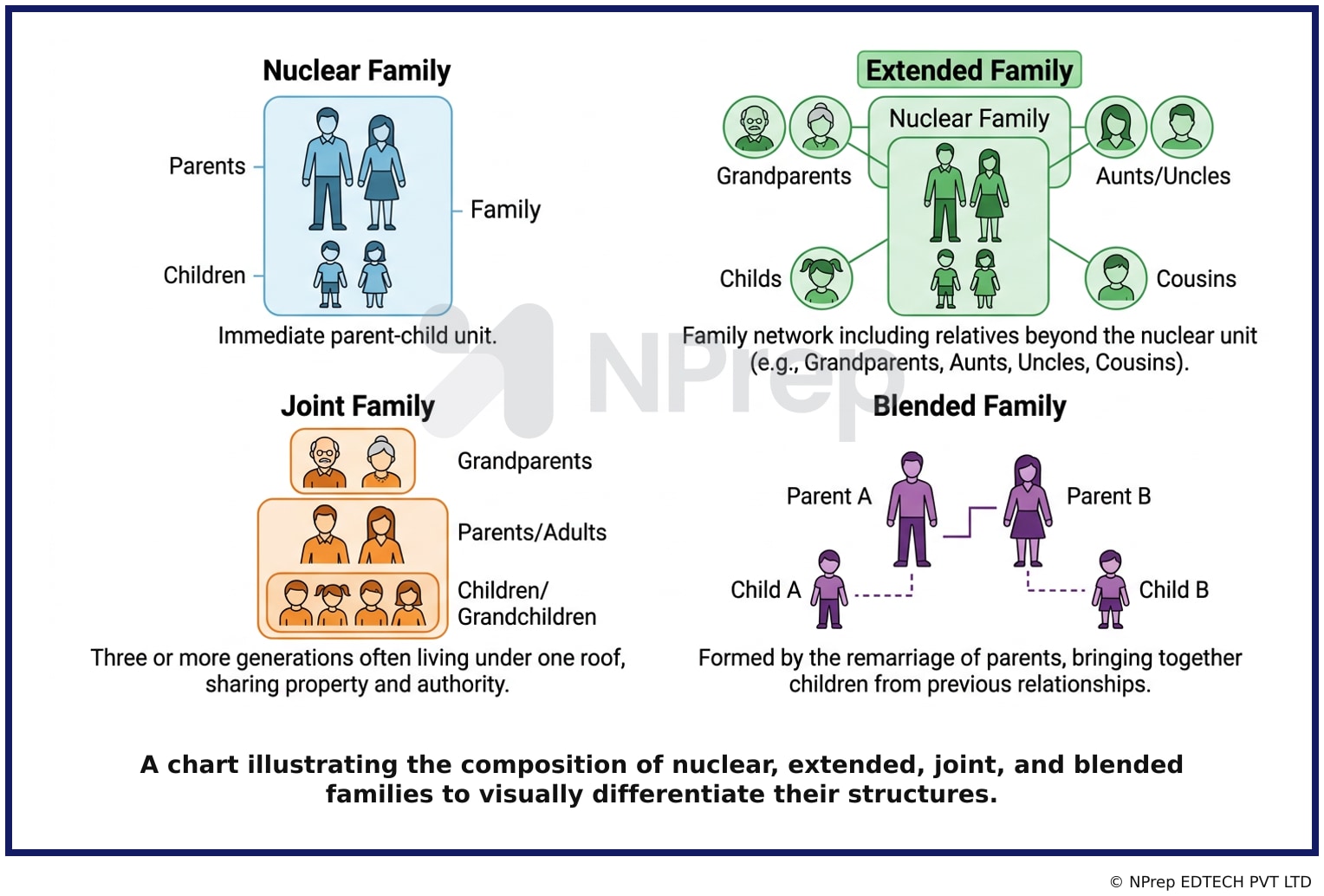
- Visual 1: Diagram - A chart illustrating the composition of nuclear, extended, joint, and blended families to visually differentiate their structures.
Clinical Relevance
- Nursing practice connection: This is primarily an exam-oriented knowledge point with limited direct bedside application, so retain Types of family structures in sociology as background academic context rather than a clinical decision trigger.
- Understanding a patient's family structure helps nurses identify the primary caregivers and support system, which is crucial for planning discharge and home care.
- In many cultures, the extended family plays a significant role in healthcare decisions. Nurses must be culturally sensitive and involve the appropriate family members in the care plan.
- What if? If a patient from a joint family is hospitalized, the nurse might need to communicate with multiple family members (e.g., the eldest son, the matriarch) who share decision-making authority, unlike in a nuclear family where it's usually the spouse or parents.
How to Approach the Question
- Read the question to identify the core definition being asked: a family with 'relatives in addition to the nuclear family'.
- Analyze each option based on standard sociological definitions of family types.
- 'Single parent family' refers to the number of parents, not the inclusion of other relatives. Eliminate this.
- 'Blended family' refers to formation through remarriage. Eliminate this.
- Compare 'Joint family' and 'Extended family'. Recognize that 'Extended family' is the broad term for any family structure beyond the nuclear unit. 'Joint family' is a more specific type. Since the question provides a general definition, 'Extended family' is the most accurate choice.
Concept Tested & Keywords
- Concept Tested: Types of family structures in sociology.
- Stem keywords: family, relatives, nuclear family
- Lead-in keywords: is
- Negative lead-in flag: false
Question ID
Q3POWPdqE4q1Km1KX31oRj
Practise the full RRB Nsg. Superintendent-20 July 2019 (Shift-3rd)
Attempt every question from this paper in a timed mock, then review the full solution for each one.
More Family and Marriage Questions
- In Duvall's eight development stages of a family life cycle, couples come under?
- Which type of family comes under the male head of the family possessing all powers?
- The type of family in which father has highest status in family who controls the social life of family is called
- The basic unit of society is?
- Which among the following is not a type of marriage?
- Polygamy is?
- Family is an?
- Fundamental unit of society is?
- Change in relationship, economic independence, small family, marriage settled by partners is an features of?
- Group in which people are not married if having blood relations but are married outside the group is termed as?
More RRB Nsg. Superintendent-20 July 2019 (Shift-3rd) Questions
- Where is oxytocin synthesized?
- What is the name of the muscle that extends from the sphenoid bone to the mandible?
- Complementary feeding should be initiated at the completion of \ \ \ \ \ \
- Where is kidney located?
- Psychosocial development stage for infants is \ \ \ \ \ \ \ \ \ \
- What immunization is given at birth?
- Functional nursing is a method of providing
- Which disease is the dementia associated with asymmetric atrophy of the frontal and temporal lobes?
- Thromboangiitis obliterans is also known as
- What is the other name of pyridoxine?