
AIIMS Jodhpur SNO-2023
Pathology & Genetics
Easy
The down's syndrome is a congenital chromosome abnormality and is also known as:
Appeared in: AIIMS Jodhpur SNO-2023
Explanation
- Down's syndrome is a genetic condition resulting from an extra copy of chromosome 21.
- This specific chromosomal abnormality is medically termed 'Trisomy 21', where 'tri-' refers to the presence of three chromosomes instead of the usual pair.
- It is the most frequently occurring chromosomal disorder and is associated with characteristic physical features and developmental delays.
- The diagnosis is confirmed by a karyotype analysis, which visually represents the chromosomes and would show the extra 21st chromosome.
Why Other Options Were Wrong
- Option A: Trisomy 20 is a rare chromosomal condition, typically seen in mosaic form, and is not associated with the clinical presentation of Down's syndrome.
- Option B: Trisomy 18 is the genetic basis for Edwards Syndrome, a different and more severe condition than Down's syndrome.
- Option C: This is a biologically impossible condition. Humans have 23 pairs of chromosomes, so a 'chromosome 31' does not exist.
Related Visual
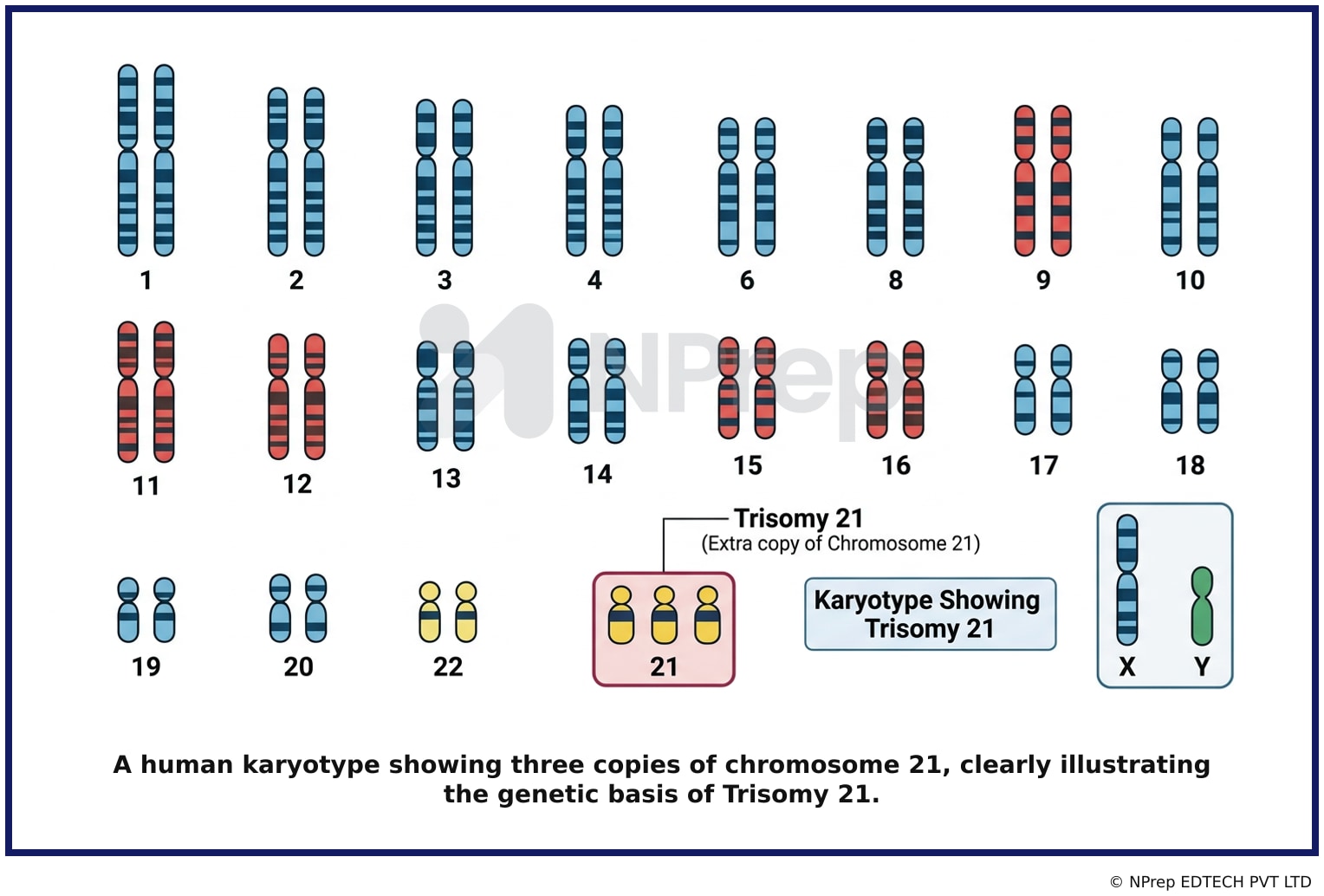
- Visual 1: Karyotype Diagram - A human karyotype showing three copies of chromosome 21, clearly illustrating the genetic basis of Trisomy 21.
- Visual 2: Infographic - A comparative chart showing the key physical features of Down Syndrome (Trisomy 21), Edwards Syndrome (Trisomy 18), and Patau Syndrome (Trisomy 13) side-by-side.
Clinical Relevance
- Nursing practice connection: Knowing Identification of the chromosomal basis for Down's syndrome helps nurses interpret findings accurately and avoid errors in routine assessment, medication administration, and patient teaching.
- Nurses play a crucial role in supporting families of newborns with Down's syndrome, from providing initial education and emotional support to coordinating care with specialists.
- Understanding the genetic basis allows nurses to explain prenatal screening tests (like non-invasive prenatal testing - NIPT) and diagnostic tests (like amniocentesis) to expectant parents.
- What if? - If a prenatal screen comes back with a high risk for Trisomy 18 instead of Trisomy 21, the nurse's counseling would shift significantly. The focus would be on preparing the family for a much poorer prognosis and the high likelihood of infant mortality, which is characteristic of Edwards Syndrome.
How to Approach the Question
- First, identify the core of the question, which is asking for the specific medical name for the chromosomal abnormality in Down's syndrome.
- This is a factual recall question. Access your knowledge of common genetic disorders.
- Recall that 'tri-' means three and 'somy' refers to the chromosome. 'Trisomy' means three copies of a chromosome.
- Associate the most common trisomies with their numbers: Down's syndrome is Trisomy 21, Edwards syndrome is Trisomy 18, and Patau syndrome is Trisomy 13.
- Evaluate the options. Eliminate impossible options like 'Trisomy 31' as humans only have 23 pairs of chromosomes.
- Select the option that correctly matches Down's syndrome with its corresponding trisomy number.
Concept Tested & Keywords
- Concept Tested: Identification of the chromosomal basis for Down's syndrome.
- Stem keywords: Down's syndrome, congenital chromosome abnormality
- Lead-in keywords: also known as
Question ID
Q5z4AWi2bcoEnpu51Nd12a
Practise the full AIIMS Jodhpur SNO-2023
Attempt every question from this paper in a timed mock, then review the full solution for each one.
More Genetics Questions
- Eugenics means:
- The genetic material, deoxyribonucleic acid (DNA) is contained in:
- Which is the mode of inheritance of cystic fibrosis?
- Karyotype of Klinefelter syndrome is?
- Same allele group also called as?
- Identify the disorder shown in this pedigree chart?
- The disease that occurs due to the defect in the genes of one or other parent and is transmitted to the offspring is known as disease/disorder?
- Haemophilia is associated with?
- Eugenics means?
- Genes work in?
More AIIMS Jodhpur SNO-2023 Questions
- Following a road accident, a patient was admitted to the neurosurgery ICU due to a head injury. During the assessment, the patient opens his eyes to…
- A short-term goal for a patient with Alzheimer's disease is:
- The primary fever in malaria corresponding to the development of the parasites in the red blood cells comprise all of the following EXCEPT:
- What is the function of mRNA?
- Second component (other than NST) in Modified Biophysical Profile is:
- What is the best position for a patient in anaphylactic shock?
- The year 2023 has been declared as The International Year of:
- Regarding the placement of leads when recording ECG all of the following are correct, EXCEPT:
- Low molecular weight heparin should be administered:
- Beta-thalassemia is an autosomal recessive disorder. It is characterised by reduced haemoglobin levels in the body and is also known as: