
IGNOU Post B. SC. Nursing entrance-2019
Obstetrics & Gynaecology
Easy
The danger of convulsion in a woman with pre-eclamptic toxaemia ends?
Appeared in: IGNOU Post B. SC. Nursing entrance-2019
Explanation
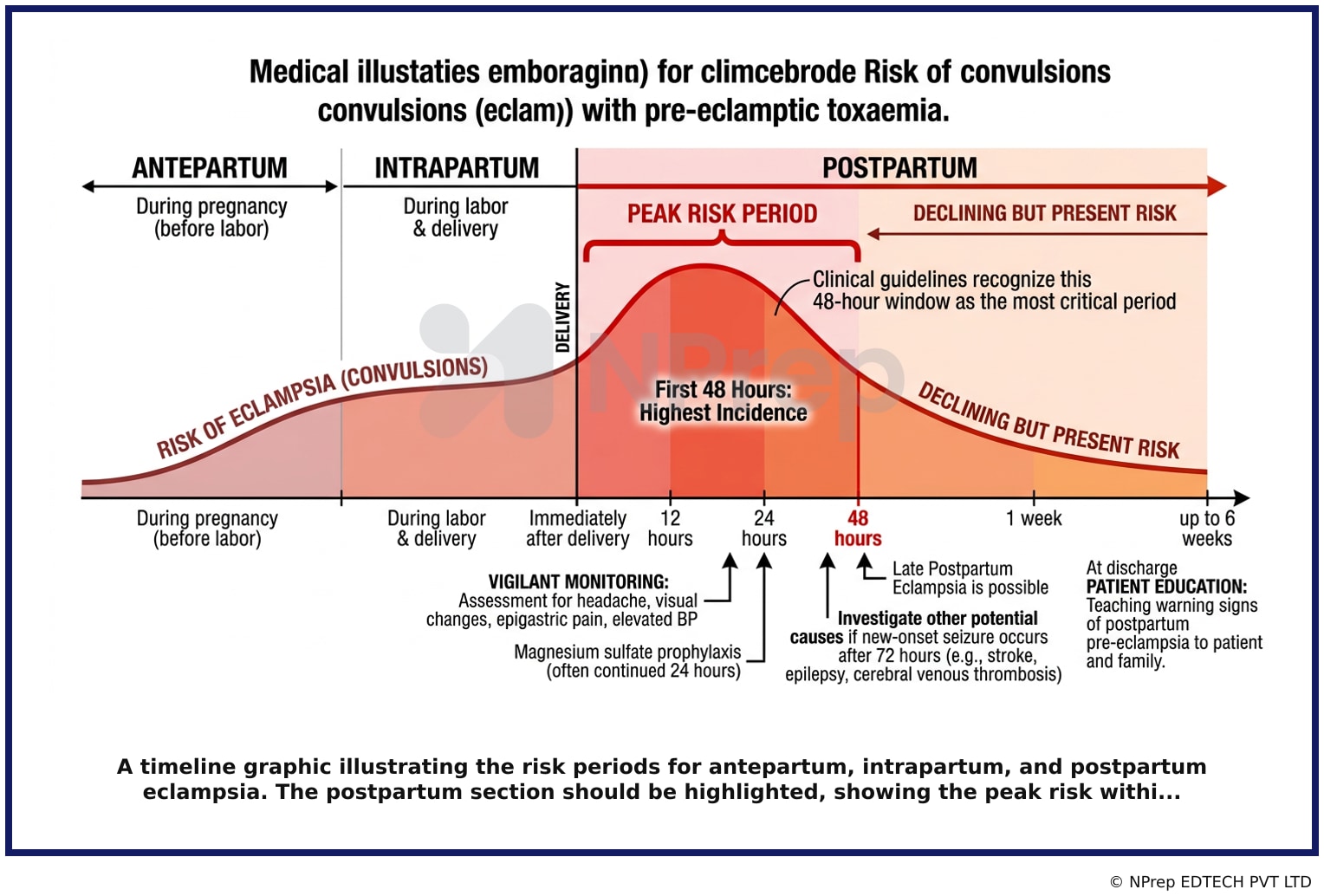
- The risk of eclamptic seizures does not resolve immediately after delivery; it persists into the postpartum period.
- The highest incidence of postpartum eclampsia occurs within the first 48 hours after childbirth.
- Clinical guidelines recognize this 48-hour window as the most critical period for monitoring and seizure prophylaxis.
- While late postpartum eclampsia can occur, convulsions presenting more than 48 hours after delivery often prompt investigation into other neurological causes.
Why Other Options Were Wrong
- Option A: This is incorrect because the risk of convulsions is still very high immediately following delivery and during the subsequent hours.
- Option B: This is incorrect. Although magnesium sulfate prophylaxis is often continued for 24 hours, the actual period of highest risk for seizures extends beyond this time.
- Option C: This is an unsafe and incorrect timeframe. The risk for eclamptic seizures remains significant well beyond 12 hours postpartum.
Related Visual
Clinical Relevance
- Nursing practice connection: This is primarily an exam-oriented knowledge point with limited direct bedside application, so retain Postpartum risk period for eclampsia as background academic context rather than a clinical decision trigger.
- Nurses must maintain vigilant monitoring of postpartum patients with pre-eclampsia for at least 48 hours, assessing for headache, visual changes, epigastric pain, and elevated blood pressure.
- Patient education upon discharge is critical. The patient and her family must be taught the warning signs of postpartum pre-eclampsia and instructed to seek immediate medical attention if they occur.
- What if? If a patient develops a new-onset seizure 72 hours postpartum, it is considered late postpartum eclampsia. While treatment for eclampsia should be initiated, the healthcare team must also urgently investigate other potential causes, such as stroke, epilepsy, or cerebral venous thrombosis, as this timing is less typical for eclampsia.
How to Approach the Question
- First, identify the core of the question: it asks for the time frame when the danger of convulsions from pre-eclampsia ends after delivery.
- Recognize the keywords: 'convulsion', 'pre-eclamptic toxaemia', 'danger ends', 'after delivery'.
- This is a factual recall question based on established clinical knowledge and guidelines in obstetrics.
- Recall that pre-eclampsia is a systemic disease, and its effects, including the risk of seizures, do not cease immediately with delivery.
- Evaluate the given timeframes. Eliminate the shorter durations (soon after, 12 hours, 24 hours) as they fall within the known high-risk period.
- Select the option that represents the standard end of the most acute risk period, which is widely accepted to be 48 hours postpartum.
Concept Tested & Keywords
- Concept Tested: Postpartum risk period for eclampsia.
- Stem keywords: convulsion, pre-eclamptic toxaemia, danger, ends, after delivery
- Lead-in keywords: ends
- Negative lead-in flag: false
Question ID
QTxCeTG_737oMVhHTTZvO5
Reference Book
E6 Obstetrics Williams p. 30-50
Practise the full IGNOU Post B. SC. Nursing entrance-2019
Attempt every question from this paper in a timed mock, then review the full solution for each one.
More Hypertensive Disorders in Pregnancy Questions
- An antenatal mother is admitted with complaints of eclampsia. What will be the loading dose of MgSO4 given to patient?
- Pregnant woman is monitored by nurse, based on the following image. Identify the wave pattern:
- All are the cardinal sign of Pre-eclampsia; EXCEPT:
- A biochemical marker of pre-eclampsia is:-
- A pregnant lady 38 weeks gestation diagnosed with eclampsia. On duty nursing officers should assess which parameters, except?
- A pregnant lady 38 weeks gestation diagnosed for pre- eclampsia is receiving magnesium therapy. Which of the following parameters should be assessed…
- A patient history of Pre-eclampsia having seizures, what is the priority management of this patient?
- Pregnant Women admitted in labor with complaint of hypertension 161/101, proteinuria grade +3, and seizure. A prudent nurse knows that this condition…
- What was maternal mortality ratio (per all live births) in Rajasthan in 2018-20? (as per economic review 2023-24)
- The primary goal of essential newborn care is to reduce \ \ \ \ \ \ and \ \ \ \ \ \ mortality.
More IGNOU Post B. SC. Nursing entrance-2019 Questions
- Midbrain (brain stem) contains the center for?
- The process to attend and react to a stimulus is known as?
- External auditory canal can be straightened most appropriately in adults by pulling the pinna?
- All of the following organs have involuntary muscles except?
- The body system that collects, processes, and responds to information using electrical signals?
- The most dilated portion of the digestive system is?
- One of the following bacteria has the capability to form spores:
- One of the following scientists demonstrated the transmission of malarial parasites by the bite of an Anopheles mosquito:
- Psychosocial theory of development was proposed by?
- Identity Vs. Role confusion as a psychosocial crisis is in which stage of development?