
SCTIMST Staff Nurse - 2015 (Set-B)
Medical & Surgical Nursing
Hard
Recommended practice for collecting a sample for culture and sensitivity from an indwelling urinary catheter is?
Appeared in: SCTIMST Staff Nurse - 2015 (Set-B)
Explanation
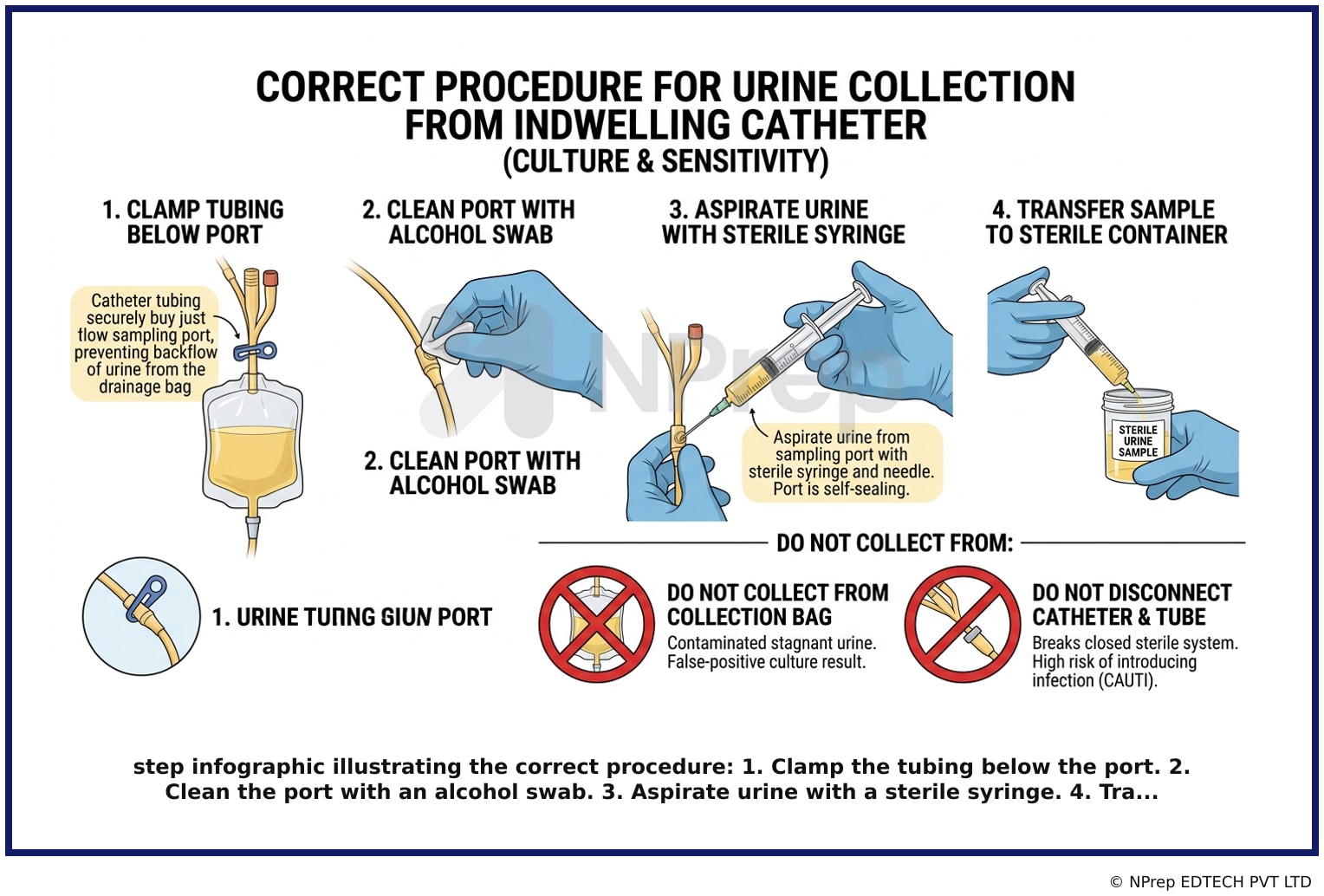
- The correct procedure is to aspirate urine from the designated sampling port on the catheter tubing.
- This method uses a sterile syringe and needle, ensuring the collection of a fresh, uncontaminated sample directly from the flow of urine from the bladder.
- It maintains the integrity of the closed urinary drainage system, which is the most critical principle in preventing Catheter-Associated Urinary Tract Infections (CAUTI).
- As shown in the image, the port is designed to be self-sealing after being punctured with a needle, preventing leaks and maintaining sterility.
Why Other Options Were Wrong
- Option A: Urine in the collection bag (uro-bag) is not a fresh specimen. It has been stagnant and is considered contaminated with bacteria from the bag's environment, which would lead to a false-positive culture result.
- Option B: Disconnecting the catheter from the drainage tube breaks the closed sterile system. This action creates a direct pathway for microorganisms to enter the bladder, posing a very high risk of introducing infection.
- Option C: Re-catheterization is an invasive, uncomfortable, and costly procedure that is not justified for the sole purpose of obtaining a urine sample. It carries its own risks of urethral trauma and infection.
Related Visual
Clinical Relevance
- Nursing practice connection: This is primarily an exam-oriented knowledge point with limited direct bedside application, so retain The concept tested is the correct sterile procedure for obtaining a urine specimen for culture and sensitivity from a patient with an indwelling urinary catheter as background academic context rather than a clinical decision trigger.
- Adhering to the correct specimen collection technique is a fundamental nursing skill for preventing Catheter-Associated Urinary Tract Infections (CAUTIs), a leading cause of healthcare-associated infections.
- An accurate culture result is essential for guiding appropriate antibiotic therapy. A contaminated sample can lead to unnecessary or incorrect antibiotic use, contributing to antibiotic resistance.
- What if? If the catheter does not have a sampling port (which is rare with modern catheters), the nurse should obtain a new catheter system that has one. If that is not possible, the catheter may need to be replaced to obtain a sterile specimen from the new catheter before connecting the drainage bag.
How to Approach the Question
- First, identify the core requirement of the question: collecting a sample for 'culture and sensitivity'. This immediately signals the need for a sterile, uncontaminated specimen.
- Next, recall the principles of managing an indwelling catheter, with the primary goal being the prevention of infection by maintaining a closed drainage system.
- Evaluate each option against these two principles (sterility and closed system).
- Option A (from the bag) violates sterility because the urine is old and colonized with bacteria.
- Option B (disconnecting) violates the closed system principle, creating a high infection risk.
- Option C (re-catheterizing) is unnecessarily invasive and risky for a routine sample.
Concept Tested & Keywords
- Concept Tested: The concept tested is the correct sterile procedure for obtaining a urine specimen for culture and sensitivity from a patient with an indwelling urinary catheter.
- Stem keywords: indwelling urinary catheter, culture and sensitivity, collecting a sample, recommended practice
- Lead-in keywords: Recommended practice
Question ID
QjPFNbitvywLq5lGNtWrv2
Reference Book
E6 Nursing Fundamentals Taylor p. 692-694
E6 Nursing Fundamentals Potter Perry 12e Part 5 p. 245-247
Practise the full SCTIMST Staff Nurse - 2015 (Set-B)
Attempt every question from this paper in a timed mock, then review the full solution for each one.
More Urinary Tract Function Questions
- Assessing the laboratory findings which results would the nurse most likely to expect to find in a client with chronic renal failure?
- A nurse is taking care of Chronic renal dysfunction patient. What diet she will advise for this patient?
- A patient is admitted with acute renal kidney injury, and nurse is advised to monitor strict urine output. She notices urine output is less than 100…
- The following are the use of the central line catheter; EXCEPT:
- The involuntary loss of urine through an intact urethra as a result of sudden increase in the intra-abdominal pressure is called:
- Which of the following is the warning sign post renal transplantation?
- What is contraindicated in male patient reporting the symptoms of redness and ecchymosis in the scrotum region?
- A patient with low urine specific gravity will have all the following characteristics; EXCEPT:
- Food contraindicated with CRF and spironolactone:
- When initiating the use of a newly inserted Central Venous Access Device (CVAD), what is the recommended syringe size for the initial flushing proced…
More SCTIMST Staff Nurse - 2015 (Set-B) Questions
- Nurse teaches the patient to rotate the site of insulin injection. Which of the following sites is inappropriate to use?
- Effects of Nicotine will increase the body's secretion of?
- The therapeutic effect of Digitalis is to?
- Significant Nursing interventions required for a patient with activity intolerance include all, except?
- The part of the brain which controls heart rate and respiration?
- Claustrophobia means?
- Which of the following features is an extrapyramidal symptom (EPS)?
- Hypernatremia is commonly detected in patients with?
- Mr. Ramu is on diuretics and Digoxin. His recent Serum Potassium value is 2.9 mEq/l. Which of the undermentioned food items is essentially required f…
- Mr. Mahesh is on a low sodium (3g) diet. Choose the most appropriate food item from the undermentioned list?