
AIIMS Bhuvneshwar NO- 2018
Applied Physiology
Easy
Oxytocin is secreted by?
Appeared in: AIIMS Bhuvneshwar NO- 2018
Explanation
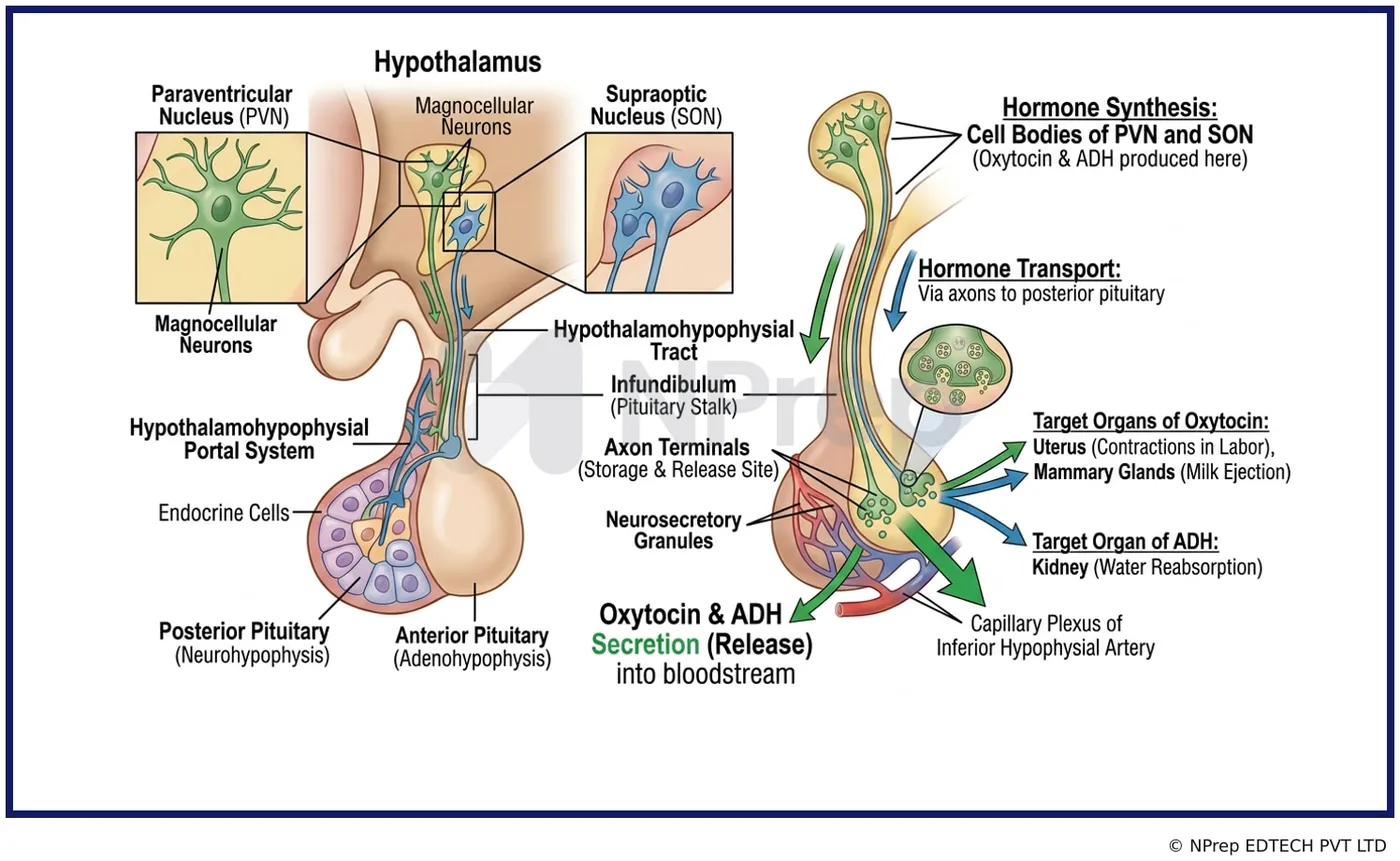
- Oxytocin is secreted (released) into the bloodstream by the posterior pituitary gland.
- It is important to distinguish secretion from synthesis. Oxytocin is synthesized in the cell bodies of magnocellular neurons located in the supraoptic and paraventricular nuclei of the hypothalamus.
- After synthesis, it is transported down the axons of these neurons to their terminals in the posterior pituitary, where it is stored in secretory granules (Herring bodies) and released upon stimulation.
- The posterior pituitary (neurohypophysis) acts as a storage and release site for two hypothalamic hormones: oxytocin and antidiuretic hormone (ADH). It does not produce its own hormones.
Why Other Options Were Wrong
- Option A: The adrenal cortex is responsible for producing and secreting steroid hormones, not peptide hormones like oxytocin.
- Option B: The anterior pituitary (adenohypophysis) synthesizes and secretes its own set of six major hormones, but oxytocin is not one of them.
- Option C: The adrenal medulla is part of the sympathetic nervous system and secretes catecholamines (epinephrine and norepinephrine) in response to stress.
Related Visual
Clinical Relevance
- Nursing practice connection: This is primarily an exam-oriented knowledge point with limited direct bedside application, so retain Hormone secretion by the pituitary gland as background academic context rather than a clinical decision trigger.
- A synthetic form of oxytocin (Pitocin) is one of the most common drugs used in obstetrics. Nurses administer it to induce or augment labor and to prevent or treat postpartum hemorrhage by causing uterine contractions.
- When administering oxytocin, nurses must vigilantly monitor uterine contraction patterns (frequency, duration, strength) and fetal heart rate to identify and prevent complications like uterine tachysystole (too many contractions), which can lead to fetal distress.
- What if? A patient receiving oxytocin for labor induction complains of a throbbing headache and seems confused. The nurse notes very low urine output. This could indicate water intoxication, a rare but serious side effect due to oxytocin's ADH-like properties. The nurse's priority is to stop the infusion and immediately notify the healthcare provider.
How to Approach the Question
- The question asks for the site of oxytocin secretion. This is a direct recall question about the endocrine system.
- First, recall the major endocrine glands listed in the options: Adrenal gland (cortex and medulla) and Pituitary gland (anterior and posterior).
- Differentiate the functions of the anterior and posterior pituitary. A key concept is that the anterior pituitary produces and secretes its hormones, while the posterior pituitary stores and secretes hormones produced by the hypothalamus.
- Associate the two posterior pituitary hormones: Oxytocin and Antidiuretic Hormone (ADH).
- Eliminate the adrenal gland options by recalling their primary hormones: corticosteroids and aldosterone from the cortex, and epinephrine/norepinephrine from the medulla.
- This leaves the posterior pituitary as the correct site of secretion.
Concept Tested & Keywords
- Concept Tested: Hormone secretion by the pituitary gland.
- Stem keywords: Oxytocin, secreted by
- Lead-in keywords: BEST, MOST RELEVANT CLUE
- Negative lead-in flag: false
Question ID
QcIHAugi7lfjGkLX9sUs5l
Reference Book
E6 Anatomy Grays 43e Vol 1 Part 3 p. 364-430
Practise the full AIIMS Bhuvneshwar NO- 2018
Attempt every question from this paper in a timed mock, then review the full solution for each one.
More Endocrine system Questions
- Inhibin is secreted by:
- What is the full form of ACTH?
- Which among the following hormone is secreted by Pituitary gland?
- The most important hormone secreted by the Pineal gland is
- Which of the following hormones is NOT secreted from the anterior pituitary?
- Which of the following hormones inhibits release of growth hormone?
- Which of the following electrolytes does insulin help to move into the cells?
- Which of the following layers of the adrenal gland secretes glucocorticoids?
- Hormone secreted by islets of Langerhans of the pancreas is?
- Which hormone maintains serum calcium level?
More AIIMS Bhuvneshwar NO- 2018 Questions
- The diluent used for reconstitution of BCG vaccine is?
- Which test is done for identifying the presence of occult blood in stool?
- Stranger anxiety develops by the age of?
- Biochemical etiology of Alzheimer's disease relates to?
- The most basic quality for culturally competent nursing care is?
- Violet blue discoloration of vaginal membrane is?
- Health-illness continuum and high level wellness models demonstrate?
- Endotoxins produced by gram negative bacteria are usually?
- The cells of gastric gland that secrete hydrochloric acid found in gastric juice are called?
- The phenomenon of a nurse respecting a patient's rights to make decisions about his/her health care is called?