
IGNOU PB Bsc Entrance-2022
Applied Nutrition & Dietetics
Medium
Most common forms of malnutrition are the following, except :
Appeared in: IGNOU PB Bsc Entrance-2022
Explanation
- Beri-beri is the correct answer because it is a disease caused by a deficiency of a specific micronutrient, thiamine (Vitamin B1).
- The other options—Marasmus, Protein-energy malnutrition, and Kwashiorkor—are all forms of macronutrient malnutrition, related to inadequate intake of protein and/or calories.
- Protein-Energy Malnutrition (PEM) is the umbrella term for the most common forms of malnutrition globally, with Marasmus and Kwashiorkor being its most severe clinical presentations.
Why Other Options Were Wrong
- Option B: This is incorrect because Marasmus is a severe and very common form of Protein-Energy Malnutrition (PEM), characterized by a deficiency of both calories and protein. The question asks for the exception.
- Option C: This is incorrect because Protein-energy malnutrition (PEM) is the broad category that encompasses the most common forms of malnutrition worldwide. The question asks for the exception to this group.
- Option D: This is incorrect because Kwashiorkor is a severe and common form of Protein-Energy Malnutrition (PEM), primarily caused by a deficiency in protein. The question asks for the exception.
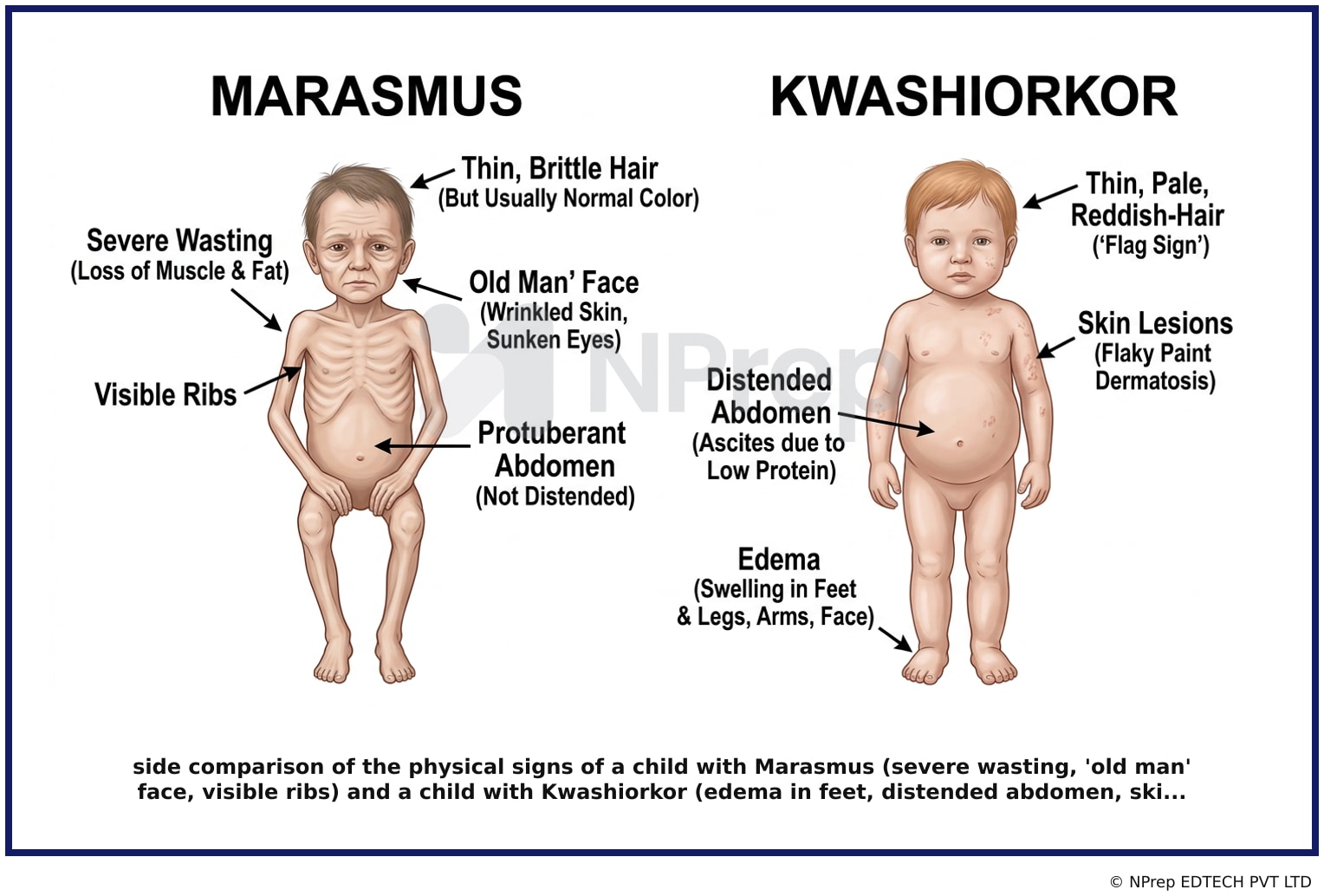
Related Visual
Clinical Relevance
- Nursing practice connection: This is primarily an exam-oriented knowledge point with limited direct bedside application, so retain Differentiating Macronutrient vs. Micronutrient Malnutrition as background academic context rather than a clinical decision trigger.
- Nurses must be able to differentiate between types of malnutrition to ensure correct nutritional support, monitoring, and patient education are implemented.
- Early identification of key signs, such as edema in Kwashiorkor versus severe wasting in Marasmus, is crucial for timely and appropriate intervention, which can be lifesaving.
- What if? If a patient with a history of chronic alcoholism presents with confusion, ataxia, and ophthalmoplegia, the nurse should suspect a thiamine deficiency (Wernicke-Korsakoff syndrome, a form of Beri-beri) rather than general PEM. This requires immediate administration of thiamine, often before other nutritional support.
How to Approach the Question
- First, identify the keyword 'except' in the question stem. This signals that you need to find the option that does not belong with the other three.
- Analyze the options to find a common theme. Notice that 'Protein-energy malnutrition' is a broad category.
- Recall or deduce that 'Marasmus' and 'Kwashiorkor' are the two classic, severe forms of Protein-Energy Malnutrition (PEM).
- This establishes a clear theme: three of the options are related to macronutrient (protein and calorie) deficiency.
- Evaluate the remaining option, 'Beri-beri'. Recognize that this is a disease caused by a specific vitamin (micronutrient) deficiency.
- Conclude that Beri-beri is the outlier because it is a micronutrient deficiency, while the others are forms of macronutrient malnutrition. Therefore, it is the correct answer to the 'except' question.
Concept Tested & Keywords
- Concept Tested: Differentiating Macronutrient vs. Micronutrient Malnutrition
- Stem keywords: malnutrition, common forms
- Lead-in keywords: except
- Negative lead-in flag: The question asks for the option that is an exception.
Question ID
QoQDYDxPjWT1DT7Fns_LMl
Reference Book
E6 Nutrition Monika Sharma 3e p. 345-347
E6 Textbook of Biochemistry for medical StudentsDM Vasudevan Part 2 — Subpart A (pp 1-239 of 478) p. 191-193
E6 Biochemistry U Satyanarayana— Part 2 (pp 421-820 of 840) p. 143-145
Practise the full IGNOU PB Bsc Entrance-2022
Attempt every question from this paper in a timed mock, then review the full solution for each one.
More Introduction to Nutrition Questions
- Which of the following are characteristic feature of malnutrition?
- Which of the following is not considered macronutrient?
- Which of the following nutrients provides energy to the body?
- As per Gomez classification, which of the following 'weight per age' comes under 'III degree malnutrition' when compared with the Harvard Growth Stan…
- Foods rich in carbohydrates and fats are called as:
- All green plants and bacteria which can synthesize their food by photosynthesis come under the category of?
- A condition of generalized ill health and malnutrition marked by weakness and emaciation?
- Identify the nutrient of proximate principle: I. Carbohydrate, II. Fat, III. Protein, IV. Vitamin, V. Mineral
- Malnutrition comprises of following form except?
- Which of these is a high-calorie diet?
More IGNOU PB Bsc Entrance-2022 Questions
- Human body system which starts from mouth and ends in anal canal is:
- Cerebrum (fore brain) controls the one of the following:
- All of the following are true for spinal cord, except:
- All of the following are endocrine glands except:
- One of the following is bone of lower limb:
- Pelvic cavity consists of one of the following structures:
- Treponema pallidum causes one of the following:
- One of the following hepatitis infections is spread by ingestion of contaminated water and food:
- Social institutions concerned with management, production and distribution of human resources are referred to as:
- Child sits with support at the age of :