
SGPGI Nursing Officer-2022
Applied Physiology
Easy
Memory stored in?
Appeared in: SGPGI Nursing Officer-2022
Explanation
- Memory is a complex cognitive process involving encoding, storage, and retrieval of information, which is exclusively a function of the brain.
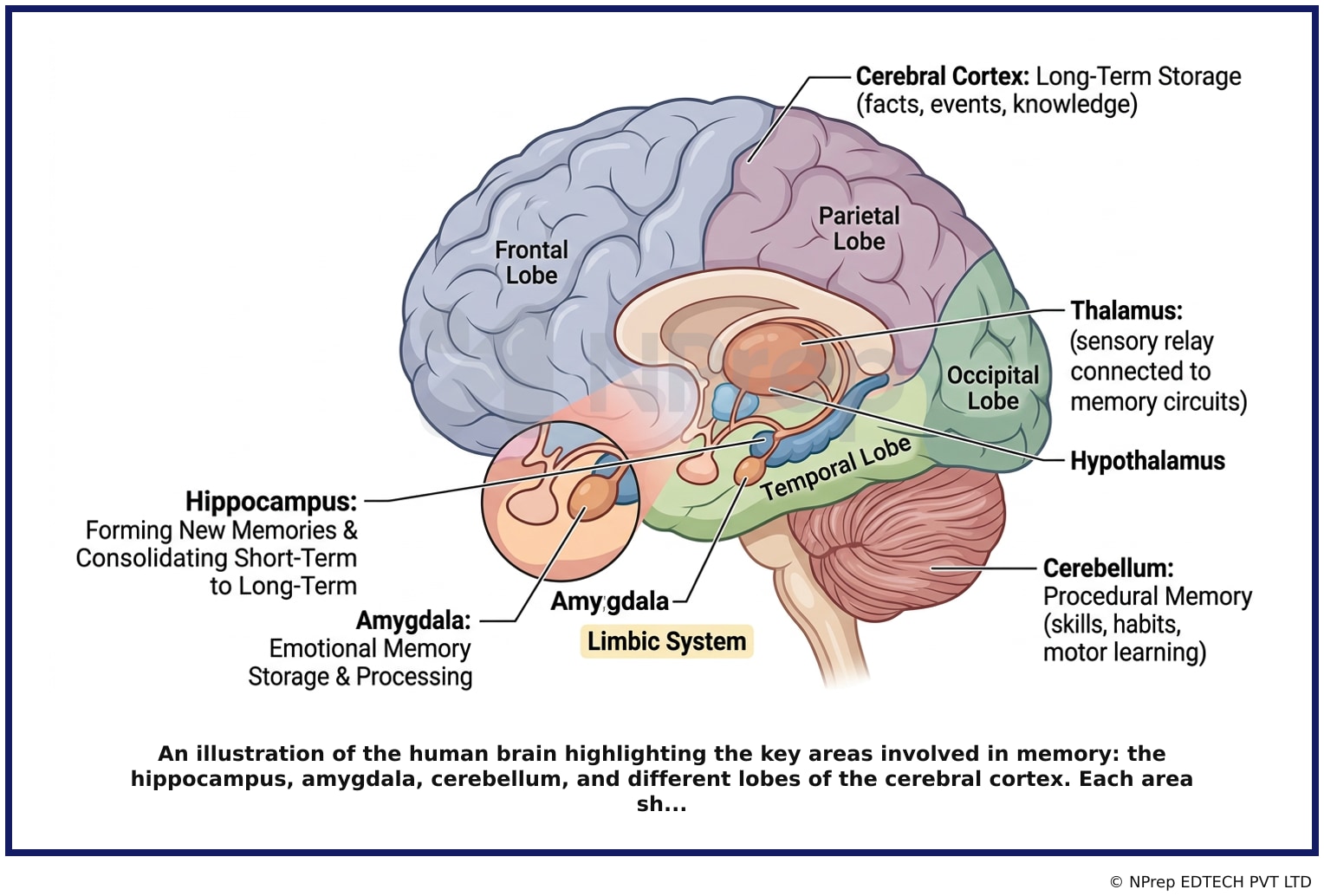
- Specific brain structures are responsible for different aspects of memory. The hippocampus is vital for forming new memories, the cerebral cortex for long-term storage, the amygdala for emotional memories, and the cerebellum for procedural memories.
- The brain has no fuel reserves and requires a constant supply of glucose and oxygen from the blood to function, consuming about 20% of the body's total energy.
- Other organs like the kidney, liver, and heart have specialized metabolic and physiological roles but are not involved in the cognitive process of memory storage.
Why Other Options Were Wrong
- Option B: The kidney's function is to filter blood, regulate fluid and electrolyte balance, and produce urine. It has no neurological or cognitive functions related to memory.
- Option C: The liver is the body's main metabolic hub, responsible for detoxification, synthesis of proteins, and glycogen storage for energy regulation. It does not store memories.
- Option D: The heart is a muscular pump that circulates blood throughout the body. Its function is purely mechanical and circulatory, with no role in memory or cognition.
Related Visual
Clinical Relevance
- Nursing practice connection: This is primarily an exam-oriented knowledge point with limited direct bedside application, so retain Anatomy and Physiology of Memory Storage as background academic context rather than a clinical decision trigger.
- Nurses frequently assess memory as part of the neurological assessment to screen for cognitive impairment. This involves checking orientation (to person, place, time) and testing both short-term (e.g., recalling three words) and long-term memory (e.g., asking about a past event).
- Changes in memory can be an early sign of serious conditions such as Alzheimer's disease, dementia, stroke, or brain tumors. Prompt identification and reporting by nurses are crucial for early diagnosis and management.
- What if? If a patient who was previously alert and oriented suddenly becomes confused and cannot recall recent events, this indicates an acute change in mental status. The nurse's priority action would be to assess for underlying causes like hypoxia, infection (e.g., UTI in the elderly), hypoglycemia, or medication side effects, and notify the physician immediately.
How to Approach the Question
- First, identify the core concept of the question, which is 'memory storage'.
- Recall basic knowledge of human anatomy and physiology to associate functions with specific organs.
- Evaluate each option. The brain is known as the center of the nervous system, responsible for thought, cognition, and memory.
- Consider the functions of the other organs: Kidney (filtration), Liver (metabolism), and Heart (circulation).
- Conclude that these other organs do not have a role in cognitive functions like memory.
- Therefore, the only plausible answer is the brain.
Concept Tested & Keywords
- Concept Tested: Anatomy and Physiology of Memory Storage
- Stem keywords: Memory, stored
- Lead-in keywords: BEST, MOST RELEVANT CLUE
- Negative lead-in flag: false
Question ID
Qo0oNPh-zh1wZ0xLcc48TX
Reference Book
E6 Textbook of Biochemistry for medical StudentsDM Vasudevan Part 1 (pp 26-370 of 370) p. 340-342
E6 Harper's Illustrated Biochemistry2023 (pp 26-793 of 813) p. 156-158
Practise the full SGPGI Nursing Officer-2022
Attempt every question from this paper in a timed mock, then review the full solution for each one.
More Nervous System Questions
- One function of parasympathetic nervous system is:
- What is the normal Intracranial pressure?
- Lumbar puncture for adults is done at:
- In healthy adults, the normal plantar flexion causes a:
- Which are the main functions of the hypoglossal nerve?
- Which is mainly responsible for fight (or) flight reactions?
- Nervous tissue is made of \ \ \ \ that receive and conduct impulses
- Which cortical area is responsible for the formulation of speech?
- Which reflex should check when death of the brain stem occurs, except?
- A patient is not able to sleep. On duty nurse what will suggest to do him?
More SGPGI Nursing Officer-2022 Questions
- Drug of choice for organophosphate (OPS) poisoning?
- Normal potassium level in children?
- Which feeding therapy is used in a critically ill client admitted to the Intensive Care Unit (ICU)?
- Dengue disease is caused by?
- Which term is used for blood cancer?
- The most common cause of nosocomial infection is?
- Causative agent of peptic ulcer?
- What number should come next in the sequence: 8, 6, 12, 24, 48...?
- Which does not cause needle stick injury?
- The nurse assesses the water seal chamber of a closed chest drainage system and notes that fluctuations are absent in the chamber. What intervention…