
RIMS Nursing Officer - 2022
Mental Health Nursing
Easy
Marked decrease in reactivity to the environment and reduction of spontaneous movements and activity in catatonic schizophrenia is?
Appeared in: RIMS Nursing Officer - 2022
Explanation
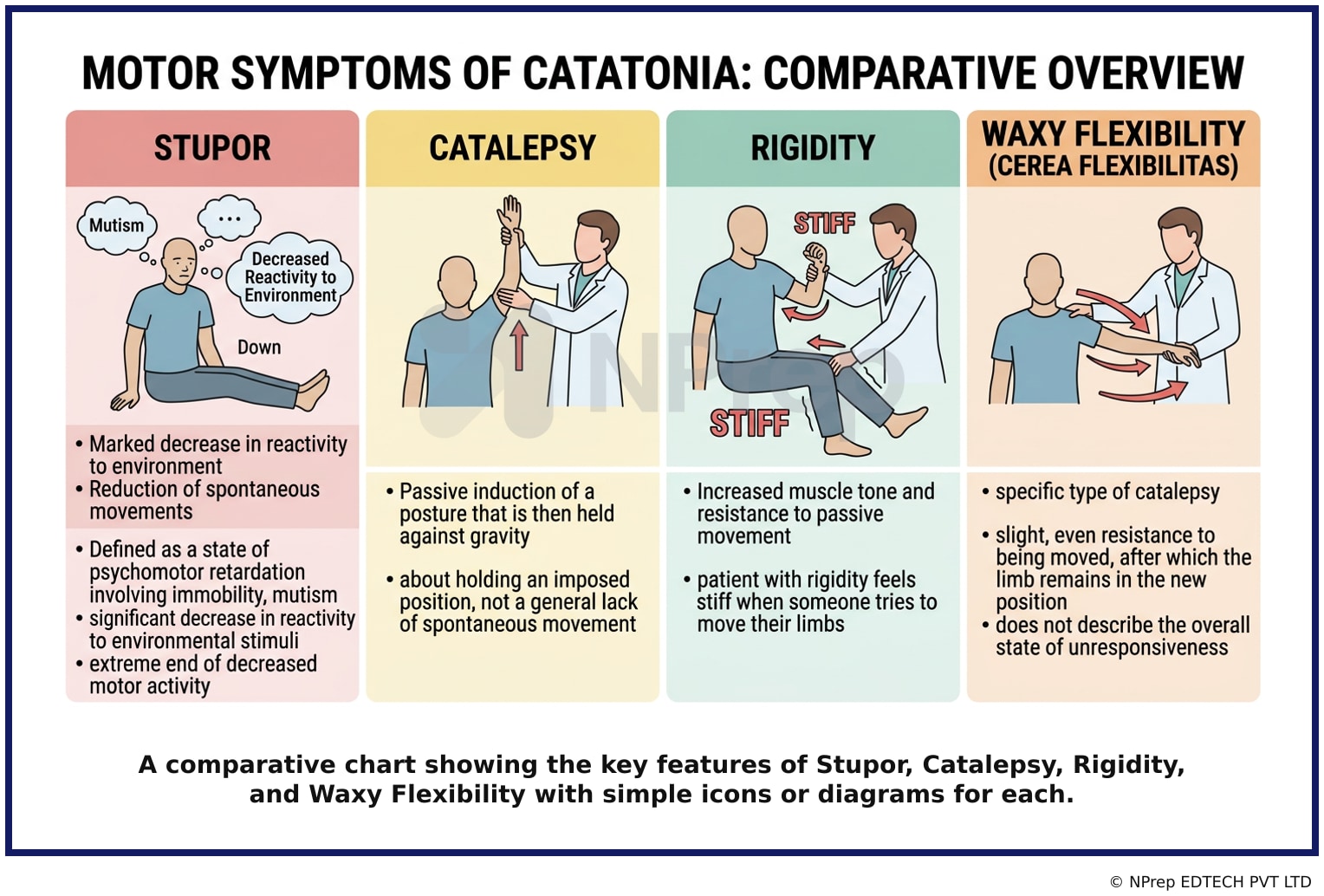
- Stupor, which is defined as a state of psychomotor retardation involving immobility, mutism, and a significant decrease in reactivity to environmental stimuli.
- The question's description of a 'marked decrease in reactivity to the environment and reduction of spontaneous movements' is the classic definition of stupor in the context of catatonia.
- According to DSM-5, stupor is one of the core diagnostic signs of catatonia, representing the extreme end of decreased motor activity.
Why Other Options Were Wrong
- Option B: Catalepsy is incorrect because it specifically refers to the passive induction of a posture that is then held against gravity. It is about holding an imposed position, not a general lack of spontaneous movement.
- Option C: Rigidity is incorrect as it describes increased muscle tone and resistance to passive movement. A patient with rigidity feels stiff when someone tries to move their limbs.
- Option D: Waxy flexibility (cerea flexibilitas) is a specific type of catalepsy. It involves a slight, even resistance to being moved, after which the limb remains in the new position. It does not describe the overall state of unresponsiveness.
Related Visual
Clinical Relevance
- Nursing practice connection: This is primarily an exam-oriented knowledge point with limited direct bedside application, so retain Motor Symptoms of Catatonia as background academic context rather than a clinical decision trigger.
- A patient in a catatonic stupor is at high risk for complications of immobility, including pressure ulcers, deep vein thrombosis (DVT), and contractures. Nursing care must prioritize safety and physiological stability.
- Nursing interventions include frequent repositioning, passive range-of-motion exercises, ensuring adequate hydration and nutrition (often via NG tube), and monitoring vital signs and skin integrity.
- What if? If a patient in a stupor suddenly becomes agitated and hyperactive, this could signify a switch to 'catatonic excitement,' another form of catatonia, which requires immediate intervention to ensure the safety of the patient and others.
How to Approach the Question
- First, analyze the question stem to identify the key descriptors. Here, the key phrases are 'marked decrease in reactivity' and 'reduction of spontaneous movements'.
- This is a factual recall question that requires knowledge of psychiatric terminology. Your goal is to match the description to the correct term.
- Define each option in your mind. Stupor = unresponsiveness/immobility. Catalepsy = holding an imposed posture. Rigidity = stiffness. Waxy flexibility = 'moldable' limbs.
- Compare the description in the stem with your definitions. The description perfectly matches the definition of stupor.
- Select the option that is a direct and complete match, eliminating others that describe more specific or different phenomena.
Concept Tested & Keywords
- Concept Tested: Motor Symptoms of Catatonia
- Stem keywords: catatonic schizophrenia, marked decrease in reactivity, reduction of spontaneous movements
- Lead-in keywords: is
Question ID
Q8knvDVHlvE3l4HVuS4xiC
Reference Book
E6 Robert Boland, Marcia L. Verduin - Kaplan and Sadock's Comprehensive Text of Psychiatry-Wolters Kluwer Health (2024) (pp 1-16525 of 16525) p. 4738-4740
E6 Kaplan Sadock's Synopsis of Psychiatry-2022 (pp 1-3768 of 3768) pp. 1090-1092, 1091-1093
Practise the full RIMS Nursing Officer - 2022
Attempt every question from this paper in a timed mock, then review the full solution for each one.
More Schizophrenia Questions
- Social skill training for Schizophrenia patient is done for which symptom?
- What is true about schizophrenia?
- A patient may report hearing voices criticizing him every time he hears the sound of a rotating fan and it stops when the fan is not running. Which t…
- According to Schneider, which of the following symptoms in schizophrenia patients are known as first rank, except?
- What are the 4 A's symptoms of schizophrenia?
- Which of the following are positive signs and symptoms of schizophrenia?
- A schizophrenic patient is stating that I am coming from other Planet and I have power to change the world. Patient may suffer from?
- Dementia praecox, a term for schizophrenia, was given by?
- False sensory perception in the absence of real external stimuli is called?
- A person seeing a design on the floor thought it was a fossil. It is an example of?
More RIMS Nursing Officer - 2022 Questions
- What is the role of a scrub nurse in an operation theatre?
- Records that relate to an agency's financial transactions, such as budget, are called?
- Which of the following is NOT an advantage of an intake and output chart?
- Which of the following chest physiotherapy devices is used to provide information about the patient's inspiratory effort by measuring the air flow (F…
- Which of the following is called the main microtubule organizing centre (MTOC) in animal cells?
- The proximal connection of metatarsal bones and tarsal bones make up the tarsometatarsal joint complex commonly referred to as?
- Which of the following is NOT included in a liver function test?
- Which of the following diabetic complications is called the atherosclerotic occlusive disease of lower extremity?
- Sporulation occurs at which stage of bacterial growth curve?
- Which type of hypersensitivity reaction causes good pasture syndrome?