
RRB Nsg Superintendent -29 April 2025 (Shift-1st)
Biochemistry & Nutrition
Easy
Lactose Intolerance occurs due to deficiency of _______.
Appeared in: RRB Nsg Superintendent -29 April 2025 (Shift-1st)
Explanation
- Lactose intolerance is a metabolic disorder caused by the deficiency of the enzyme lactase.
- Lactase is a brush border enzyme in the small intestine responsible for hydrolyzing lactose (milk sugar) into absorbable monosaccharides: glucose and galactose.
- In lactase deficiency, unhydrolyzed lactose travels to the colon, where bacterial fermentation causes symptoms like abdominal pain, bloating, flatus, and diarrhea.
- This condition can be primary (genetically determined decline in the enzyme) or secondary to intestinal mucosal injury (e.g., from gastroenteritis or celiac disease).
Why Other Options Were Wrong
- Option A: β-glycosidase is a very broad class of enzymes that cleave glycosidic bonds. While lactase is technically a type of β-galactosidase (a related class), 'Lactase' is the specific and clinically precise name for the enzyme deficient in this condition.
- Option B: Amylase is responsible for the digestion of starch (a complex carbohydrate) into smaller sugars. It has no role in the digestion of lactose.
- Option C: Isomaltase is part of the sucrase-isomaltase enzyme complex. It digests isomaltose, which is formed during the breakdown of starch. It does not digest lactose.
Related Visual
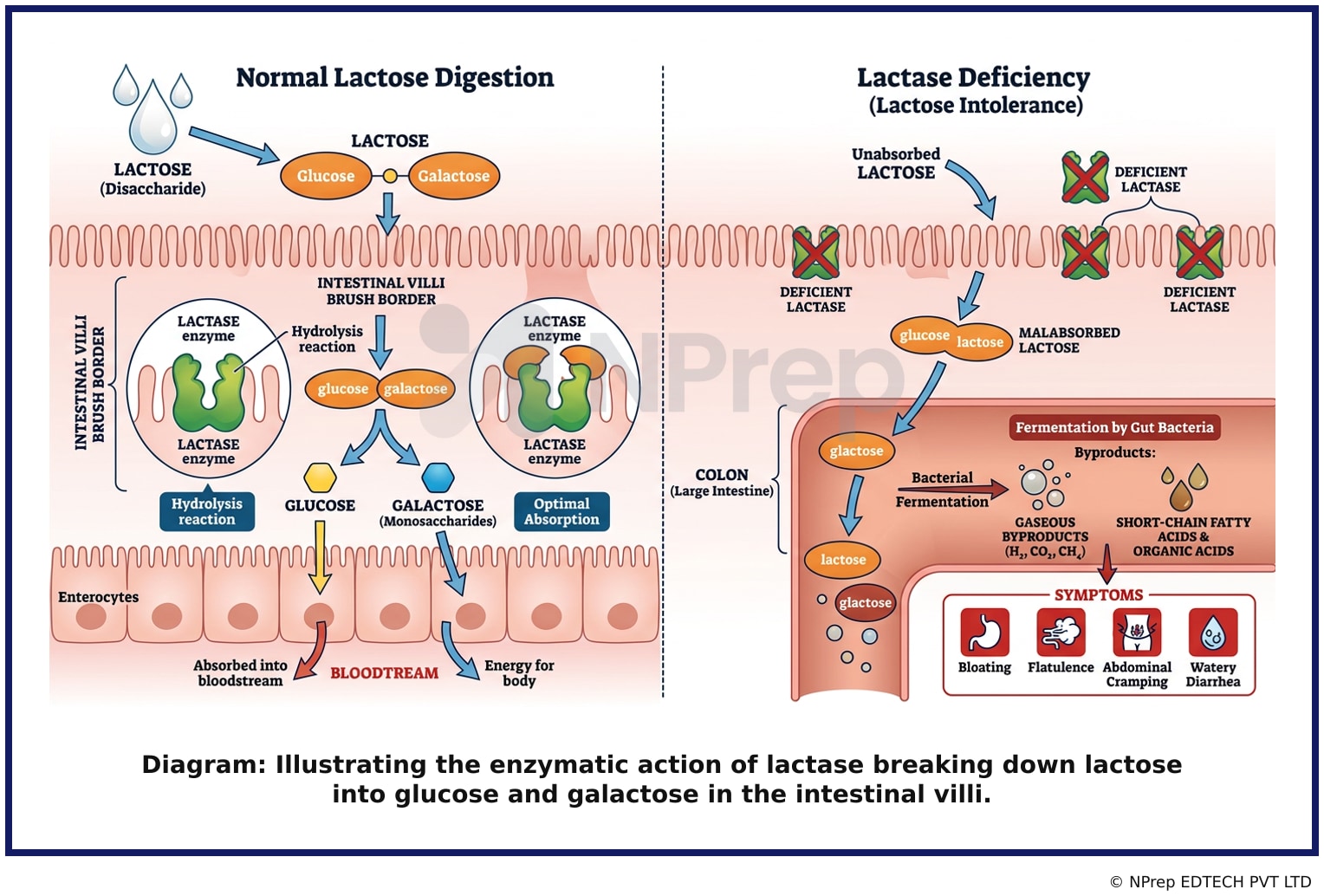
- Visual 1: Diagram: Illustrating the enzymatic action of lactase breaking down lactose into glucose and galactose in the intestinal villi.
- Visual 2: Flowchart: Depicting the pathophysiology of lactose intolerance, starting from lactase deficiency, leading to undigested lactose in the colon, bacterial fermentation, and resulting clinical symptoms.
Clinical Relevance
- Nursing practice connection: This is primarily an exam-oriented knowledge point with limited direct bedside application, so retain Carbohydrate digestion and enzyme deficiencies as background academic context rather than a clinical decision trigger.
- Nurses are central to patient education for managing lactose intolerance. This includes teaching dietary modifications, such as avoiding high-lactose foods, choosing lactose-free alternatives, and reading food labels for hidden lactose.
- Since dairy products are a primary source of calcium, nurses should assess the patient's risk for calcium and vitamin D deficiency and recommend alternative sources (e.g., fortified foods, leafy greens) or supplements.
- What if? If an infant presents with severe diarrhea and failure to thrive from birth after consuming milk, the nurse should suspect congenital lactase deficiency, a rare but serious condition. The immediate intervention would be to switch to a specialized lactose-free formula.
How to Approach the Question
- This is a factual recall question that tests your knowledge of digestive physiology.
- Identify the core concept: The question asks for the specific enzyme deficiency linked to 'Lactose Intolerance'.
- Analyze the term 'Lactose'. Many enzymes are named by adding the suffix '-ase' to their substrate. Therefore, the enzyme that digests lactose is 'lactase'.
- Evaluate the options based on this knowledge. 'Lactase' directly corresponds to the substrate 'lactose'.
- Briefly recall the functions of the other enzymes to confirm they are incorrect. Amylase digests starch, and isomaltase digests isomaltose. β-glycosidase is too general.
- Select 'Lactase' as the most specific and accurate answer.
Concept Tested & Keywords
- Concept Tested: Carbohydrate digestion and enzyme deficiencies
- Stem keywords: Lactose Intolerance, deficiency
- Lead-in keywords: BEST, MOST RELEVANT CLUE
- Negative lead-in flag: false
Question ID
QunUvG67-2Gy-SM3grRzi8
Practise the full RRB Nsg Superintendent -29 April 2025 (Shift-1st)
Attempt every question from this paper in a timed mock, then review the full solution for each one.
More Carbohydrates Questions
- Lactose present in milk is a?
- The pathway through which a cell produces the maximum number of ATP molecules is?
- The heteropolysaccharide that acts as a lubricant and shock absorber in joints is?
- Lactose is made up of?
- Breakdown of glycogen to glucose is known as?
- The process by which ADP is phosphorylated by Pi (inorganic phosphate) to ATP in the electron transport chain is known as?
- Which one among the following gives a negative Benedict's test?
- Which of the following has the highest glycemic index?
- Glycerol is converted to glucose in?
- The connecting link between glycolysis and Kreb's cycle in aerobic respiration is?
More RRB Nsg Superintendent -29 April 2025 (Shift-1st) Questions
- In a certain code language, 'A + B' means 'A is the daughter of B', 'A - B' means 'A is the brother of B', 'A × B' means 'A is the wife of B' and 'A…
- Which constitutional body is responsible for auditing the accounts of the Union and State Governments in India?
- Which of the following statements about the human eye is NOT correct?
- Manish can complete a piece of work in 32 days. He worked for 4 days and then left. Satish completed the remaining work in 16 days. In how much time…
- If the volume of cube is 117649 m³, then find the total surface area of cube in m².
- In the following number-pairs, the second number is obtained by applying certain mathematical operations to the first number. Select the pair in whic…
- Which of the following is CORRECT regarding the water harvesting is an age-old concept in India?
- Which of the following statements about the Kyoto Protocol's enforcement in 2005 is true?
- Which of the following unsaturated hydrocarbons contains a triple bond?
- A person's vision can become blurred over time due to \ \ \ \ \ defects in the eye.