
RRB Nsg. Superintendent-20 July 2019 (Shift-3rd)
Applied Sociology
Easy
______ is the practice that one must marry within one's own caste (or) group.
Appeared in: RRB Nsg. Superintendent-20 July 2019 (Shift-3rd)
Explanation
- Endogamy is the sociological rule that dictates marriage must occur within a specific social group, caste, or tribe.
- This practice is aimed at preserving the group's identity, social structure, and cultural traditions.
- A prominent example is caste endogamy in India, where marriage outside one's caste is traditionally prohibited.
- The key differentiator is the restriction of marriage to an 'in-group', as opposed to marrying outside the group (exogamy) or the number of partners (monogamy/polygamy).
Why Other Options Were Wrong
- Option A: Polygamy refers to the number of spouses a person has (more than one), not the group from which they can choose a spouse.
- Option C: Monogamy refers to having only one spouse at a time. It does not specify any rules about the group from which the spouse must be chosen.
- Option D: Quadrigamy is not a standard sociological term. It literally implies a fourth marriage or having four spouses, which is a specific form of polygamy, but it does not relate to the rule of marrying within a specific group.
Related Visual
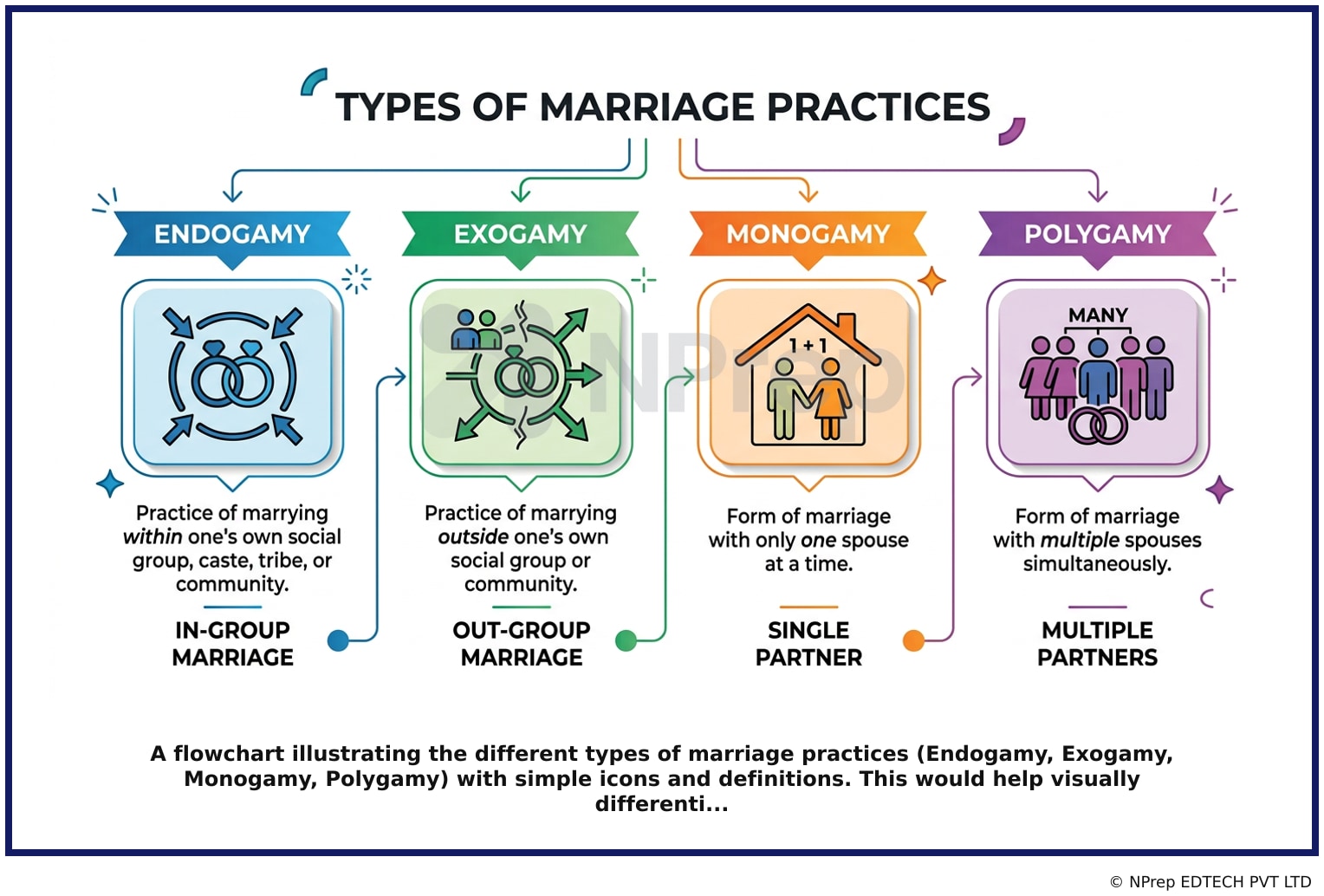
- Visual 1: Diagram - A flowchart illustrating the different types of marriage practices (Endogamy, Exogamy, Monogamy, Polygamy) with simple icons and definitions. This would help visually differentiate the concepts.
Clinical Relevance
- Nursing practice connection: This is primarily an exam-oriented knowledge point with limited direct bedside application, so retain Sociological Concepts of Marriage as background academic context rather than a clinical decision trigger.
- As a nurse, understanding concepts like endogamy is crucial for providing culturally competent care. It can influence family dynamics, social support systems, and decision-making processes related to health.
- Endogamous communities may have a higher prevalence of certain genetic disorders due to a limited gene pool. Awareness of this can be important for genetic counseling and health screening.
- What if? If a patient comes from a strictly endogamous community and requires a tissue or organ transplant, the nurse should be aware that the search for a compatible donor might be primarily focused within that same community, which can present unique challenges and require culturally sensitive communication.
How to Approach the Question
- First, read the question carefully to identify the key concept. The question asks for the term for marrying 'within one's own caste or group'.
- Analyze the keywords: 'within', 'own caste', 'group'. This points to a rule of inclusion or restriction.
- Define each option in your mind or on paper. Polygamy (many partners), Endogamy (marrying in), Monogamy (one partner), Quadrigamy (four partners).
- Compare the definition from the question with the definitions of the options.
- The definition 'marrying within one's own group' directly matches the definition of Endogamy.
- Select Endogamy as the correct answer and eliminate the other options based on their incorrect definitions in this context.
Concept Tested & Keywords
- Concept Tested: Sociological Concepts of Marriage
- Stem keywords: practice, marry, within, own caste, group
- Lead-in keywords: BEST, MOST RELEVANT CLUE
- Negative lead-in flag: false
Question ID
Q3eoC5WTPsucptm0Zd6h7x
Practise the full RRB Nsg. Superintendent-20 July 2019 (Shift-3rd)
Attempt every question from this paper in a timed mock, then review the full solution for each one.
More Family and Marriage Questions
- In Duvall's eight development stages of a family life cycle, couples come under?
- Which type of family comes under the male head of the family possessing all powers?
- The type of family in which father has highest status in family who controls the social life of family is called
- The basic unit of society is?
- Which among the following is not a type of marriage?
- Polygamy is?
- Family is an?
- Fundamental unit of society is?
- Change in relationship, economic independence, small family, marriage settled by partners is an features of?
- Group in which people are not married if having blood relations but are married outside the group is termed as?
More RRB Nsg. Superintendent-20 July 2019 (Shift-3rd) Questions
- Where is oxytocin synthesized?
- What is the name of the muscle that extends from the sphenoid bone to the mandible?
- Complementary feeding should be initiated at the completion of \ \ \ \ \ \
- Where is kidney located?
- Psychosocial development stage for infants is \ \ \ \ \ \ \ \ \ \
- What immunization is given at birth?
- Functional nursing is a method of providing
- Which disease is the dementia associated with asymmetric atrophy of the frontal and temporal lobes?
- Thromboangiitis obliterans is also known as
- What is the other name of pyridoxine?