
OSSSC Nursing Officer-2021
Nursing Foundation
Easy
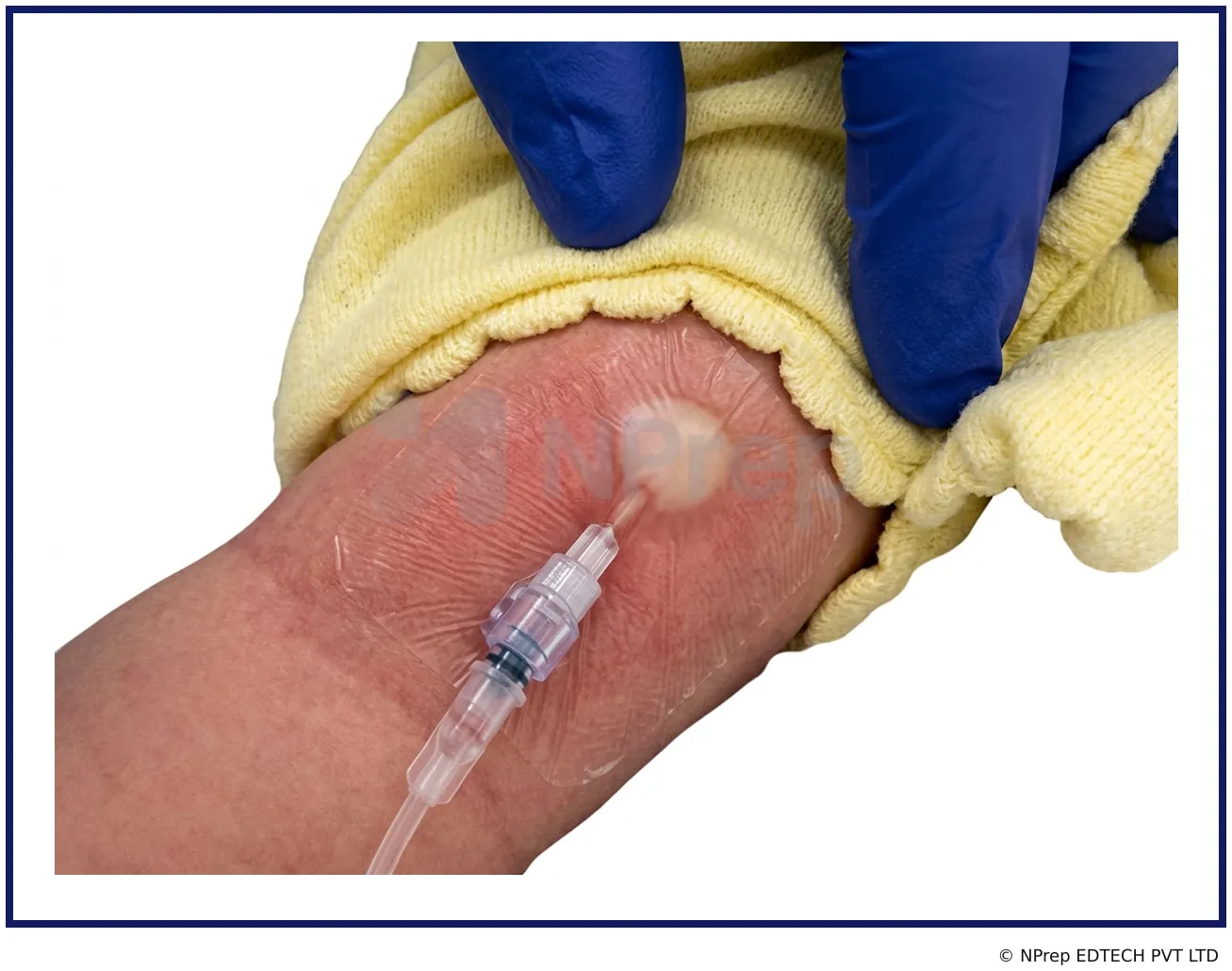
Injection technique shown in figure is used to administer?
Appeared in: OSSSC Nursing Officer-2021
Explanation
- The image shows the characteristic technique of an intradermal injection, identified by the shallow 10-15 degree angle of the needle and the formation of a raised wheal or bleb on the skin.
- The Bacillus Calmette-Guérin (BCG) vaccine is specifically administered via the intradermal route to ensure a localized immune response.
- This method deposits the vaccine into the dermis, which is rich in immune cells, making it ideal for the BCG vaccine's mechanism of action.
Why Other Options Were Wrong
- Option B: The Measles vaccine (usually as MMR) is administered subcutaneously, not intradermally. A subcutaneous injection uses a 45-degree angle to reach the fatty tissue beneath the skin.
- Option C: The Hepatitis B vaccine is administered intramuscularly, at a 90-degree angle, to deliver the vaccine deep into the muscle tissue for systemic absorption.
- Option D: The Japanese Encephalitis (JE) vaccine is given either subcutaneously (45 degrees) or intramuscularly (90 degrees), but not intradermally.
Related Visual

Clinical Relevance
- Nursing practice connection: This is primarily an exam-oriented knowledge point with limited direct bedside application, so retain Vaccine Administration Routes as background academic context rather than a clinical decision trigger.
- Correctly identifying and using the prescribed injection route is a fundamental nursing skill crucial for patient safety and vaccine efficacy. Using the wrong technique can lead to reduced immune response, local injury, or unnecessary pain.
- The formation of a wheal during an intradermal injection is a visual confirmation of correct placement. If a wheal does not form, it may indicate the needle was inserted too deeply, and the injection may need to be repeated at another site.
- What if? If BCG vaccine were accidentally administered subcutaneously instead of intradermally, it could lead to a severe local reaction, including abscess formation and regional lymphadenitis, without providing optimal protection against TB.
How to Approach the Question
- First, carefully analyze the image provided. Identify the key features of the injection technique shown, such as the angle of the needle and the reaction of the skin (formation of a wheal).
- Based on these visual cues, classify the injection type. The shallow angle (10-15 degrees) and the wheal are classic signs of an intradermal injection.
- Next, review the options provided. Recall or look up the standard administration route for each vaccine listed.
- Compare your identification of the injection technique with the known routes for each vaccine. BCG is given intradermally, Measles subcutaneously, Hepatitis B intramuscularly, and JE subcutaneously or intramuscularly.
- Select the option that matches the technique shown in the image. In this case, the intradermal technique matches the administration route for the BCG vaccine.
Concept Tested & Keywords
- Concept Tested: Vaccine Administration Routes
- Stem keywords: Injection technique, figure, administer
- Lead-in keywords: used to
- Clinical cues: Image showing a shallow-angle injection creating a skin wheal.
Question ID
QuKuUC5wvGGR-v44VlhFjp
Reference Book
E6 Comprehensive Textbook of Community Health Nursing for BSc Nursing Students Part 2 — Subpart B (pp 276-535 of 550) pp. 234-236, 233-235
E6 Anatomy Applied Ashalatha 4e p. 232-234
Practise the full OSSSC Nursing Officer-2021
Attempt every question from this paper in a timed mock, then review the full solution for each one.
More Administration of medications Questions
- Which is the appropriate site to administer Intramuscular injections in children?
- The route of Mantoux skin test is:
- What is the size of needle for Intramuscular (IM) injection in adults?
- You are administering an intravenous medication to a patient, and the medication label instructs you to infuse 50 mL over 15 minutes. What is the cor…
- A physician orders a medication to be administered to a patient in a dose of 200mg twice daily (BD). The pharmacy provides tablets of the medication,…
- Desired dose of Morphine for a patient is 0.4 mg. Dose available is 1 mg/mL. The correct formulation for this patient is:
- Cefuroxime sodium, 1 g in 50 mL normal saline (NS), is to be administered over 30 minutes to a client with an infection. The drop factor is 15 drops…
- To ensure accurate medication administration and prevent errors, what is the most comprehensive method for verifying a patient's identity?
- Maximum chance of sciatic nerve injury during which site of I.M injection?
- Identify route of drug administration:
More OSSSC Nursing Officer-2021 Questions
- A man completed a journey in 10 hours. He travelled first half of the total distance at the rate of 21 km/hr and second half at the rate of 24 km/hr.…
- A person crosses a 600 metre long street in 5 minutes. What is his speed in kilometer per hour?
- What is the cube of -1 1/3?
- What is the ratio between 0.02 and 0.002?
- After 4 years the principal amount of Rs. 12000 grows into Rs. 14,400. Find out the rate of simple interest?
- What is the decimal of 9% ?
- If the marked price of an article is Rs. 400/- and its sale price is Rs. 340/-, Find out the percentage of discount.
- If three-fifth (3/5) of 60% of a number is 36, then what is the number?
- After 15 years, a man will be just four times as old as he was 15 years ago. What is his present age?