
NORCET 3 - 2022 (Shift-1)
Pathology & Genetics
Hard
In the following human pedigree, the filled symbols represent the affected individuals. Identify the type of given pedigree? 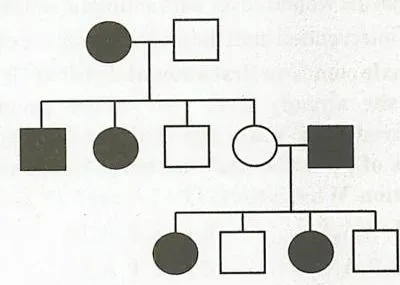
Appeared in: NORCET 3 - 2022 (Shift-1)
Explanation
- The key to identifying the inheritance pattern is the offspring of the affected father (II-5) and unaffected mother (II-4).
- This couple has two affected daughters and two unaffected sons. An affected father transmitting the trait to all his daughters and none of his sons is the classic hallmark of X-linked dominant inheritance.
- This occurs because a father passes his only X chromosome (which carries the dominant allele) to all his daughters, making them affected. He passes his Y chromosome to his sons, so they cannot inherit the trait from him.
- The trait also appears in every generation, which is consistent with a dominant pattern of inheritance.
Why Other Options Were Wrong
- Option B: This is ruled out because the affected mother in generation I (I-1) has an unaffected son (II-3). In X-linked recessive inheritance, an affected mother would pass the trait to all of her sons.
- Option C: While this pattern also shows vertical transmission (appearing in every generation), it does not typically result in an affected father passing the trait to 100% of his daughters and 0% of his sons. In autosomal dominant inheritance, an affected parent has a 50% chance of passing the trait to each child, regardless of sex.
- Option D: This pattern is characterized by skipping generations, which is not seen here as the trait appears in all three generations. Also, in recessive inheritance, affected individuals typically have unaffected (carrier) parents.
Related Visual

- Visual 1: Diagram: A flowchart for systematic pedigree analysis, starting with checking for dominant/recessive patterns and then for autosomal/X-linked patterns.
- Visual 2: Infographic: A visual comparison of the four main Mendelian inheritance patterns (Autosomal Dominant, Autosomal Recessive, X-linked Dominant, X-linked Recessive) with example pedigrees for each.
Clinical Relevance
- Nursing practice connection: Knowing Pedigree analysis and modes of genetic inheritance helps nurses interpret findings accurately and avoid errors in routine assessment, medication administration, and patient teaching.
- Understanding pedigree analysis is crucial for genetic counseling, allowing nurses and physicians to assess disease risk, predict recurrence in a family, and guide decisions about genetic testing.
- Examples of X-linked dominant disorders include Vitamin D-resistant rickets, Rett syndrome, and Alport syndrome.
- What if... the affected father (II-5) had an affected son? This single observation would definitively rule out X-linked inheritance and make Autosomal Dominant the correct answer, as it would demonstrate male-to-male transmission.
How to Approach the Question
- First, observe the overall pattern. Does the trait appear in every generation? Yes (I, II, III). This suggests a dominant inheritance pattern.
- Next, look for clues to distinguish between autosomal and X-linked inheritance.
- Focus on the most informative part of the pedigree: an affected parent with multiple children.
- Examine the offspring of the affected father (II-5) and unaffected mother (II-4). Note that all daughters are affected, and all sons are unaffected.
- Recall the rules of X-linked inheritance: fathers pass their X chromosome to all daughters and their Y chromosome to sons. The observed pattern perfectly matches X-linked dominant inheritance.
- Confirm this by checking for contradictions elsewhere. For example, an affected mother (I-1) can have an unaffected son (II-3), which is consistent with her being heterozygous.
Concept Tested & Keywords
- Concept Tested: Pedigree analysis and modes of genetic inheritance.
- Stem keywords: human pedigree, affected individuals, identify the type
- Lead-in keywords: Identify
- Clinical cues: Affected father has all affected daughters and no affected sons
- Negative lead-in flag: false
Question ID
Qplxd9kzb6dDeIILD7zC1U
Practise the full NORCET 3 - 2022 (Shift-1)
Attempt every question from this paper in a timed mock, then review the full solution for each one.
More Genetics Questions
- Eugenics means:
- The genetic material, deoxyribonucleic acid (DNA) is contained in:
- Which is the mode of inheritance of cystic fibrosis?
- Karyotype of Klinefelter syndrome is?
- Same allele group also called as?
- Identify the disorder shown in this pedigree chart?
- Haemophilia is associated with?
- Eugenics means?
- Which causes Klinefelter syndrome?
- Down syndrome is also known as?
More NORCET 3 - 2022 (Shift-1) Questions
- A patient is getting IV fluid through peripheral cannula, shows redness, cool, oedema and decreased flow rate. The possible diagnosis is?
- The Endemic Disease that occurs every 4 years of interval is called?
- The nurse witnesses a neighbour's husband sustain a fall from the roof of his house. The nurse rushes to the victim and determines the need to open t…
- In a patient IV site shows redness, heat, tenderness, decrease flow rate, are the classical sign of?
- Which measure is used for growth monitoring at Anganwadi centre?
- Which of the following muscles should always be avoided for IM Injection to prevent sciatic nerve injury?
- The doses of Elemental Iron and folic acid in Anaemia Mukht Bharat (AMB) program for pregnant women?
- A child is suffering from diarrhoea with restlessness, agitation and irritability. Which of the following clinical sign is not indicating to severe d…
- A 45 year female client with clinical manifestation of worthlessness, hopelessness, and not involved in her family activities and she is not eating f…
- A 7-year-old child is brought to the ER at midnight by his mother after symptoms appeared abruptly. The nurse's initial assessment reveals a temperat…