
ESIC Nursing Officer 2016 (shift-1)
Community Health Nursing
Medium
In India it is recently found that incidence of malaria is increasing due to?
Appeared in: ESIC Nursing Officer 2016 (shift-1)
Explanation
- The primary driver for the resurgence of malaria is the development of insecticide resistance in the Anopheles mosquito, the vector for the disease.
- Dichlorodiphenyltrichloroethane (DDT) has been widely used in Indoor Residual Spraying (IRS) programs to kill mosquitoes.
- When mosquitoes become resistant to DDT, the IRS programs fail, allowing the vector population to increase.
- An increased vector population leads to more effective transmission of the malaria parasite to humans, causing a rise in the incidence of the disease.
Why Other Options Were Wrong
- Option A: While poor sanitation creates more breeding sites for mosquitoes, it is a chronic, ongoing issue. It contributes to the overall malaria burden but is not the specific cause for a recent, sharp increase in incidence compared to the impact of insecticide resistance.
- Option B: An increase in population size expands the pool of susceptible hosts but does not inherently increase the transmission rate per person. The efficiency and density of the vector (mosquito) are more direct drivers of an epidemic surge.
- Option D: Poverty is a critical social determinant of health that increases vulnerability and worsens outcomes from malaria due to factors like poor housing and lack of access to care. However, it is not the direct epidemiological cause for an increase in the rate of new infections.
Related Visual
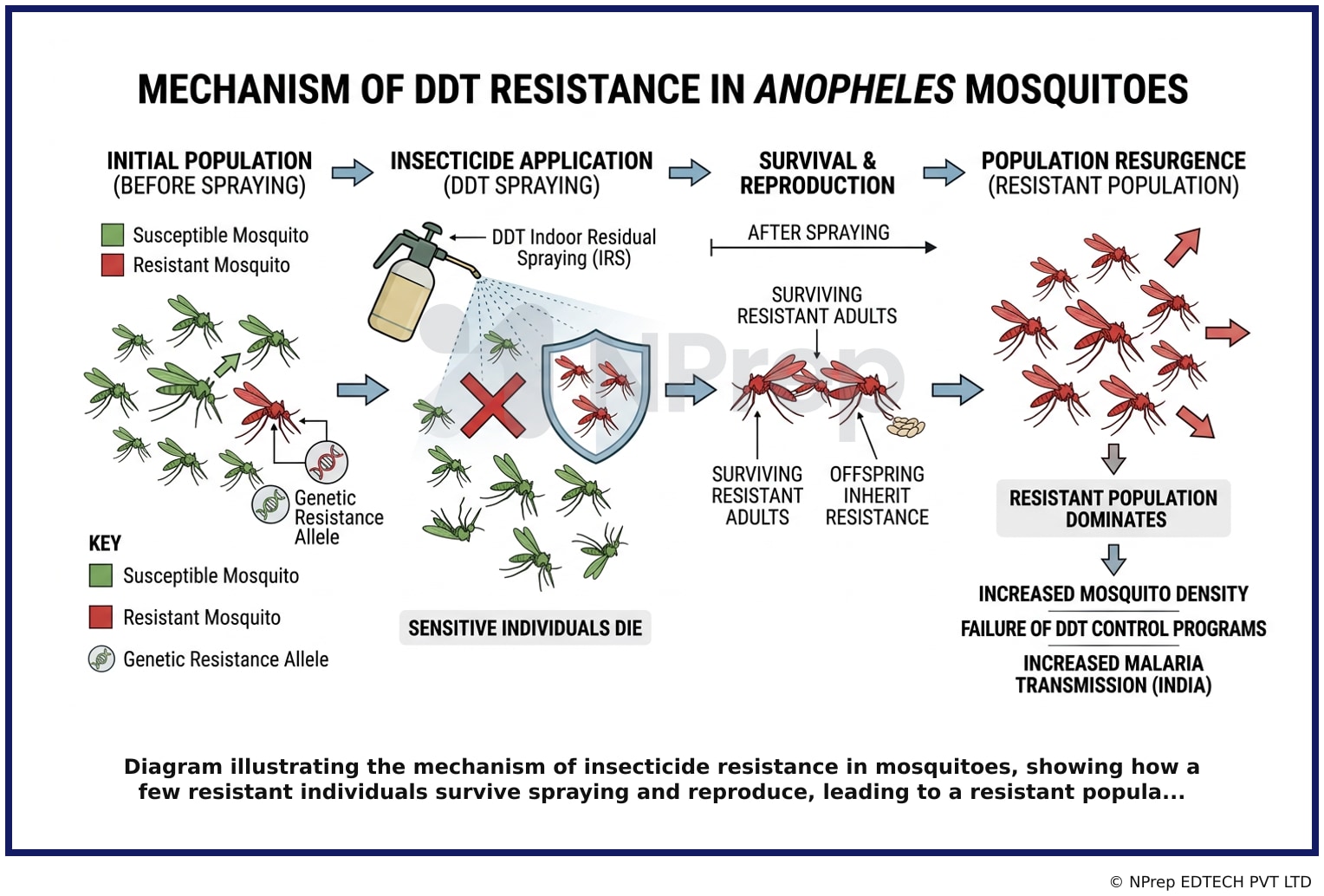
- Visual 1: Diagram illustrating the mechanism of insecticide resistance in mosquitoes, showing how a few resistant individuals survive spraying and reproduce, leading to a resistant population.
- Visual 2: Flowchart of Integrated Vector Management (IVM) strategies for malaria control, including IRS, LLINs, larval management, and community education.
- Visual 3: Map of India highlighting regions with high malaria endemicity and reported insecticide resistance.
Clinical Relevance
- Nursing practice connection: This is primarily an exam-oriented knowledge point with limited direct bedside application, so retain Factors influencing malaria incidence as background academic context rather than a clinical decision trigger.
- Nurses play a crucial role in community health education, teaching about malaria prevention strategies like using Long-Lasting Insecticidal Nets (LLINs), which are vital where insecticide resistance has reduced the effectiveness of IRS.
- Community health nurses must advocate for and participate in environmental sanitation and source reduction activities (e.g., draining stagnant water) as part of an Integrated Vector Management (IVM) approach.
- Recognizing the signs of malaria early and ensuring prompt diagnosis and treatment is a key nursing responsibility, especially in high-risk areas.
How to Approach the Question
- First, identify the core of the question: it asks for the cause of a recent increase in malaria cases in India.
- Analyze the options to determine which represents a significant change or failure in control measures, rather than a chronic or background condition.
- Recall that malaria is a vector-borne disease. Therefore, factors that directly impact the mosquito vector's population and its ability to transmit the disease are likely to cause sharp changes in incidence.
- Evaluate the options: Poor sanitation, population growth, and poverty are ongoing issues. Mosquitoes becoming resistant to a primary insecticide (DDT) represents a specific failure of a major control strategy.
- Conclude that the failure of vector control due to insecticide resistance is the most direct and potent cause for a recent increase in malaria incidence.
Concept Tested & Keywords
- Concept Tested: Factors influencing malaria incidence
- Stem keywords: India, malaria, increasing incidence
- Lead-in keywords: due to
Question ID
QZhHp7R0kJriYmfBUMXEa_
Practise the full ESIC Nursing Officer 2016 (shift-1)
Attempt every question from this paper in a timed mock, then review the full solution for each one.
More Arthropod-borne infections Questions
- Match the following: Types of Diseases Example a. Vector borne diseases 1. Tuberculosis b. Infectious diseases 2. Malaria c. Zoonotic diseases 3. Cho…
- Which is the main vector responsible for the transmission of dengue fever?
- Which of the following is a vector borne disease?
- National malaria eradication program was launched in the year?
- Dengue fever is caused by which mosquito?
- Which of the following statements about Dengue fever is correct? 1. It is the most commonly found arboviral infection. 2. Its incidence has been decr…
- Dengue is spread by which mosquito?
- Which of the following is responsible for the spread of dengue?
- Chain of spreading of malaria is?
- Dengue fever is transmitted by?
More ESIC Nursing Officer 2016 (shift-1) Questions
- Normal Bi-Parietal (BPD) Measurement of full term fetal head is?
- Negri bodies are found in cells infected with?
- Which one of these is not an obstetric forceps?
- Whooping cough is caused by?
- Difficulty in achieving and maintaining balance, gross or fine motor in coordination called?
- is considered mood disorder, which include the occurrence of depressive episodes and one or more related mood episodes?
- Lumbar puncture (spinal tap) is done in between vertebrae?
- The normal non-pregnant uterus weighs in gm is?
- "Moslem prayer" position is used in surgery?
- The term meningocele means?