
INI-CET EXAM -2026
Pathology & Genetics
Medium
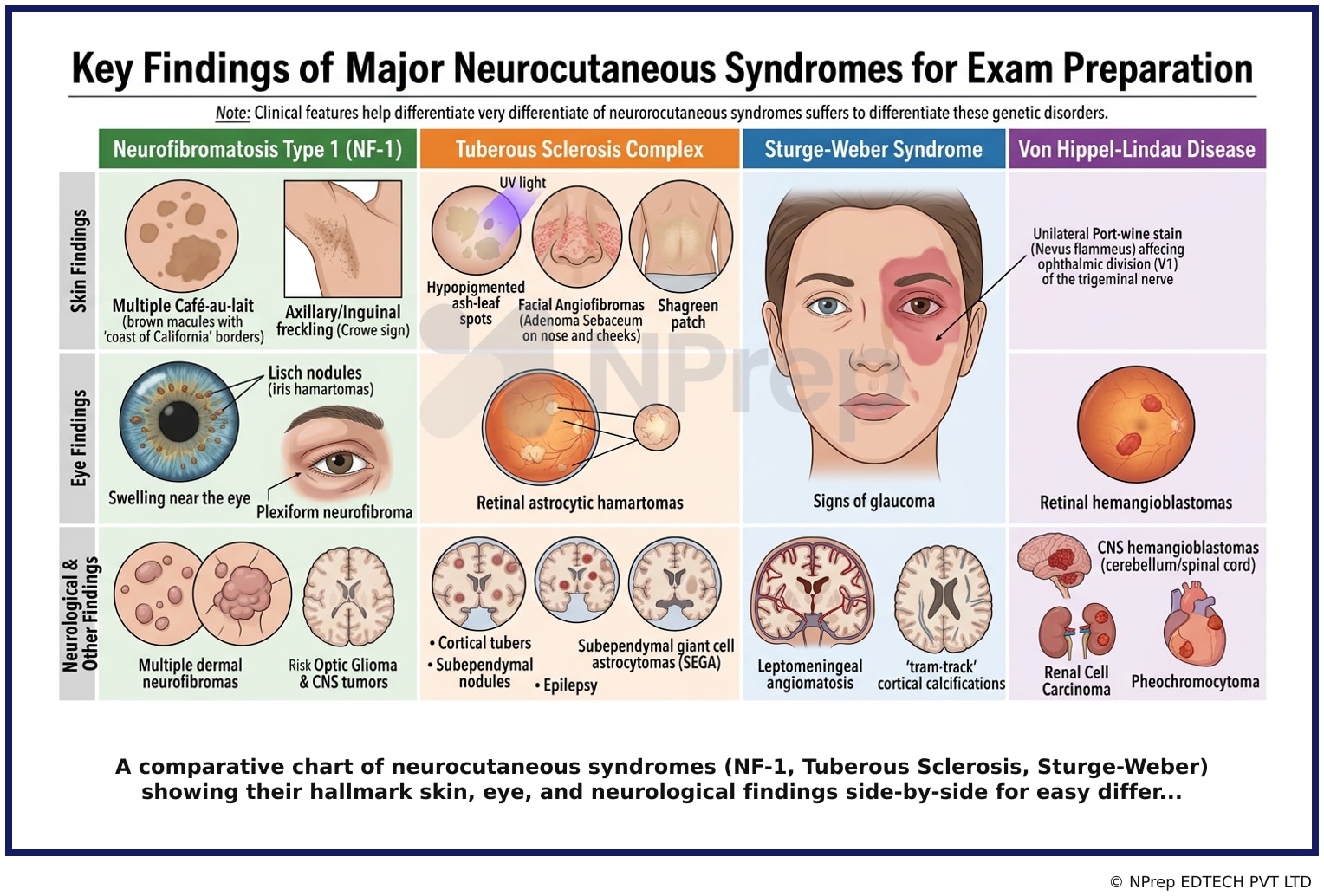
Images show café au lait spots, Lisch nodules on the iris, and swelling near the eye. Identify the most likely syndrome:
Appeared in: INI-CET EXAM -2026
Explanation
- NF-1 is a genetic disorder affecting the nervous system and skin, caused by a mutation in the NF1 gene on chromosome 17.
- The diagnosis is clinical, requiring two or more specific criteria to be met.
- The patient's signs—café-au-lait spots (a pigmentary finding), Lisch nodules (iris hamartomas), and swelling near the eye (likely a plexiform neurofibroma)—satisfy three of the major diagnostic criteria.
- Café-au-lait macules are the hallmark of NF-1 and are present in almost all patients.
- Lisch nodules are found in over 90% of adults with NF-1 and are best seen with a slit-lamp examination.
- Plexiform neurofibromas are congenital tumors that can cause significant disfigurement and complications.
Why Other Options Were Wrong
- Option B: Tuberous sclerosis is characterized by different signs, primarily hypopigmented 'ash-leaf' spots, facial angiofibromas (adenoma sebaceum), and shagreen patches. It does not present with the combination of café-au-lait spots and Lisch nodules.
- Option C: Sturge-Weber syndrome is a vascular, not neuro-tumoral, disorder. Its classic sign is a facial port-wine stain (nevus flammeus) in the distribution of the trigeminal nerve, often associated with glaucoma and leptomeningeal angiomas.
- Option D: Von Hippel-Lindau disease is characterized by the growth of tumors and cysts in various organs, particularly hemangioblastomas in the retina and central nervous system, renal cell carcinoma, and pheochromocytomas. The skin and iris findings of NF-1 are absent.
Related Visual
Clinical Relevance
- Nursing practice connection: Knowing Diagnosis of neurocutaneous syndromes based on clinical signs helps nurses interpret findings accurately and avoid errors in routine assessment, medication administration, and patient teaching.
- Nurses play a key role in identifying the signs of neurocutaneous syndromes during routine assessments, especially in pediatric settings. Early recognition is crucial for timely referral to specialists.
- Management of NF-1 is multidisciplinary and focuses on surveillance for complications. Nurses must monitor blood pressure (risk of hypertension), assess for scoliosis, and perform regular vision screenings (risk of optic glioma).
- Patient and family education is a vital nursing function, covering the genetic nature of the disorder, the variable expression, and the importance of regular follow-up to monitor for tumor development (e.g., malignant peripheral nerve sheath tumors).
How to Approach the Question
- First, carefully analyze the clinical findings presented in the question: café-au-lait spots (skin), Lisch nodules (eye), and swelling near the eye (nerve tumor).
- Recognize that this combination of signs affecting multiple systems (skin, eyes, nerves) points towards a systemic genetic syndrome, specifically a neurocutaneous disorder.
- Systematically review the diagnostic criteria for each option provided.
- Evaluate Option A (NF-1): Recall or look up the criteria. The presence of café-au-lait spots, Lisch nodules, and a probable neurofibroma strongly matches the diagnostic criteria for NF-1.
- Evaluate the other options (B, C, D): Note that Tuberous Sclerosis, Sturge-Weber, and Von Hippel-Lindau have distinct and different hallmark features that are not present in the question's description.
- Conclude that NF-1 is the most likely diagnosis as it is the only one that accounts for all the presented clinical signs.
Concept Tested & Keywords
- Concept Tested: Diagnosis of neurocutaneous syndromes based on clinical signs.
- Stem keywords: café au lait spots, Lisch nodules, swelling near eye, syndrome
- Lead-in keywords: Identify the most likely
- Clinical cues: The presence of a triad of specific signs (skin, eye, and nerve tumor) points towards a single underlying genetic disorder.
Question ID
QNxJ49f1ZVu5K1JHc3dCKC
Reference Book
E6 Nelson Textbook of Pediatrics(2024) — Volume 2 pp. 1459-1461, 1460-1462
E6 Ghai Essential Pediatrics(pp 26-904 of 913) p. 576-578
Practise the full INI-CET EXAM -2026
Attempt every question from this paper in a timed mock, then review the full solution for each one.
More Genetics Questions
- Eugenics means:
- The genetic material, deoxyribonucleic acid (DNA) is contained in:
- Which is the mode of inheritance of cystic fibrosis?
- Karyotype of Klinefelter syndrome is?
- Same allele group also called as?
- Identify the disorder shown in this pedigree chart?
- Haemophilia is associated with?
- Eugenics means?
- Which causes Klinefelter syndrome?
- Down syndrome is also known as?
More INI-CET EXAM -2026 Questions
- In the diagram of the abdominal wall musculature, the muscle labelled 'X' and the structure formed by its aponeurosis are best identified as:
- A 45-year-old chronic smoker is being counselled for smoking cessation therapy. Which of the following statements regarding nicotine replacement and…
- Lamotrigine is most effective in which of the following seizure types?& x20;
- In the labelled diagram of laryngeal intrinsic muscles, which labelled muscle is solely responsible for abduction of the vocal cords?
- & x20;Which muscle, as shown in the diagram, attaches to the cartilaginous portion of the Eustachian tube and also blends with the soft palate?
- Q4. Match each of the following organs with its correct embryological tissue of origin: Organ Embryological Origin& x20; A. Thyroid gland 1. Neural c…
- Q5. Match each of the following gastrointestinal organs with its distinctive histological feature: & x20;Organ Histological Feature & x20;1\. Ileum a…
- Q6. A developmental remnant of the embryological hindgut persisting in the retrorectal (presacral) space is most likely to give rise to which of the…
- & x20;The histological section shown in the image, characterized by predominantly serous acini, is best identified as which organ?
- A failure of fusion of the maxillary process with the medial nasal process during embryonic development results in which type of cleft anomaly?