
NIMHANS Nursing Officer - 2021
Mental Health Nursing
Medium
If a person is asked, "what will he do if he sees a house on fire"? Then what is being tested in that person?
Appeared in: NIMHANS Nursing Officer - 2021
Explanation
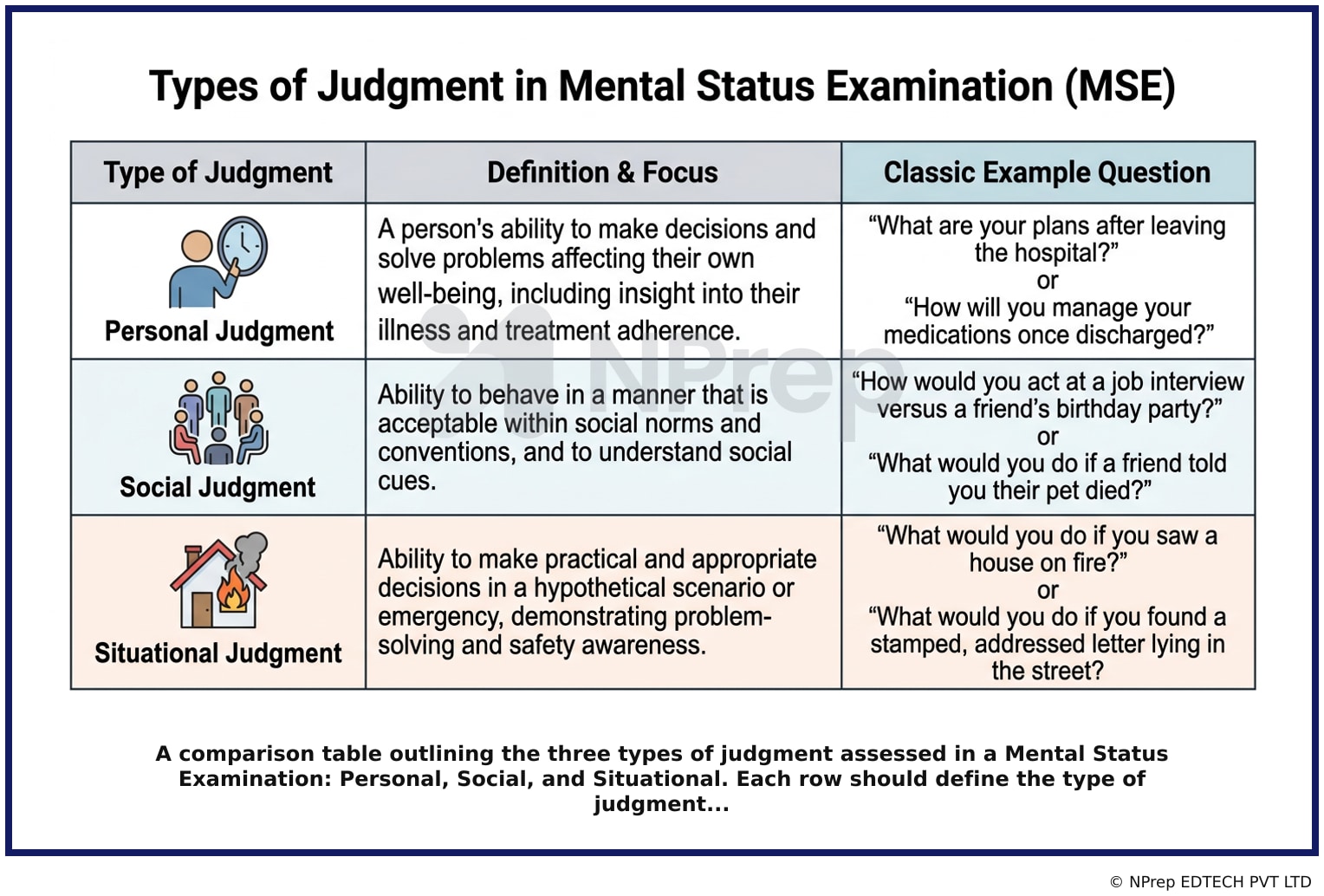
- This question assesses situational judgment, which is the ability to make practical and appropriate decisions in a hypothetical scenario.
- The 'house on fire' scenario is a classic tool in Mental Status Examinations (MSE) to evaluate a person's problem-solving skills and safety awareness in a potential emergency.
- An appropriate response, such as calling for help and ensuring the safety of oneself and others, indicates that the person's situational judgment is intact.
- This type of judgment is considered an executive function, primarily mediated by the frontal lobe of the brain.
Why Other Options Were Wrong
- Option A: This is not a standard clinical term used in the Mental Status Examination for assessing judgment.
- Option B: Insight refers to a person's awareness and understanding of their own illness and its consequences, not their ability to handle external situations.
- Option C: Social judgment relates to behaving in a manner that is acceptable within social norms and conventions (e.g., at a funeral or during an interview). The fire scenario tests emergency action, not social appropriateness.
Related Visual
Clinical Relevance
- Nursing practice connection: This is primarily an exam-oriented knowledge point with limited direct bedside application, so retain Assessment of Judgment in Mental Status Examination (MSE) as background academic context rather than a clinical decision trigger.
- Assessing a patient's judgment is a critical nursing function as it helps determine their ability to make safe decisions, adhere to treatment, and function independently after discharge.
- Impaired judgment can be a sign of various conditions, including frontal lobe dysfunction, psychosis, mania, or dementia, signaling a need for increased supervision and safety precautions.
- What if? If a patient with mania answers the 'house on fire' question correctly but their history shows they recently spent their life savings impulsively, it highlights a crucial clinical finding: a discrepancy between abstract (test) judgment and real-world (demonstrable) judgment.
How to Approach the Question
- First, identify the core concept being tested. The question asks about a specific assessment technique ('what will he do if...').
- Recognize that this is a standard question from the Mental Status Examination (MSE), a key part of a psychiatric assessment.
- Recall the different components of the MSE, specifically the assessment of 'judgment'.
- Differentiate between the sub-types of judgment taught in nursing: personal, social, and situational (or test).
- Match the scenario (a hypothetical emergency) to the correct sub-type. A 'house on fire' is a test of how one would act in a specific situation, which directly corresponds to situational judgment.
Concept Tested & Keywords
- Concept Tested: Assessment of Judgment in Mental Status Examination (MSE)
- Stem keywords: house on fire, what will he do, being tested
- Lead-in keywords: what is being tested
- Negative lead-in flag: false
Question ID
QwuJKAycQFL4nTaPk4HgT7
Reference Book
E6 Robert Boland, Marcia L. Verduin - Kaplan and Sadock's Comprehensive Text of Psychiatry-Wolters Kluwer Health (2024) (pp 1-16525 of 16525) pp. 3255-3257, 3809-3811
E6 Nursing Fundamentals Potter Perry 12e Part 3 p. 124-126
Practise the full NIMHANS Nursing Officer - 2021
Attempt every question from this paper in a timed mock, then review the full solution for each one.
More Nursing process in Psychiatry Questions
- What is the meaning of insight in MSE?
- Major cause of mental problems in elderly people?
- Mental status examination is used to identify?
- A patient is assessed using the Mini-Mental State Examination (MMSE) and scores 19/30. Which category does this score fall into?
- Name of the scale for measuring symptom severity in patients with schizophrenia?
- MSE means
- Which is a 30-point questionnaire scale that is used extensively in clinical and research settings to measure cognitive impairment at bed side in psy…
- As per the gazetted guidelines for assessment of persons with disability, which tool is used to assess mentaldisability for purpose of certification?
- Which of the following tools does a nurse use to assess the cognitive function of a client?
- Nursing Officer is taking mental status examination (MSE) in a patient and asks difference between apple and orange. What parameter is checking by as…
More NIMHANS Nursing Officer - 2021 Questions
- Types of lesion found in the muscles?
- In which nerve compression causes Saturday night palsy?
- Which of the following is a live vaccine?
- Lazy, inattentive driving causing an accident to a person suggests damage to which lobe of the brain?
- Which neurotransmitter is deficient in Parkinson's disease?
- National Health Protection Mission is also known as?
- What precaution should be kept in mind while administering phenytoin?
- Which is the most common site for IM injection in children?
- What are complications of ruptured ectopic pregnancy, except?
- Select the correct odd one?