
NORCERT 8 Mains-2025
Obstetrics & Gynaecology
Easy
Identify the obstetric maneuver shown in the image ? 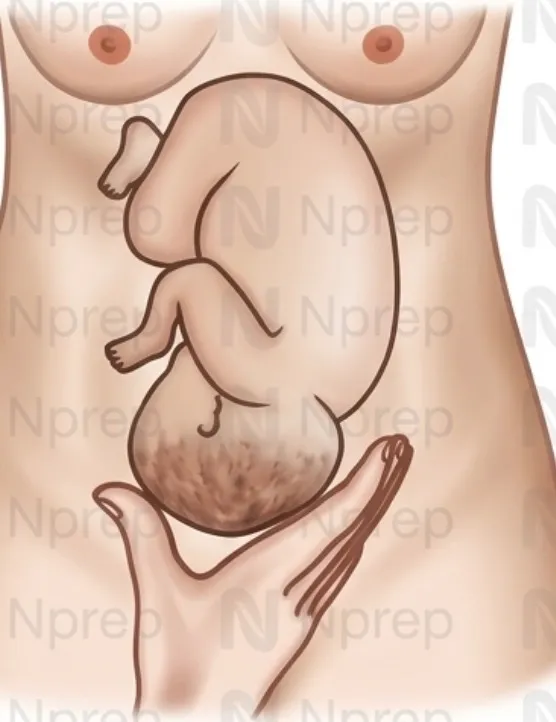
Appeared in: NORCERT 8 Mains-2025
Explanation
- The image correctly depicts the Third Leopold's Maneuver, also known as Pawlik's Grip.
- This maneuver is characterized by the use of a single hand, with the thumb and fingers spread, to grasp the lower uterine segment just above the symphysis pubis.
- The primary purpose of Pawlik's grip is to identify the fetal presenting part (e.g., head or breech) and to determine if it is engaged (fixed) or unengaged (movable/ballotable) in the maternal pelvis.
Why Other Options Were Wrong
- Option A: The Fundal Grip is the First Leopold's Maneuver, which involves using both hands to palpate the top of the uterus (fundus), not one hand on the lower abdomen.
- Option C: The Pelvic Grip is the Fourth Leopold's Maneuver. It requires the examiner to face the woman's feet and use both hands to palpate the presenting part as it enters the pelvis. The image shows a single hand with the examiner facing the woman's head.
- Option D: The Lateral Grip is the Second Leopold's Maneuver. It uses both hands placed on the sides of the abdomen to locate the fetal back and limbs, which is different from the single-hand grasp shown.
Related Visual

- Visual 1: Diagram - A comparative chart showing the hand placements for all four Leopold's maneuvers (Fundal, Lateral, Pawlik's, and Pelvic grips) on a pregnant abdomen. This helps learners differentiate them visually.
Clinical Relevance
- Nursing practice connection: This is primarily an exam-oriented knowledge point with limited direct bedside application, so retain Identification of Leopold's Maneuvers as background academic context rather than a clinical decision trigger.
- Leopold's maneuvers are a crucial, non-invasive clinical skill for nurses and midwives to assess fetal lie, presentation, position, and engagement during routine antenatal check-ups and labor.
- The findings from these maneuvers help in anticipating the progress of labor and planning the mode of delivery, identifying potential complications like malpresentation (e.g., breech or transverse lie) that may require intervention.
- What if? - If during Pawlik's grip, the presenting part is found to be soft, bulky, and irregular instead of hard and round, it suggests a breech presentation, which would significantly alter the management plan for labor and delivery.
How to Approach the Question
- First, carefully analyze the image provided. Pay close attention to the number of hands being used and their specific placement on the pregnant abdomen.
- Observe that the image shows a single hand grasping the lower part of the abdomen, just above the pubic area.
- Recall the four distinct Leopold's maneuvers and the technique for each one.
- Match the observed technique to the correct maneuver. The first (Fundal) and second (Lateral) maneuvers use two hands. The fourth (Pelvic) maneuver uses two hands with the examiner facing the patient's feet.
- The third maneuver, Pawlik's Grip, is uniquely performed with one hand grasping the lower uterine segment.
- Based on this systematic comparison, conclude that the maneuver shown is Pawlik's Grip.
Concept Tested & Keywords
- Concept Tested: Identification of Leopold's Maneuvers
- Stem keywords: obstetric maneuver, image
- Lead-in keywords: Identify
Question ID
QBhLVhiOXjroq43MaaS48B
Practise the full NORCERT 8 Mains-2025
Attempt every question from this paper in a timed mock, then review the full solution for each one.
More Fetus-in-Utero Questions
- Identify the palpation technique in the image below?& x20;
- Which method is used to determine the engagement of the fetal presenting part during a prenatal examination?
- The relationship of the long axis of foetus to the long axis of uterus is?
- The relation of the long axis of the fetus to the long axis of the uterus is known as?
- When the lower pole of the uterus is grasped with the right hand and facing the woman's head, it is known as?
- What does the term "lie" refer to in obstetrics?
More NORCERT 8 Mains-2025 Questions
- A patient admitted in the ICU is receiving feeding through a Ryles tube. The nursing officer is about to give the next feed, which is scheduled for e…
- What clinical condition is shown in the image below?
- What is the most significant diagnostic test that needs to be done prior to a lumbar puncture?
- Identify the device shown in the image.
- The nurse is monitoring a child with burns during treatment. Which assessment provides the most accurate guide to determine the adequacy of fluid res…
- Which of the following assessment techniques should be avoided in a child with Wilms' tumor?
- In a conscious and stable patient, what instructions should be given while removing the central venous catheter to minimize complications?
- A nurse is caring for a schizophrenia patient who is experiencing auditory hallucinations. Which intervention is MOST appropriate?
- A belief that persists despite evidence to the contrary is characteristic of what?
- A schizophrenic patient with renal failure is admitted to the psychiatric ward for dialysis. When the time for the procedure arrives, the patient ref…