
AIIMS Delhi NO - 2018
Medical & Surgical Nursing
Easy
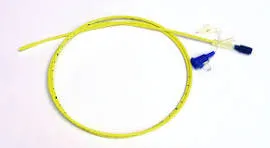
Identify the marked thing in below procedural picture?
Appeared in: AIIMS Delhi NO - 2018
Explanation
- The image shows a long, thin, flexible tube consistent with a nasogastric or nasoenteric feeding tube.
- Key identifying features visible are the Y-port connector for feeding/flushing, the yellow color indicating it's for enteral use, and depth markings for placement verification.
- These tubes are used to administer nutrition, fluids, and medications directly into the gastrointestinal tract when a patient cannot take them orally.
- The small bore (diameter) is designed for patient comfort during short-term use.
Why Other Options Were Wrong
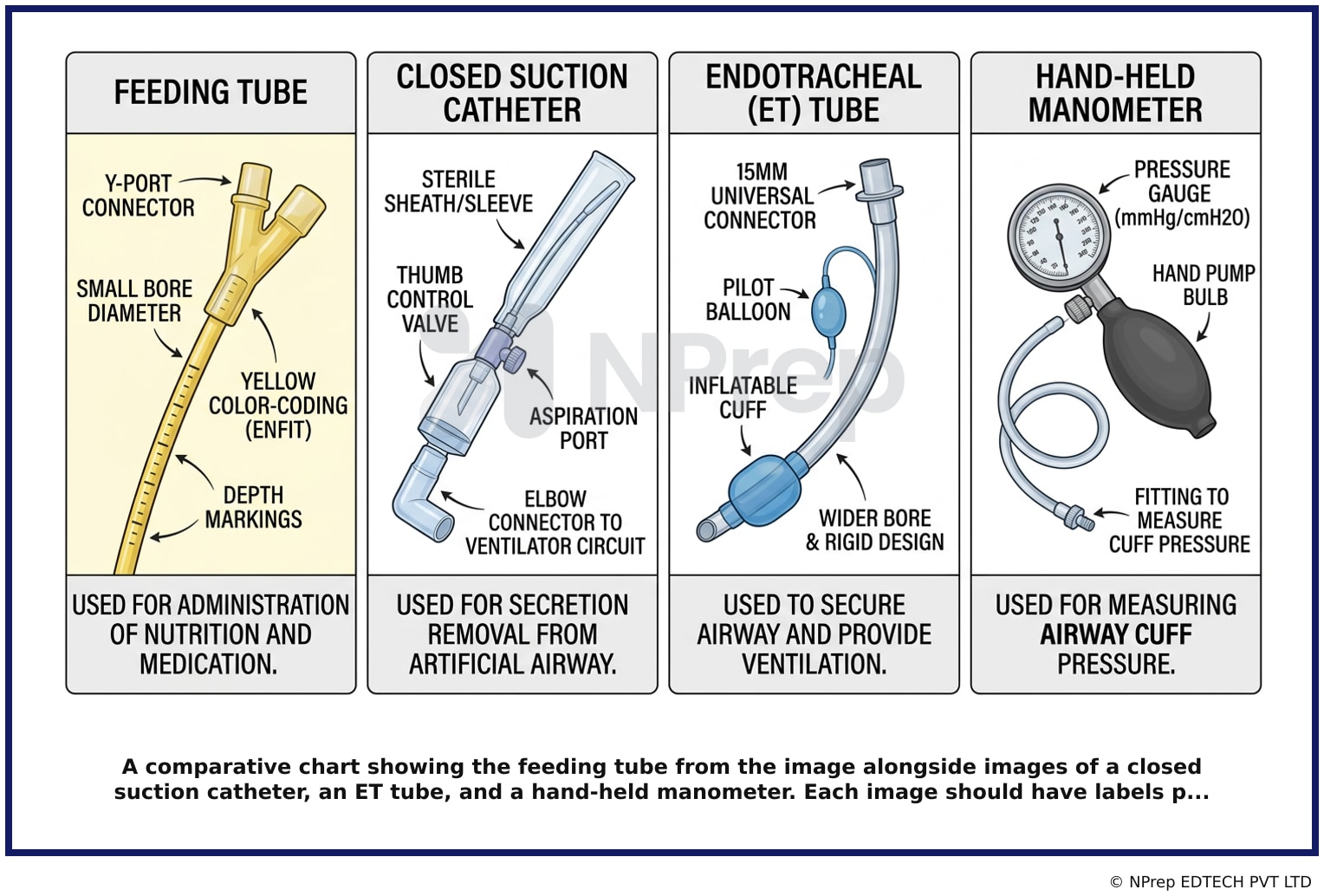
- Option B: A closed suction catheter is enclosed in a clear plastic sheath to maintain sterility during suctioning of an artificial airway. The tube in the image is exposed and designed for feeding.
- Option C: An endotracheal (ET) tube is much wider, shorter, and more rigid. It has a 15mm universal connector and an inflatable cuff at the distal end to seal the airway. The tube in the image lacks these features.
- Option D: A hand-held manometer is a pressure gauge device, not a tube for instilling fluids. It is used to measure pressure, for example, in an ET tube cuff.
Related Visual
Clinical Relevance
- Nursing practice connection: This is primarily an exam-oriented knowledge point with limited direct bedside application, so retain Identification of Enteral Feeding Tube as background academic context rather than a clinical decision trigger.
- Correctly identifying medical tubes is a critical patient safety skill for nurses. Misidentifying a feeding tube could lead to catastrophic errors, such as connecting an enteral feed to an IV line.
- The yellow color-coding (ENFit standard) is a safety initiative designed to prevent misconnections between enteral and other systems (e.g., IV, respiratory).
- What if the tube was clear and wider? If the tube was clear, wider, and had a blue pigtail vent, it would likely be a Salem Sump tube, which is used for gastric decompression (suctioning) rather than primarily for feeding.
How to Approach the Question
- First, carefully examine the image, paying attention to all details of the object shown: its color, shape, size, length, and any connectors or markings.
- Identify the key features. In this case, the yellow color, the thin and flexible nature, the Y-port connector, and the black depth markings are crucial clues.
- Relate these features to your knowledge of common medical equipment. The Y-port suggests multiple functions (e.g., feeding and flushing), and the markings suggest a need for precise placement measurement.
- Evaluate each option against your visual analysis. Ask yourself, 'Does this object match the description of a feeding tube? A suction catheter? An ET tube? A manometer?'
- Eliminate the options that do not match. A suction catheter is sheathed, an ET tube is wider with a cuff, and a manometer is a pressure gauge. This process of elimination leaves 'Feeding tube' as the only plausible answer.
Concept Tested & Keywords
- Concept Tested: Identification of Enteral Feeding Tube
- Stem keywords: procedural picture, identify
- Lead-in keywords: Identify
- Clinical cues: The image shows a yellow tube with a Y-port, which is characteristic of a feeding tube.
Question ID
Qlrbm3tB9yz_KQnp7RQDvZ
Reference Book
E6 Nursing Brunner Adult Health 3SA Vol 1 Part 2 pp. 89-91, 90-92
Practise the full AIIMS Delhi NO - 2018
Attempt every question from this paper in a timed mock, then review the full solution for each one.
More Digestive and Gastrointestinal Function Questions
- Which of the following patient is at risk of fluid volume deficit?
- Borborygmi refers to:
- An inflammation of oral mucosa is termed:
- Identify the following procedure which nurse is doing in following image:
- Find out the problem in the following image:
- What is the colostomy size for a client whose stoma diameter is of 27 mm size?
- A common nursing diagnosis for all patients with an ileostomy is:-
- What is the absolute contraindication for performing nasal tracheal intubation in a critically ill patient?
- Which condition is defined as the inflammation of the peritoeum?
- Which types of stools are seen in Gastric bleeding?
More AIIMS Delhi NO - 2018 Questions
- Another tentative diagnosis made for the client is Wernicke's Encephalopathy. If the client has this, the nurse anticipates that the first physician'…
- A 35-year-old man was in an automobile accident with an admitting diagnosis of a head injury. He has a Glasgow Coma Scale score of 4. Upon MRI and CT…
- A 28-year-old male client is admitted to the hospital for a suspected brain tumor. While assessing this client, the nurse would keep in mind that the…
- Following admission to the hospital, a diagnosis of increasing intracranial pressure was made. The nursing intervention appropriate in the care of th…
- The nurse has orders to administer phenytoin (Dilantin) 100 mg IV as an anticoagulant. The priority action while administering this drug is to:
- The most appropriate nursing action for a depressed patient who does not want to join a group is to:
- The client is to take lithium regularly after she is discharged from the hospital. The nursing care plan includes discharge planning. The most import…
- A patient is taking a proper diet as prescribed for bulimia nervosa, but the patient's weight is not gaining. Which nursing action is appropriate?
- Identify the size of the cannula shown here?& x20;
- Identify the following image? & x20;