
NORCET 3 - 2022 (Shift-1)
Medical & Surgical Nursing
Easy
Identify the given Image? 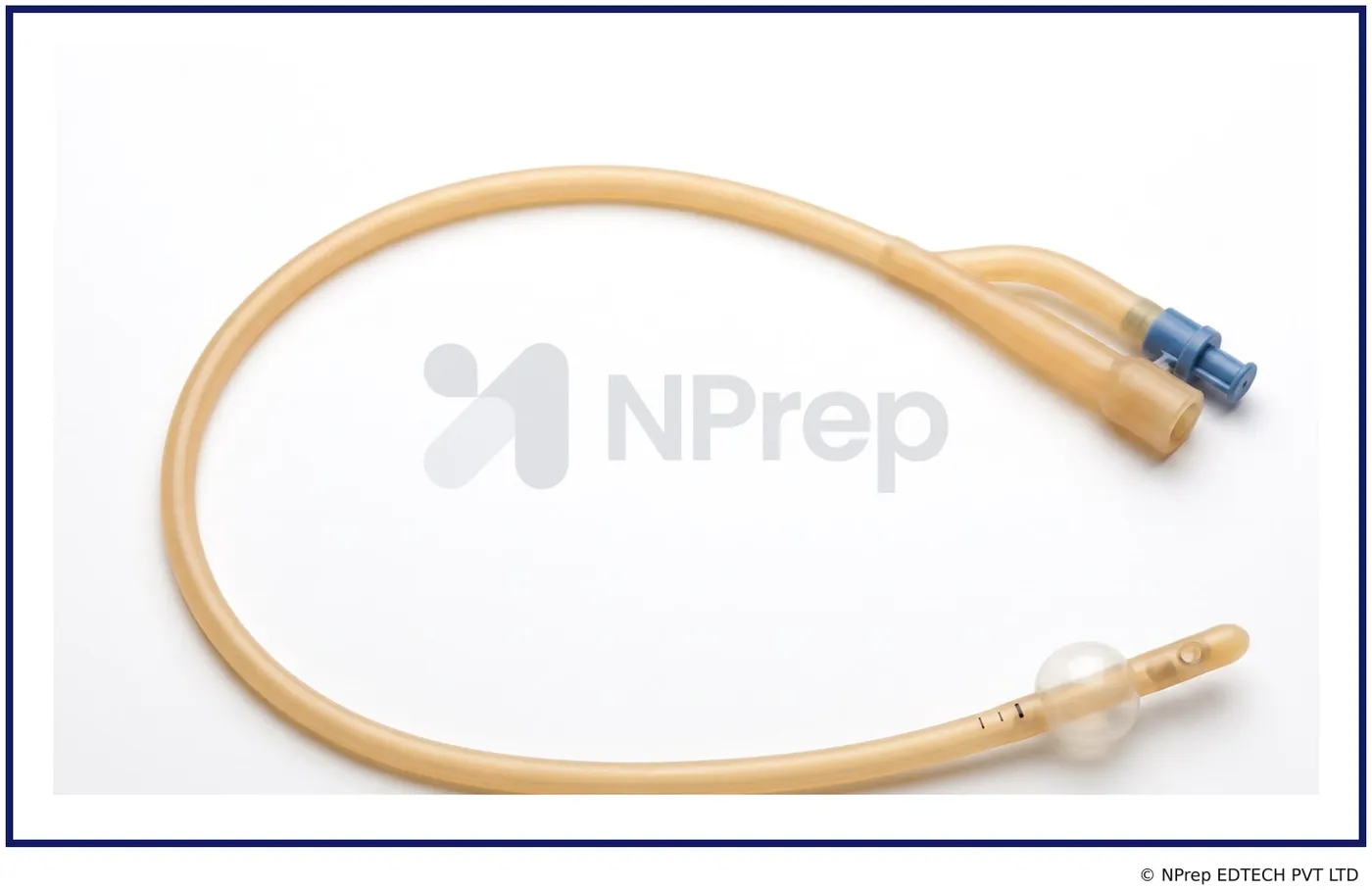
Appeared in: NORCET 3 - 2022 (Shift-1)
Explanation
- The device shown is a Foley catheter, also known as an indwelling urinary catheter.
- The key identifying feature visible in the image is the inflatable balloon near the tip, which is used to secure the catheter within the patient's bladder.
- The Y-shaped end has two ports: a larger one for urine to drain out and a smaller one with a valve used to inflate the balloon with sterile water.
- This dual-lumen design with an anchoring balloon is characteristic of a Foley catheter and distinguishes it from other medical tubes.
Why Other Options Were Wrong
- Option A: A feeding tube (or NG tube) is used to provide nutrition directly to the stomach or small intestine. It does not have an inflatable balloon at the tip for anchoring in the bladder.
- Option C: A suction tube (like a Yankauer) is a rigid or semi-rigid instrument with a large opening at the tip, designed for aspirating secretions from the mouth or a surgical site. It is not an indwelling catheter and lacks a balloon.
- Option D: An NG (nasogastric) tube is a specific type of feeding tube. As with other feeding tubes, it is designed for nutritional support or gastric decompression, not urinary drainage, and lacks the characteristic anchoring balloon of a Foley catheter.
Related Visual

Clinical Relevance
- Nursing practice connection: This is primarily an exam-oriented knowledge point with limited direct bedside application, so retain Identification of common medical equipment as background academic context rather than a clinical decision trigger.
- Proper identification is crucial for patient safety. Using a Foley catheter for feeding would be a critical error.
- Nurses are responsible for Foley catheter care, which includes maintaining a sterile, closed drainage system to prevent Catheter-Associated Urinary Tract Infections (CAUTIs).
- The drainage bag must always be kept below the level of the bladder to prevent the backflow of urine, which increases infection risk.
How to Approach the Question
- First, carefully examine the image provided, paying close attention to the unique features of the medical device.
- Identify the key components: notice the flexible tube, the balloon structure at the tip, and the two distinct ports at the other end.
- Consider the function of these components. An inflatable balloon suggests an anchoring mechanism inside a body cavity. A drainage port suggests the removal of fluid.
- Evaluate the given options based on your observations. A 'Feeding Tube' or 'NG Tube' is for nutrition, not urinary drainage, and lacks this type of balloon.
- A 'Suction Tube' is for aspirating fluids and has a different, typically more rigid, structure.
- Conclude that the device's features (anchoring balloon, drainage port) perfectly match the description of a 'Foley Catheter' used for indwelling urinary drainage.
Concept Tested & Keywords
- Concept Tested: Identification of common medical equipment
- Stem keywords: Identify, Image
- Lead-in keywords: BEST, MOST RELEVANT CLUE
- Negative lead-in flag: false
Question ID
QvVL-saNi_w5wjyauTlMSK
Reference Book
E6 Nursing Fundamentals Taylor p. 510-512
E6 Nursing Brunner Adult Health 3SA Vol 1 Part 2 pp. 89-91, 90-92
Practise the full NORCET 3 - 2022 (Shift-1)
Attempt every question from this paper in a timed mock, then review the full solution for each one.
More Urinary Tract Function Questions
- Assessing the laboratory findings which results would the nurse most likely to expect to find in a client with chronic renal failure?
- A nurse is taking care of Chronic renal dysfunction patient. What diet she will advise for this patient?
- A patient is admitted with acute renal kidney injury, and nurse is advised to monitor strict urine output. She notices urine output is less than 100…
- The following are the use of the central line catheter; EXCEPT:
- The involuntary loss of urine through an intact urethra as a result of sudden increase in the intra-abdominal pressure is called:
- Which of the following is the warning sign post renal transplantation?
- What is contraindicated in male patient reporting the symptoms of redness and ecchymosis in the scrotum region?
- A patient with low urine specific gravity will have all the following characteristics; EXCEPT:
- Food contraindicated with CRF and spironolactone:
- When initiating the use of a newly inserted Central Venous Access Device (CVAD), what is the recommended syringe size for the initial flushing proced…
More NORCET 3 - 2022 (Shift-1) Questions
- A patient is getting IV fluid through peripheral cannula, shows redness, cool, oedema and decreased flow rate. The possible diagnosis is?
- The Endemic Disease that occurs every 4 years of interval is called?
- The nurse witnesses a neighbour's husband sustain a fall from the roof of his house. The nurse rushes to the victim and determines the need to open t…
- In a patient IV site shows redness, heat, tenderness, decrease flow rate, are the classical sign of?
- Which measure is used for growth monitoring at Anganwadi centre?
- Which of the following muscles should always be avoided for IM Injection to prevent sciatic nerve injury?
- The doses of Elemental Iron and folic acid in Anaemia Mukht Bharat (AMB) program for pregnant women?
- A child is suffering from diarrhoea with restlessness, agitation and irritability. Which of the following clinical sign is not indicating to severe d…
- A 45 year female client with clinical manifestation of worthlessness, hopelessness, and not involved in her family activities and she is not eating f…
- A 7-year-old child is brought to the ER at midnight by his mother after symptoms appeared abruptly. The nurse's initial assessment reveals a temperat…