
NORCET 5 mains
Medical & Surgical Nursing
Easy
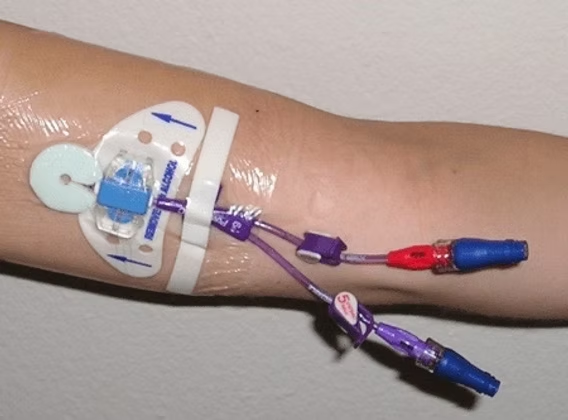
Identify the following image?
Appeared in: NORCET 5 mains
Explanation
- The image displays a catheter inserted into a peripheral vein in the upper arm, which is the defining visual characteristic of a Peripherally Inserted Central Catheter (PICC line).
- Although it is inserted peripherally, its tip is advanced to a large central vein (the superior vena cava), making it a type of central venous access device.
- PICC lines are specifically used for intermediate to long-term intravenous therapy, such as extended courses of antibiotics or chemotherapy.
Why Other Options Were Wrong
- Option B: While a PICC line is technically a type of central line (because its tip is in a central vein), the term 'Central line' in clinical practice commonly refers to a non-tunneled catheter that is inserted directly into a central vein, such as the internal jugular (in the neck) or the subclavian (in the chest). The insertion site in the image is the arm, not the neck or chest.
- Option C: A standard peripheral IV line is much shorter than a PICC line and is typically inserted in the veins of the hand or forearm. It is used for short-term therapy only (usually a few days). The device in the image is inserted in the upper arm and is designed for long-term use.
- Option D: This option is incorrect because the device shown in the image is clearly identifiable as a specific type of medical catheter, a PICC line.
Related Visual

Clinical Relevance
- Nursing practice connection: This is primarily an exam-oriented knowledge point with limited direct bedside application, so retain Identification of intravenous access devices based on visual characteristics as background academic context rather than a clinical decision trigger.
- A primary nursing responsibility is the prevention of Central Line-Associated Bloodstream Infections (CLABSI). This involves strict adherence to aseptic technique for all dressing changes, flushing, and medication administration through the PICC line.
- Nurses must educate patients to not allow blood pressure cuffs or tourniquets on the arm with the PICC line, as this can cause catheter occlusion or damage.
- Regular assessment of the insertion site for signs of infection (redness, swelling, pain, drainage) or phlebitis is a critical patient safety measure.
How to Approach the Question
- First, carefully analyze the image to identify key visual cues. Note the specific location of the catheter's insertion site, which is the upper arm.
- Next, read all the options provided: PICC line, Central line, and IV line.
- Recall the definitions and distinguishing features of each type of intravenous access device.
- A standard IV line is short and placed in the hand or forearm.
- A 'central line' is typically inserted directly into a large vein in the neck or chest.
- A PICC line is inserted in the upper arm but extends to a central vein.
Concept Tested & Keywords
- Concept Tested: Identification of intravenous access devices based on visual characteristics.
- Stem keywords: Identify, image
- Lead-in keywords: Identify
Question ID
Qs5ZHhQmK3-C6rqC9jcr8g
Reference Book
E6 Nursing Fundamentals Taylor p. 796-798
E6 Nursing Fundamentals Potter Perry 12e Part 5 pp. 68-70, 69-71
Practise the full NORCET 5 mains
Attempt every question from this paper in a timed mock, then review the full solution for each one.
More Fluid and Electrolytes: Balance and Distribution Questions
- All are crystalloid solution; except:
- ECG of the patient is showing ST depression, Prominent U wave and inverted T wave. Which of the electrolyte imbalance present?
- A patient reports calcium loss. What is the nursing intervention?
- The principle of hemodialysis in which the water is moving under high pressure to an area of lower pressure is:
- Measurement of arterial blood gas shows pH: 7.2, PaCO2 : 70 mm Hg, HCO3: 27 mmol/L and PaO2: 59 mm Hg. Interpret this:
- Fluid volume deficit or hypovolemia describes the loss of
- 100 mL fluid is given to patient and patient's CVP is 3 mm Hg, then what is the next intervention?
- A patient presents to the emergency department with a serum pH of 7.25, pCO2 of 40 mmHg, HCO3 of 22 mEq/L, sodium of 150 mEq/L, and chloride of 100 m…
- A 65-year-old patient is admitted to the hospital with a serum sodium level of 132 mmol/L. Despite being asymptomatic at admission, the patient begin…
- How would you most accurately assess fluid volume status in a patient with 20% total body surface area (TBSA) burns?
More NORCET 5 mains Questions
- Identify the following instrument?
- Maximum level of alcoholism legally allowed for driving in India?
- When evaluating the therapeutic response for a client receiving a heparin infusion, which laboratory results should the nurse monitor?
- A nurse should carefully monitor a client for the following side effect of MgSO4?
- Hypoxia is the primary problem related to near-drowning victims. The first organ that sustains irreversible damage after submersion in water is the?
- Iron dextran (Imferon) is a parenteral iron preparation. The nurse should know that it:
- A 56-year-old patient is admitted to the psychiatric unit in a state of total despair. She feels hopeless and worthless, has a flat affect and very s…
- A client is admitted to the hospital for an induction of labor owing to a gestation of 42 weeks confirmed by dates and ultrasound. When she is dilate…
- A 3-year-old child is hospitalized with burns covering her trunk and lower extremities. Which of the following would the nurse use to assess adequacy…
- Under National Family Welfare Program, IUCD 380 copper T would be effective for?