
NORCET-7 Mains-2024
Obstetrics & Gynaecology
Medium
Identify the following image? 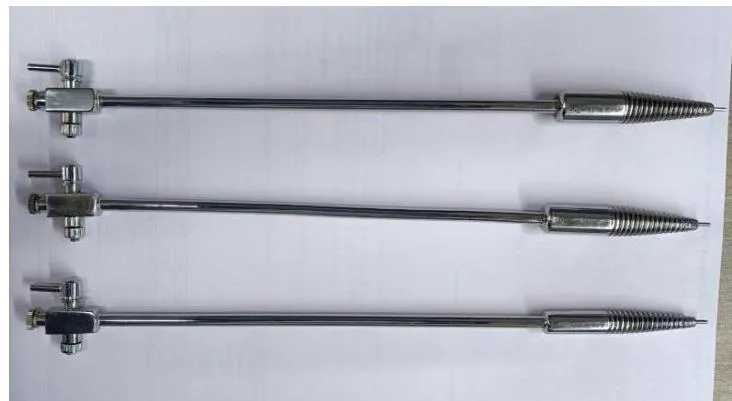
Appeared in: NORCET-7 Mains-2024
Explanation
- The instrument in the image is a Leech-Wilkinson HSG Cannula.
- It is identified by its long metallic shaft, a stopcock valve at the proximal end, and a unique conical, threaded (screw-like) tip at the distal end.
- The threaded tip is designed to be screwed into the cervical canal to create a secure, leak-proof seal.
- The stopcock allows for the controlled injection of contrast media or dye, which is its primary function in procedures like Hysterosalpingography (HSG).
Why Other Options Were Wrong
- Option A: Hegar dilators are solid, non-cannulated metal rods used for progressive cervical dilation. They lack the hollow channel, stopcock, and threaded tip seen in the image.
- Option B: A Yankauer cannula is a suction instrument used to clear secretions from the oropharynx. It has a characteristic bulbous, curved tip with a large opening and is connected to a suction source, which is visually distinct from the instrument shown.
- Option D: A supra-pubic cannula is part of a trocar system used for percutaneous bladder drainage. It is designed to puncture the abdominal wall and enter the bladder, and its appearance is very different from the long, slender instrument with a cervical tip shown.
Related Visual

- Visual 1: Diagram - An illustration showing the Leech-Wilkinson cannula correctly placed in the cervix during a Hysterosalpingography (HSG) procedure, demonstrating how the threaded tip creates a seal.
- Visual 2: Comparison Chart - A chart comparing the images, features, and uses of the Leech-Wilkinson cannula, Hegar dilator, Yankauer suction tip, and a supra-pubic trocar to highlight their differences.
Clinical Relevance
- Nursing practice connection: This is primarily an exam-oriented knowledge point with limited direct bedside application, so retain Identification of gynecological surgical instruments as background academic context rather than a clinical decision trigger.
- Nurses play a crucial role in preparing patients for procedures involving this instrument, such as HSG. This includes patient education about the procedure, managing anxiety, and assessing for contraindications like iodine allergy.
- Post-procedure, nurses monitor for complications such as pain, bleeding, and signs of infection, providing essential care and instructions to the patient.
- What if the patient has a known iodine allergy? The nurse must ensure this is communicated to the team. An alternative, non-iodinated contrast medium might be used, or a different diagnostic procedure like saline-infusion sonography (SIS) might be considered.
How to Approach the Question
- First, carefully observe the key features of the instrument in the image. Note the long shaft, the mechanism at the handle end, and the shape of the working tip.
- Identify the most distinctive features: a stopcock valve (suggesting fluid injection) and a conical, threaded tip (suggesting it needs to be screwed in to form a seal).
- Systematically evaluate each option against your visual analysis.
- Eliminate 'Hegar dilator' because it's a solid dilator, not a cannula for injection.
- Eliminate 'Yankauer cannula' as it's a suction tip with a different shape and purpose.
- Eliminate 'Supra-pubic cannula' as it's for bladder access through the abdomen and looks different.
Concept Tested & Keywords
- Concept Tested: Identification of gynecological surgical instruments
- Stem keywords: Identify, image
- Lead-in keywords: BEST, MOST RELEVANT CLUE
- Clinical cues: Instrument with stopcock
- Clinical cues: Threaded conical tip
Question ID
QG4o21iIFDYSLn-2HYnHWT
Practise the full NORCET-7 Mains-2024
Attempt every question from this paper in a timed mock, then review the full solution for each one.
More Operative Obstetrics Questions
- A normal vaginal labor is conducted. Which activity will always be present in this procedure?
- Major benefit of doing mediolateral episiotomy is?
- Identify the following instrument?
- What is the characteristics of false pain for labour? (Choose the most appropriate option from below)
- Compared to the use of the vacuum extractor, forceps delivery is associated with increased risk of?
- Third degree perineal tear is involvement of?
- Vulsellum forceps used for clipping the?
- All of the following are characteristics of FALSE labor, Except?
- Position given to a mother for a cesarean section?
- Incision made into the perineum to enlarge the vaginal outlet and facilitate delivery is called?
More NORCET-7 Mains-2024 Questions
- What is the correct statement regarding pre-oxygenation in children before intubation?
- A pregnant woman is ready for caesarean section and transferred to labor room. Which is the best position for the woman during caesarean section?
- A woman comes in labor room with 3 cm cervical dilation, 80% effacement and energetic and excited. The women in which phase of labor?
- The ambient temperature of the labor room should maintain?
- The recommended dose of iron and folic acid for adolescent girls under Weekly Iron & Folic Acid Supplementation (WIFS) program?
- A 14-week Rh-negative pregnant woman presents with mild vaginal bleeding and abdominal pain. Ultrasound shows a viable intrauterine pregnancy. Her hu…
- A new newborn care unit is inaugurated in the hospital. The child health nurse known about iKMC. What mean I in iKMC?
- A nurse teaching to a woman regarding breast feeding. Which statement is incorrect about breast feeding?
- Swenson and Duhamel procedure used to correction of?
- Cohort study also known as?