
DSSSB October 2024
Medical Surgical Nursing
Easy
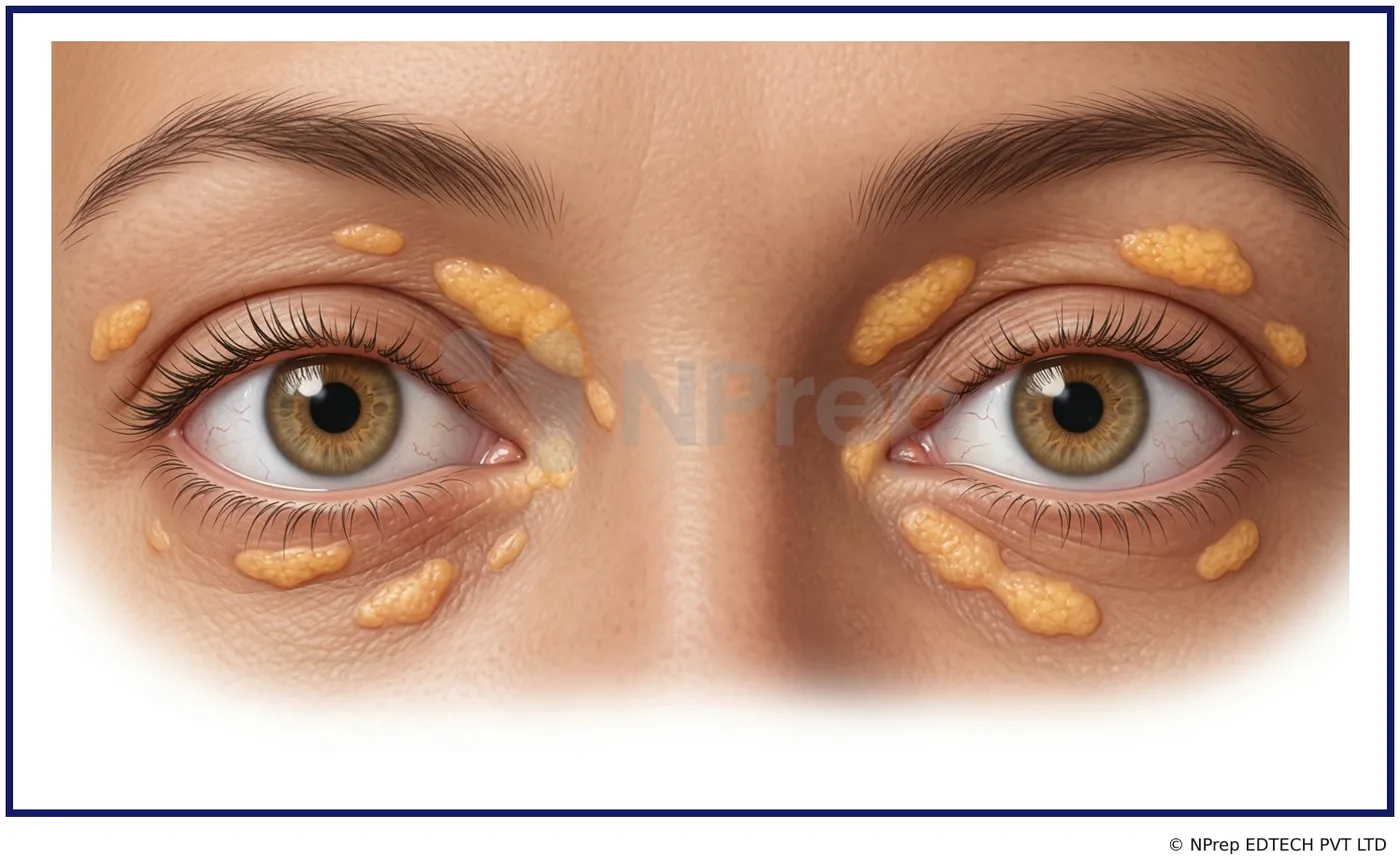
Identify the finding on the eyelids of the patient in the following image.
Appeared in: DSSSB October 2024
Explanation
- Xanthelasma palpebrarum are yellowish, flat, or slightly elevated plaques of cholesterol deposited under the skin.
- The image clearly shows these characteristic lesions on the medial aspect of the upper and lower eyelids, which is the typical location.
- These lesions are often soft and painless and are a key clinical sign to recognize during a physical assessment.
- While not always indicative of a problem, they are frequently associated with high levels of lipids (fats) in the blood, particularly cholesterol.
Why Other Options Were Wrong
- Option A: The Flag sign is characterized by alternating bands of depigmented and normal-colored hair, which is a sign of protein-energy malnutrition (Kwashiorkor). It does not involve skin lesions on the eyelids.
- Option C: Corneal arcus (or arcus senilis) is a white, grey, or blue opaque ring in the corneal margin of the eye itself. The finding in the image is on the skin of the eyelid, not the cornea.
- Option D: Frank's sign is a diagonal crease in the earlobe. It has no relation to any findings on or around the eyes.
Related Visual

Clinical Relevance
- Nursing practice connection: Use the key finding related to Identification of clinical signs on physical examination to guide bedside assessment, documentation, and the next nursing action.
- A key nursing assessment skill is to recognize cutaneous signs of systemic diseases. Identifying xanthelasma should prompt the nurse to inquire about the patient's history of high cholesterol and advise them to see a physician for a lipid panel.
- Patient education is crucial. The nurse can explain that while the growths themselves are benign, they can be a warning sign for cardiovascular risk and that managing cholesterol through diet, exercise, and medication is important.
- What if? If the patient was young (under 40) and presented with xanthelasma, it would raise a higher suspicion for familial hypercholesterolemia, a genetic disorder causing very high cholesterol levels, and would warrant a more urgent and thorough cardiovascular workup.
How to Approach the Question
- First, carefully examine the image provided, paying close attention to the specific location, color, and texture of the finding.
- Note the key features: The lesions are on the eyelids, they are yellowish, and they appear as slightly raised plaques.
- Next, review the definitions of each option provided.
- Compare your visual analysis with the definitions. 'Xanthelasma' is defined as yellowish cholesterol deposits on the eyelids, which is a direct match for the image.
- Eliminate the other options by confirming they describe different signs in different locations (Flag sign in hair, Corneal arcus on the cornea, Frank's sign on the earlobe).
- This systematic process of observation, definition recall, and comparison allows you to confidently select the correct answer.
Concept Tested & Keywords
- Concept Tested: Identification of clinical signs on physical examination
- Stem keywords: eyelids, finding, image
- Lead-in keywords: Identify
- Clinical cues: Yellowish plaques on eyelids
Question ID
QupNis8Tkkr6ryUcqoTzX0
Reference Book
E6 Medicine Harrison 22e Part 1 p. 445-447
Practise the full DSSSB October 2024
Attempt every question from this paper in a timed mock, then review the full solution for each one.
More Integumentary System and Burns Questions
- A patient has a pressure ulcer in which subcutaneous fat is visible BUT bone, tendon or muscle is not exposed or visible. This is a:
- A patient is found to have a reddened area of skin with serum-filled blister formation. The wound is staged as
- Superficial ulceration of the skin, appearing as an abrasion and a blister is a characteristic of?
- Diffuse, purulent inflammation of a tissue is called?
- A................is an elevation of skin filled with fluid and is less than 1 cm in diameter?
- Large heaped-up mass of scar tissue developed and extending beyond the wound surface is known as?
- A patient is admitted to the emergency department with a burn. Following the treatment and procedures used for healing the wound, identify the type o…
- Which patient is most prone to pressure ulcers?
- Vascular skin lesions which are benign tumor consisting of blood and lymph vessels are called
- Wound caused by an injury with a blunt object, leading to tearing of soft tissue is known as
More DSSSB October 2024 Questions
- What is the main indication of the flooding therapy?
- Which of the following is the correct sequence of general anaesthesia?
- Identify the article in the following image.
- A schizophrenic patient was asked how many members were there in his family. He replied, "Oh, maybe seven-since many people tell me because it is too…
- What is the size of the pink colour-coded IV cannula?
- Which is a chronic, progressive and degenerative disorder that occurs due to the destruction of myelin sheath?
- Which of the following programmes is known as the National Programme of Nutritional Support to Primary Education?
- Which of the following stages of psychosexual development is commonly characterised by the Electra complex and Oedipus complex?
- All of the following are the features of Reiter's syndrome, EXCEPT:
- Which article is shown in the given image?