
RUHS, Jaipur, M.Sc Nursing Entrance Exam-2022
Medical Surgical Nursing
Easy
Ice collar was the recommended post-operative nursing intervention in case of
Appeared in: RUHS, Jaipur, M.Sc Nursing Entrance Exam-2022
Explanation
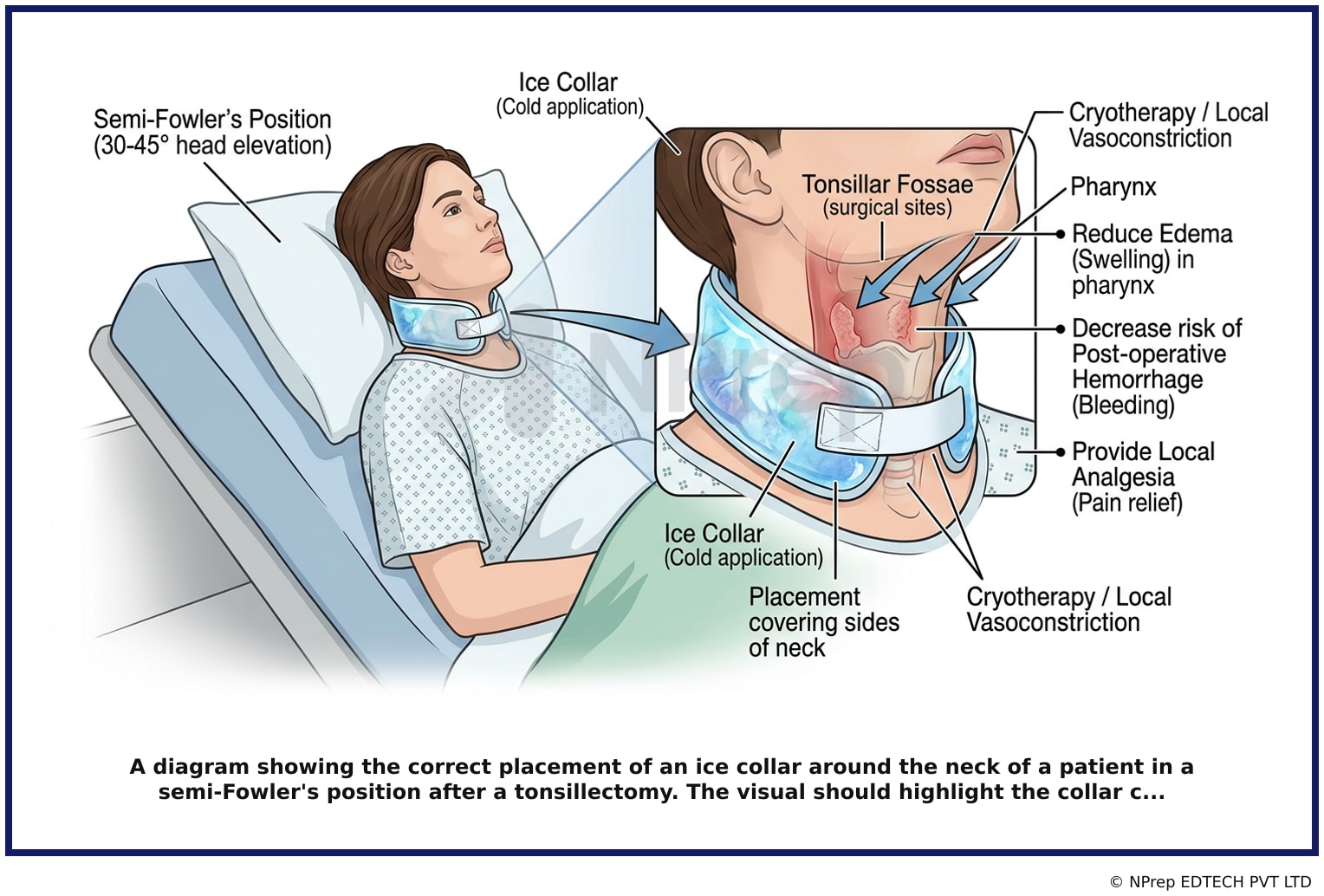
- An ice collar is a standard post-operative intervention for tonsillectomy.
- The primary reason is to induce vasoconstriction, which reduces blood flow to the surgical site and significantly lowers the risk of post-operative hemorrhage.
- Cold application also helps to decrease swelling (edema) in the pharynx, which maintains airway patency.
- Additionally, the cold provides a local analgesic effect, soothing the severe sore throat experienced by the patient.
Why Other Options Were Wrong
- Option A: Post-tracheostomy care prioritizes maintaining a patent airway through suctioning, providing humidified oxygen, and ensuring stoma care. An ice collar is not indicated and could obstruct assessment and care of the tracheostomy site.
- Option B: Following a thyroidectomy, the nursing priorities are monitoring for respiratory distress (due to hematoma or laryngeal nerve injury), bleeding, and signs of hypocalcemia. While cold fluids or a small ice pack might be offered for comfort, a routine ice collar is not a primary intervention.
- Option C: Post-parathyroidectomy care focuses intensely on monitoring for hypocalcemia (which can cause tetany and laryngospasm) and respiratory distress. An ice collar is not a standard intervention.
Related Visual
Clinical Relevance
- Nursing practice connection: Knowing Post-operative nursing interventions and the therapeutic use of cold application (cryotherapy) helps nurses interpret findings accurately and avoid errors in routine assessment, medication administration, and patient teaching.
- Preventing post-tonsillectomy hemorrhage is a critical patient safety goal. The nurse's role in applying the ice collar, monitoring for bleeding (e.g., frequent swallowing, restlessness, vomiting bright red blood), and educating the patient is vital.
- This intervention directly impacts patient outcomes by reducing pain, swelling, and the risk of a life-threatening bleed.
- What if? If the patient reports the ice collar is too cold or their skin appears reddened or blanched, the nurse should wrap the collar in a thin towel or cloth to prevent skin injury and continue to monitor skin integrity frequently.
How to Approach the Question
- First, identify the core concept of the question: the specific indication for an ice collar as a post-operative measure.
- Recall the primary goals and risks associated with each surgical procedure listed in the options.
- For tonsillectomy, the main risk is hemorrhage from the highly vascular surgical bed. Cold application (vasoconstriction) is a direct countermeasure.
- For thyroidectomy and parathyroidectomy, the main risks are airway compromise from hematoma and metabolic complications (hypocalcemia), which are not primarily managed with an ice collar.
- For tracheostomy, the focus is on airway patency at the stoma site.
- By matching the intervention (ice collar for vasoconstriction) to the primary risk (hemorrhage after tonsillectomy), you can identify the correct answer.
Concept Tested & Keywords
- Concept Tested: Post-operative nursing interventions and the therapeutic use of cold application (cryotherapy).
- Stem keywords: Ice collar, post-operative, nursing intervention
- Lead-in keywords: recommended
Question ID
QU4eGTixFern5xMzpT1LNE
Reference Book
E6 Nursing Brunner Adult Health 3SA Vol 2 Part 1 p. 37-39
E6 Nursing Brunner Adult Health 3SA Vol 1 Part 4 p. 27-29
Practise the full RUHS, Jaipur, M.Sc Nursing Entrance Exam-2022
Attempt every question from this paper in a timed mock, then review the full solution for each one.
More Peri-operative Nursing Questions
- A female patient has a laparoscopic cholecystectomy this morning she is now complaining of right shoulder pain. The nurse would explain to the patien…
- The suture shown in the image is:
- A patient has just returned from the post anesthesia care unit (PACU) after hemorrhoidectomy. His postoperative orders include sitz bath every mornin…
- The priority nursing intervention for a patient during the immediate post-operative period is?
- During ongoing surgery under general anesthesia, which parameter is the first priority?
- An opening of surgical wound edges is called?
- Lead rubber aprons are used in OT when following equipment is used?
- In which surgery is the following mesh used?& x20;
- Which of the following is the best response by the nurse regarding paralytic ileus after abdominal surgery?
- Nursing care of the patient after thyroid surgery includes all of the following EXCEPT
More RUHS, Jaipur, M.Sc Nursing Entrance Exam-2022 Questions
- The average life span of platelets is
- A surfactant is a combination of
- BIOT's breathing, seen in the following condition is
- Which of the following tissues is the hardest part in the human body?
- The principle of plasma protein responsible for exerting colloidal osmotic pressure is
- Which of the following classifications of carbohydrates produces glycosidic linkage?
- The following gram-staining, gram-positive organisms take up ---colour
- Universal safety precautions are a set of guidelines designed to protect the
- Chronic decompression sickness is referred to as
- The ectopic rest of a normal tissue is called